Last updated on September 4th, 2026 at 12:09 pm
AI has seeped into the process of making and promoting music. A 2025 LANDR survey of musicians and producers found that 87% use AI somewhere in their workflow, often to save time, cut costs, or handle work they would otherwise outsource. For some musicians, the benefits are increased independence and faster output.
At the same time, as AI makes music easier and cheaper to produce, it puts more pressure on how musicians make a living. In a CISAC study cited by GEMA, researchers project that by 2028, “AI-made music” could take more streaming and production-music revenue, leaving less income for some artists.
People want to support other people, and this is where authorship becomes important. As more AI music enters the market, it’s harder for listeners to distinguish it from human-made music. A 2025 survey commissioned by Deezer and conducted by Ipsos found that most respondents failed to identify fully AI-generated songs in a blind listening test. Even so, a large majority said those tracks should be clearly labeled.
While these studies, taken together, describe an industry under pressure, they don’t seek the opinions of artists themselves. They don’t ask how they define AI involvement, where they draw the line, or whether they want labeling at all. Our own earlier research with music supervisors and licensing professionals pointed in the same direction—nearly all wanted AI music clearly labeled—but that raised a natural question: what do the people actually making the music think?
Our team at Cyanite felt the creator’s view was missing, so we surveyed 266 independent artists, producers, signed artists, composers, and other music creators. Our aim was to understand how the people closest to the work are making sense of a conversation that often speaks about artists more than it speaks to them.
The answers reveal a lack of consensus on what AI music is and anxieties about being mislabeled as AI. Artists want transparency, but many don’t trust that others will disclose AI use honestly.
Artists want AI labels but don’t trust them
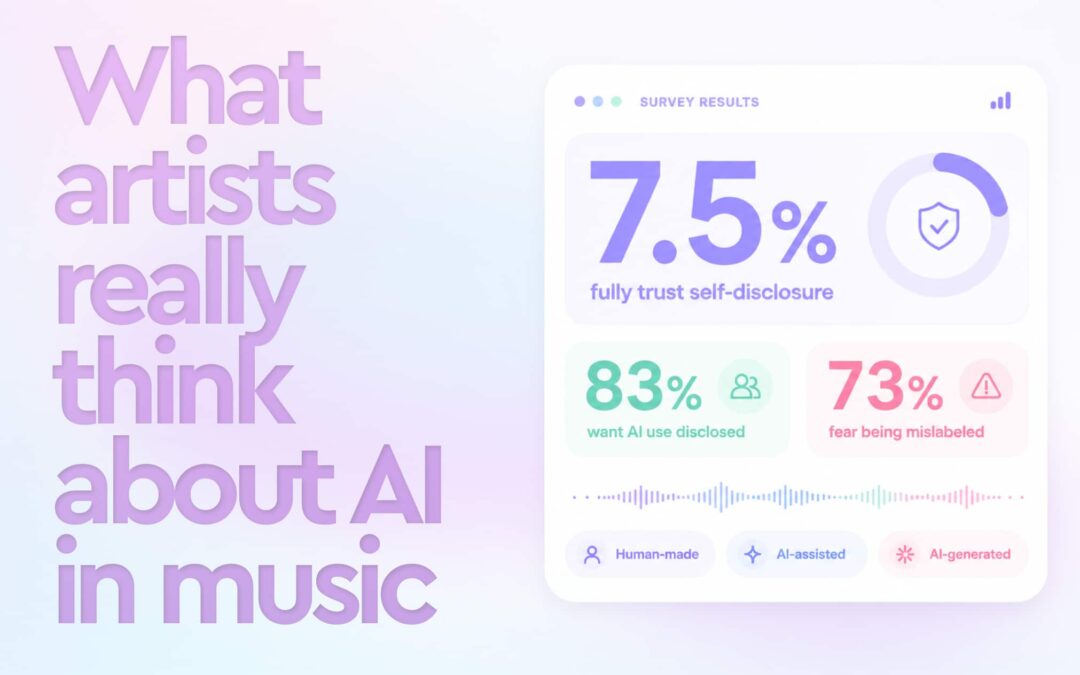
Nearly 73% of respondents said they would be very concerned if their human-made music was mislabeled as AI-generated. This suggests that AI labeling already carries significant professional and reputational weight.
Research also indicates that AI-generated music is perceived as less original and creative, so being tagged as AI can affect how a track is judged in professional contexts, impacting an artist’s reputation over time.
At the same time, creators overwhelmingly want transparency. Around 83% said they want to know when AI is used in a track, while only 16.5% said it doesn’t matter to them.
The demand for transparency appears across all roles we surveyed. For instance, though a small group, all composers want disclosure, reflecting how AI involvement already affects contracts and delivery in that part of the industry.
Under the EU AI Act, disclosure of AI-generated content becomes enforceable in 2026. At the same time, the European Parliament has reaffirmed that fully AI-generated work doesn’t qualify for copyright protection.
Among the rest, responses about wanting disclosure remain close:
- 86% of signed artists
- 85% of producers
- 83% of respondents in the “other” category
- 81% of independent artists
Independent artists also show the most variation, with 18.9% saying it doesn’t matter to them.
It’s not contradictory to want transparency and also fear mislabeling. Musicians want labels they can trust, but the current conditions don’t give them confidence in how those labels would be applied.
The trust gap
When music being mislabeled as AI carries consequences, it becomes more important to distinguish human-made music from AI-generated work. At the same time, those stakes make self-disclosure harder to trust.
Only 7.5% of respondents said they fully trust other artists to disclose AI use honestly. Nearly half, 48%, said they don’t trust self-disclosure at all, while the rest fall somewhere in between.
That skepticism holds even among creators who use AI themselves. Across the survey, doubt outweighs trust regardless of experience or adoption level.
And yet, 45.5% of respondents say the artist should be responsible for flagging AI use. Streaming platforms followed at 20.7%, with distributors, labels, and independent verification systems receiving far less support.
Artists have effectively been assigned responsibility for a transparency system they don’t believe will be applied honestly. That makes voluntary self-reporting difficult to rely on. It also points to the need for platform- and distributor-level approaches to make disclosure consistent.
AI music means different things to different creators
To label a track as AI, the industry would need a shared definition of what counts as AI-generated music.
But there is no shared definition. We have copyright laws that focus on human authorship, while platforms set their own rules based on AI use, without defining the term itself.
Survey responses show that creators have their own definitions.
Many see AI involvement as a spectrum. Others draw clearer boundaries: a song becomes AI-generated when there’s little or no human input, or when “you push a button and everything is made.”
Others focus on core elements. If AI writes the lyrics, melody, or vocals, the track is no longer seen as fully human.
Some try to quantify it, placing the threshold somewhere between 20% and 75% AI contribution. Others reject fixed thresholds altogether and describe it in more subjective terms, pointing to repetition, lack of variation, or what one respondent called “the moment it loses its soul.”
There’s also a clear distinction between generating and assisting. Creating a full track from a prompt is consistently treated as a different category from using AI to sketch ideas or support production.
How usage shapes how creators see AI
Creators don’t approach AI with fixed opinions. Their attitudes toward it are shaped by whether they actually use the tools.
Across all respondents, sentiment was mixed overall:
- 43.6% of respondents expect AI to have a negative impact on music creators.
- 24.8% expect a positive impact.
- The largest group, 31.6%, expects a mix of both.
But the split becomes much clearer when responses are broken down by AI usage.
Creators who use AI regularly are mostly positive about it, with 69.7% seeing it as a good thing and only 6.1% seeing it as bad. Those who do not use AI feel the opposite: 72.8% expect it to be bad, while fewer than 6% think it will be good.
This shows that the more people use these tools, the more positive they become, while those who avoid them remain concerned.
This also explains why producers land somewhere in the middle. They appear to have a more balanced view and less concern about mislabeling. Their work already revolves around tools, so they approach AI in practical terms. That perspective could help shape more grounded standards.
The divide around AI is driven as much by access as by opinion. Exposure can help reframe negative perceptions, but only to a point. Without a transparent and reliable infrastructure, skepticism is likely to persist.
AI music labeling needs a system creators can trust
Creators are already working with AI in ways that don’t fit a single definition. At the same time, expectations around disclosure are increasing, often without a shared understanding of what should be disclosed or how. Labeling is discussed as a solution, but without clear criteria and consistent application, it can create new uncertainty.
As labels begin to affect distribution, licensing, and reputation, the cost of getting them wrong increases. More than just a description, a label shapes how work is interpreted and how creators are perceived. That makes accuracy and accountability essential.
No single layer can solve this on its own.
- Self-disclosure is limited by trust.
- Definitions remain inconsistent.
- Labels without verification are difficult to enforce.
What’s needed is a system where all these parts work together. And this is what Cyanite’s AI music detection is designed to achieve.
It analyzes the audio itself for patterns that are characteristic of known generation models, such as repetition structures, spectral artifacts, and synthesis behaviors that don’t occur in the same way in human-made recordings.
Labels are applied only when these patterns are strong and consistent across the track. This limits false positives and makes the output usable in real workflows where incorrect labeling has consequences.
As our survey results suggest, artists want transparency but lack trust, so unbiased systems like this can help facilitate transparency.
See how it works for yourself and request early access to Cyanite’s AI music detection.

Our newsletter specifically for businesses.
New features, smarter workflows, and insider tips - straight from the Cyanite team.
Our newsletter specifically for businesses.
New features, smarter workflows, and insider tips - straight from the Cyanite team.