
Last updated on September 4th, 2026 at 12:09 pm
See how Cyanite analyzes your music. Try it free with 5 songs.
If you’ve started researching AI music analysis tools, you might have quickly realized that everyone seems to be talking about something different. Some platforms focus on understanding individual songs. Others are built to organize, search, and analyze large music catalogs.
To help you understand which tool might better fit your workflow, we’ve grouped the leading AI music analysis tools by use case and explained what each one is designed to do.
What to look for in an AI music analysis tool
The features that matter to a catalog team aren’t necessarily the ones that matter to an artist or producer. Below, we’ve broken down the key considerations for catalog teams and for users analyzing individual songs, so you know what to compare in each case.
If you’re managing a music catalog
-
- Audio-based vs. metadata-based analysis: Some platforms analyze the audio itself, while others rely on existing metadata. Understanding where the analysis comes from can help you assess how useful the results will be when metadata is incomplete, inconsistent, or missing.
- Tagging depth: The quality of an AI music analysis platform often comes down to the metadata it generates. More detailed tagging can make a catalog easier to search, understand, and work with.
- Search capabilities: A large catalog isn’t useful if users can’t find what they are looking for. When comparing platforms, look beyond basic filtering and consider how well they handle nuance, context, and discovery across the catalog.
- API integration: Look at how much of the platform’s functionality is available through the API and whether it can support automated workflows at scale.
- Catalog scale: Some platforms are built for occasional analysis, while others are designed to support ongoing catalog operations. Understanding how a tool scales can help avoid limitations as your catalog grows.
If you’re analyzing individual songs
-
- Analysis attributes: Make sure the tool covers the attributes you care about, whether that’s tempo, key, genre, mood, instrumentation, or lyrics.
- Speed and ease of use: For single-track analysis, the experience should be straightforward. Most users want results quickly, without a lengthy setup process.
- Free tier: Many song analyzers offer free access or limited free usage. This makes it easier to test a tool before committing to a paid plan.
- Lyrics analysis: Some platforms analyze lyrics alongside the audio, providing additional context around themes, sentiment, and subject matter. This can be especially useful for artists, A&R teams, and music professionals evaluating individual tracks.
AI Music analysis tools at a glance
AI music analysis tools for catalog management
AI music analysis tools are designed for teams managing large volumes of music. They turn large collections of audio into structured, searchable data. They also integrate with existing systems through APIs, making them suitable for professional catalog and discovery workflows.
Cyanite
Cyanite is an audio intelligence solution built for music discovery and catalog management. It analyzes the audio itself to generate structured metadata that helps music companies organize, search, and understand large collections of music.
Among the tools covered here, Cyanite is the only one that combines audio intelligence, search, and AI music detection within the same system.
Key features:
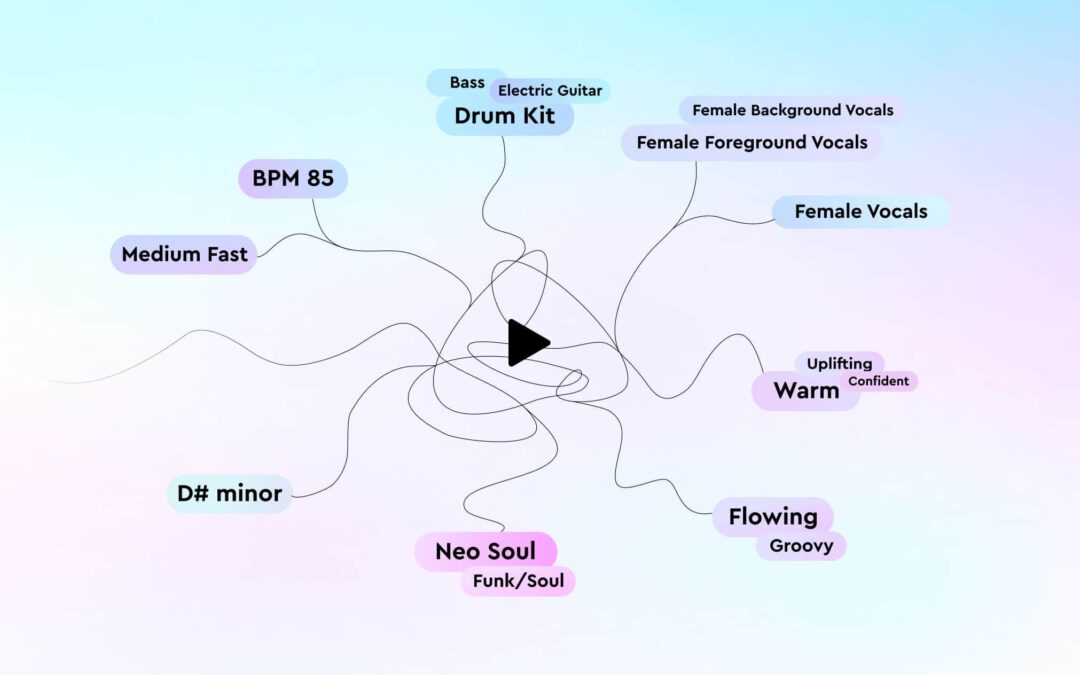
- Auto-Tagging: Generates structured metadata across genre, mood, instrumentation, BPM, key, vocals, energy, and other musical attributes, helping teams organize and search large catalogs more effectively.
- Similarity Search: Finds tracks with a similar sound to a reference song, making it easier to discover alternatives or complementary music within a catalog.
- Free Text Search: Translates natural-language descriptions and creative briefs into music searches, helping teams find tracks without relying on keywords or predefined tags.
- Advanced Search: An API-based feature that combines audio similarity, natural-language search, metadata filters, and detailed scoring to support more complex discovery workflows.
- AI Music Detection: Estimates the likelihood that a track contains AI-generated music, helping teams review incoming content and maintain transparency across their catalogs.
Best for:
Music companies that manage large catalogs, including publishers, labels, production music libraries, sync platforms, distributors, and streaming services.
Limitations:
Cyanite focuses on understanding the audio itself. Information that exists outside the sound, including organization-specific metadata, still requires human input. The platform doesn’t currently support video-to-music search workflows.
Bridge.audio
Bridge.audio is a collaborative workspace for managing, sharing, and discovering music. It combines catalog management, metadata enrichment, AI auto-tagging, and sync-focused workflows in a single environment.
Key features:
- AI auto-tagging: Automatically generates metadata for genre, mood, instrumentation, vocals, themes, language, tempo, and other musical characteristics.
- Catalog search: Uses AI-generated tags to help teams surface tracks across large music collections.
- Metadata management: Supports metadata editing, enrichment, versioning, and bulk updates across catalogs.
- Sync workflows: Connects rights holders and music buyers through discovery hubs and sync-focused catalog experiences.
- Collaboration tools: Provides shared workspaces, file sharing, project management, analytics, and music submission workflows.
Best for:
Labels, publishers, music libraries, sync agencies, and rights holders looking to combine catalog management, metadata enrichment, collaboration, and sync pitching within a single workflow.
Limitations:
Bridge.audio’s strength lies in workflow management, collaboration, and sync operations. Teams looking for deeper audio analysis or a broader set of audio intelligence capabilities may need additional tools.
AIMS
AIMS is an AI-powered music search and discovery solution built for large music catalogs. Its focus is multi-modal discovery, allowing users to search through audio similarity, natural-language prompts, lyrics, and video.
Key features:
- Prompt search: Searches for music using free-form prompts, including natural-language descriptions, creative briefs, scenes, emotions, and musical styles.
- Similarity search: Finds tracks based on audio similarity to one or more reference songs, with support for uploaded audio files and streaming links.
- Lyrics search: Finds songs based on lyrical themes, sentiment, meaning, and narrative content rather than exact keyword matches.
- Video search: Matches music to video content by analyzing visual tone, pacing, and emotion.
- Auto-tagging: Generates metadata to support search, filtering, and discovery workflows across large catalogs.
Best for:
Production music libraries, publishers, labels, broadcasters, sync teams, and content platforms that need multiple ways to search and discover music across large catalogs.
Limitations:
Tagging is not AIMS’ primary focus. Its core technology is built around search and discovery, which may make it less suitable for teams whose main priority is metadata generation and catalog enrichment.
Read more: Best AI music tools 2026 (buyer’s guide)
AI music analysis tools for individual tracks
These tools focus on individual tracks. They’re designed to help artists and music professionals quickly understand a song’s musical characteristics.
Sonoteller.ai
Sonoteller.ai analyzes the music and lyrics of a song, generating information about genre, mood, instrumentation, BPM, key, themes, and explicit content. It also provides a written song summary and identifies the track’s most impactful section: its “golden minute.”
Soundplate Analyzer
Soundplate Analyzer focuses on the fundamentals, providing information such as BPM, key, and basic audio characteristics for individual tracks. It’s lightweight and free to use, making it popular among DJs and producers who need quick technical insights.
Tunebat
Tunebat is another lightweight option that provides information such as BPM, key, energy, loudness, danceability, and harmonic compatibility for individual tracks. It’s a popular choice for users who need quick song analysis—particularly useful when preparing a playlist or DJ set.
Note on Musiio
Musiio was one of the most widely used AI music analysis tools before it was acquired by SoundCloud. It’s no longer available as a standalone product. Teams looking for an alternative can explore our guides on migrating Musiio search and tagging workflows.
Cyanite’s web app can analyze individual songs, with five free analyses available each month. Upload a track or paste a YouTube link to get detailed genre, mood, BPM, key, vocal, and instrumentation insights, plus AI-generated descriptions and Similarity Search results.
What happens after the analysis
The growing number of AI music analysis tools reflects the multitude of ways people work with music. A producer looking at a single track has different needs than a publisher managing a catalog, so both will evaluate these tools differently.
As AI music analysis becomes more common, attention is shifting from the analysis itself to the systems built around it. For organizations working with large catalogs, the value often comes from how easily insights can be searched, shared, and put to use.
If you’d like to see how audio intelligence can support your own catalog, create a free Cyanite account and start exploring your music.
FAQs
What is AI music analysis?
AI music analysis is the process of using machine learning to analyze music and identify characteristics and musical attributes.
Can AI understand a sync brief and find matching tracks?
An AI song analyzer can identify genre, mood, instrumentation, BPM, key, energy level, vocals, and lyrical themes.
What’s the difference between catalog management tools and song analyzers?
Catalog management tools are designed to process large volumes of music and make it searchable through metadata and discovery features. Song analyzers focus on individual tracks.
Can AI analyze music without existing metadata?
Yes. Audio intelligence platforms like Cyanite analyze the sound itself. This allows them to generate metadata even when information about a track is incomplete, inconsistent, or missing.
Are there free AI song analyzers?
Yes. Sonoteller.ai, Soundplate Analyzer, and Tunebat provide free track analysis, while Cyanite’s web app includes five free song analyses per month.
What’s the most accurate software for finding similar songs in a music library?
Accuracy depends on how deeply a system analyzes audio. Cyanite compares tracks across multiple acoustic dimensions simultaneously. It also supports segment-based search and multi-track references, filtering for genre, key, BPM, and voice presence to refine results further.