
Last updated on October 15th, 2026 at 11:12 am
Bring deeper music understanding into your catalog. Request access to Auto-Tagging 2.0.
We’re excited to announce that the biggest upgrade to Cyanite’s music tagging is ready!
So what’s new? The update brings new and improved models, a deeper understanding of what’s happening within each track, and a new REST API built to scale with large catalogs.
The result is richer, structured music data that can power your team’s existing workflows while providing a reliable music understanding layer for the AI-powered workflows you build next.
What’s new in Auto-Tagging 2.0
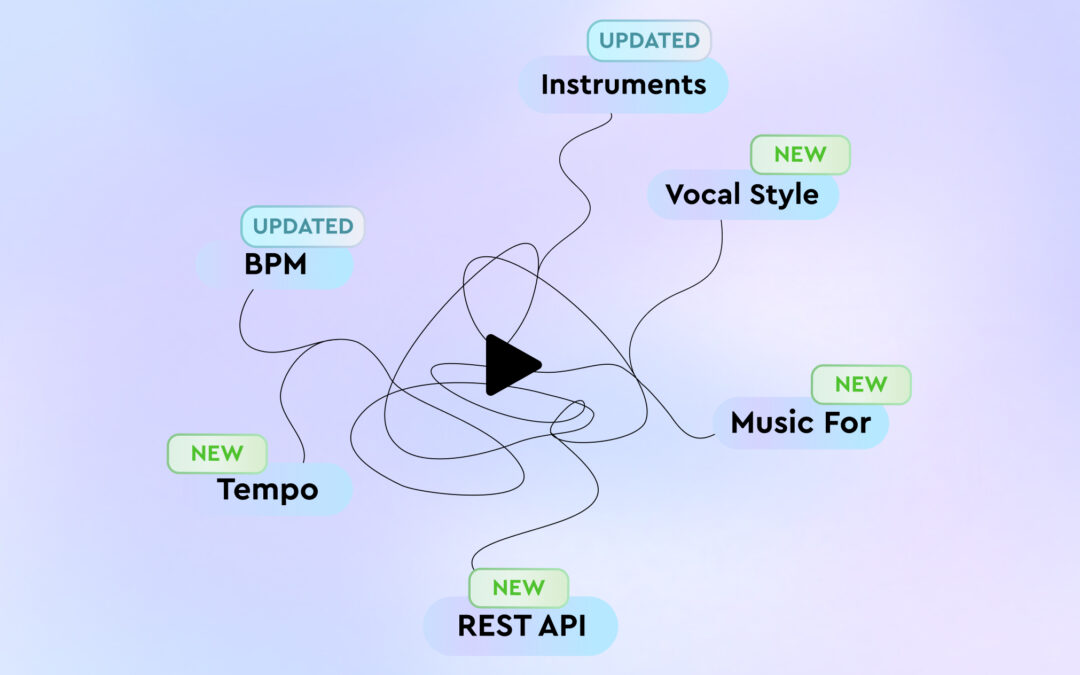
We’ve improved every model across our tagging system, added new ways to classify and understand music, and introduced a REST API built for scale.
- New Music For use case matching, for understanding where and how a track could be used
- New Vocal Style for more detailed vocal classification
- New Tempo for understanding how fast or slow a track feels
- Updated BPM for more accurate BPM detection
- Updated Instrument for more precise instrument recognition
- New REST API for scalable catalog analysis and enrichment
Together, these updates give you more ways to classify, search, and match music across your catalog. The improved classifiers now analyze the music every 10 seconds compared with every 15 seconds before the update, allowing them to follow changes within a track more precisely. With the expanded and improved models, this produces up to 2,500 data points per minute of music.
Read more: What music understanding actually enables your LLM to do.
Music For
Search for music with the use case in mind
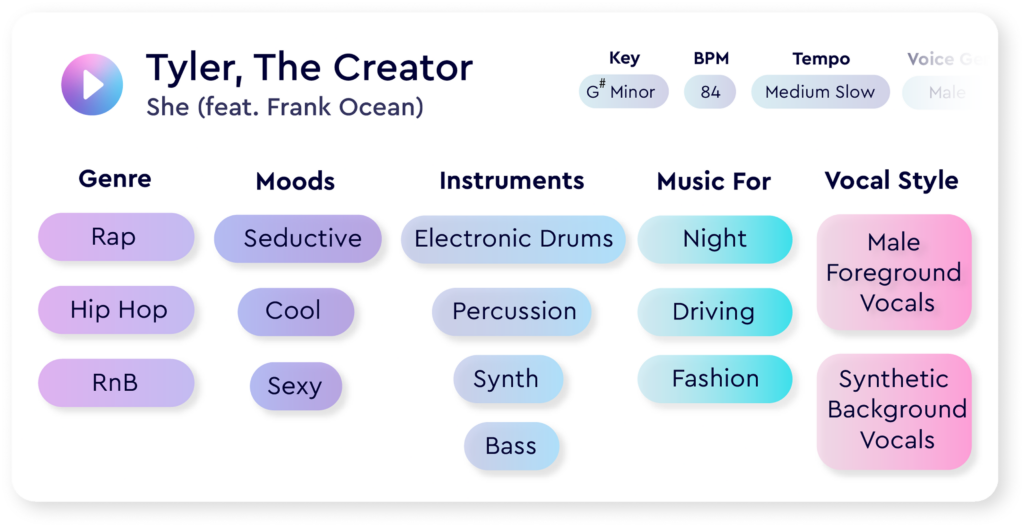
Our new Music For model adds use-case information to your metadata, helping you classify tracks based on the contexts they could fit. Our Music For taxonomy includes use cases such as wellness, advertising, gaming, and film, to name a few.
For example, a production library might have thousands of tracks that could work for sports content, but that potential isn’t necessarily captured by genre or mood alone. Music For adds that use-case information directly to the catalog, so when a sports brief comes in, the team can filter for tracks suited to that context and refine the results using their other metadata.
BPM + Tempo
Understand how a track moves and feels
Our updated BPM model is 10% more accurate, meaning you get more reliable data for classifying music across your catalog. It also follows changes within a track more closely and reduces half-time and double-time errors where related values such as 70 BPM and 140 BPM can be mistaken for one another.
The new Tempo model adds another way to understand a song’s speed. While BPM measures beats per minute, Tempo captures how fast or slow the music feels, including how that perception changes over time.
Together, they give you more precise ways to classify music. You can work with exact BPM values when a workflow calls for them, or use Tempo when you need to capture how fast or slow the music feels.
Instruments + Vocal Style
Hear every layer
The updated tagging gives you a more precise picture of a track’s arrangement. The improved Instrument model detects instruments more accurately and can pinpoint when they are playing more closely. The new Vocal Style model adds another layer of detail, identifying characteristics such as whether vocals are foreground or background, a cappella or choir, as well as whether they are male, female, mixed, or synthetic.
This becomes useful when a brief depends on details within the arrangement. A certain instrument may need to appear in one part of a track, or a particular vocal style in another. With those characteristics captured in the metadata, suitable tracks can be narrowed down before anyone spends time listening through the catalog.
New REST API
Bring it into your workflow at scale
The new REST API is built to bring Cyanite’s tagging directly into your existing music platform or catalog system. With rate limits up to 10x higher and throughput up to 5x faster, it can analyze more music in less time.
For a music platform or CMS, tagging can become part of the catalog ingestion process. As new music is added, tracks can be sent to Cyanite for analysis and the resulting metadata brought back into the system where your team already manages and searches the catalog.
The increased capacity also makes it easier to enrich large existing catalogs containing thousands to millions of tracks.

Ready to try Auto-Tagging 2.0?
More precise tagging opens up additional ways to search, classify, and work with your catalog. Auto-Tagging 2.0 brings that added depth to the workflows you use today, while providing richer music data for the AI-powered workflows you build next.
As those workflows become more automated, reliable music understanding and secure infrastructure become part of the foundation they depend on. Cyanite is built to provide both, so you can confidently bring deeper music understanding into human and agentic workflows.
Auto-Tagging 2.0 is available now. We’re thrilled to put this deeper level of music understanding in your hands. Now it’s time to put it to work across your catalog.