
Last updated on October 21st, 2026 at 10:24 am
Want to see AI-generated metadata in action on your catalog? Try Cyanite for free.
Music metadata is often treated as supporting information. Yet it plays a central role in how tracks move through the industry, determining whether they can be found, licensed, recommended, and paid for.
With more than 100,000 tracks being uploaded to streaming services every day, descriptive metadata helps music professionals find relevant tracks across growing catalogs, making discovery faster for A&Rs, publishers, sync teams, and rights holders.
Even then, music metadata is much broader than many people realize.
What is music metadata?
The audio file contains the music itself, while song metadata brings together relevant information about the song. Depending on the type of metadata, that information may be embedded in the file, stored alongside it, or managed within external systems.
Because metadata sits at the center of so many catalog processes, its quality directly impacts how music is managed and used. The more precise and reliable the information is, the easier it becomes to work with music at scale.
The four types of music metadata
Music metadata covers a wide range of information, and not all of it serves the same purpose. To better understand how metadata works within a modern music catalog, it helps to think of it in four layers, each with a different role.
Release & asset metadata
Release and asset metadata describes what a music release and its recordings are. It provides the core information needed to identify, organize, distribute, and manage music consistently across labels, distributors, streaming services, and catalog management systems.
It includes release-level information such as the album, EP, or single title, artwork, release format, track sequence, and release identifier (UPC/EAN). At the recording level, it includes information such as the track title, performing artist, duration, version or mix, language, explicit content status, file format, and recording identifier (ISRC).
Most of this metadata is created before a release is distributed and accompanies the recording throughout its lifecycle, allowing music systems to consistently identify the same release and recording across different platforms.
Rights & ownership metadata
Rights and ownership metadata identifies who owns or controls a piece of music and how royalties should be allocated. It connects recordings and compositions to the people and organizations responsible for creating and administering them.
This includes songwriter, composer, publisher, and label information, songwriter splits, CMO affiliations, licensing status, clearance details, one-stop status, and composition identifiers such as the ISWC.
Accurate rights metadata is essential for licensing and royalty distribution. Missing or incomplete rights information can prevent royalties from reaching the correct rights holders. In fact, hundreds of millions of dollars remain unmatched every year due to incomplete or inconsistent rights data.
Commercial & usage metadata
Commercial and usage metadata describes how music is released, distributed, and consumed. It governs where, when, and under what commercial terms a release is made available, and it also captures the data generated through its use.
This includes release dates, territory availability, licensing windows, commercial models, platform availability, embargoes, and other distribution rules, alongside data such as streams, downloads, sales, and broadcasts used for royalty reporting and commercial analysis.
Distributors and digital service providers rely on this metadata to make releases available under the correct commercial terms, while labels, publishers, and collective management organizations use usage data to reconcile royalties and monitor performance.
Descriptive & enrichment metadata
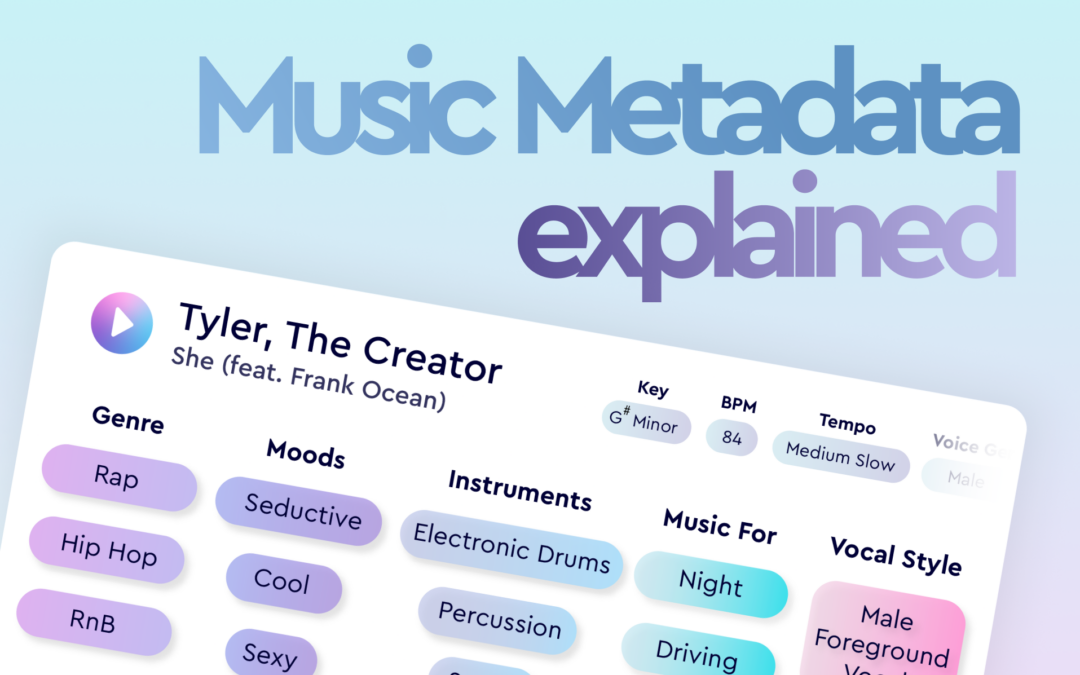
Descriptive and enrichment metadata explains what a piece of music sounds like and provides additional context that improves search, recommendation, catalog organization, and music discovery.
It includes genres, themes, keywords, lyrics, editorial descriptions, and contextual information such as artist origin, cultural background, or whether a track was created with AI. It can also include metadata generated through audio analysis, including instrumentation, vocal characteristics, tempo, energy, emotional qualities, and musical similarity.
Together, this metadata makes music easier to organize and discover. It enables music libraries, streaming services, and rights holders to support semantic search, natural language queries, similarity search, recommendation engines, playlist generation, and AI-powered catalog management.
Why music metadata matters for discovery, sync, and revenue
Each metadata group serves a different purpose. Together, they help music companies organize their catalogs, understand what they own, and maintain the information needed to generate revenue.
Their roles become clearer when you look at the work they support.
Discoverability
Music can’t be discovered if it can’t be described. But what counts as a useful description has changed significantly over time.
Catalogs were once organized around broad categories such as genre and artist. Today, music is increasingly organized by mood, energy, instrumentation, activity, and other characteristics that help match tracks to a specific use case.
This creates a new challenge for catalogs. The more ways music can be searched, filtered, and recommended, the more complete descriptive and enrichment metadata needs to be. A track may be easy to identify but difficult to surface if it lacks the information modern discovery systems rely on.
Rich metadata also provides catalog intelligence. By making recordings consistently searchable, it’s easier to understand what a catalog contains and identify opportunities to make better use of existing music.
Read more: How Thematic uses Cyanite for AI music discovery
Revenue integrity
Holding the rights to a song isn’t the same as getting paid for its use. Royalties are only distributed when rights and ownership metadata can be accurately matched with the deal and usage metadata that records how music is used.
This is why even small metadata errors can have significant financial consequences. A discrepancy in songwriter ownership, for example, can prevent royalties from being distributed until the conflict is resolved. Those delays can last months or years, particularly when multiple parties are involved.
On a larger scale, metadata quality can even influence how catalogs are valued, since buyers need confidence that future revenue can be traced back to the correct rights holders.
Workflow optimization
Managing a music catalog means maintaining many different types of metadata over time. As new releases are added and older recordings are updated, manual tagging and inconsistent information quickly become difficult to manage at scale.
Consistent metadata reduces that operational burden. Teams spend less time entering, correcting, or standardizing information, while structured metadata can be reused across existing catalog systems and workflows. This allows catalog managers to focus more of their time on curation and commercial decisions than on routine metadata maintenance.
What good music metadata looks like in practice
Good music metadata provides a complete picture of a track. It identifies the recording, establishes ownership, describes how the music sounds, and captures the context around its creation.
In practice, all of that information lives in the same record. A catalog manager reviewing a track should be able to see all the details without having to piece information together from multiple sources.
Cyanite paints a full picture by analyzing the audio itself. Every track is described using the same sound-based logic, creating a consistent layer of metadata that makes recordings easier to compare, search, and work with across an entire catalog.
That consistency is most effective when established at ingestion. When tracks enter a catalog with a structured metadata foundation already in place, teams can build workflows around a shared source of information. As new tools become easier to build, that same metadata can be used to solve specific operational problems.
Read more: From upload to output: how Cyanite tags music at scale
How AI is changing music metadata
Traditionally, music metadata was made by people. However, as catalogs have grown and metadata has become more detailed, keeping that information complete through manual tagging alone has become increasingly difficult.
As a result, metadata generation is becoming increasingly automated. AI can analyze the audio itself and generate metadata at a scale that would be difficult to maintain manually. Because every track is evaluated using the same logic, catalogs can maintain a more consistent description of sound, even as they continue to grow.
Want to see how modern music metadata works in practice? Sign up for Cyanite for free and explore Auto-Tagging, Similarity and Free Text Search, and AI Music Detection on your own catalog.
FAQs
What is metadata in music?
Music metadata is the information associated with a piece of music, recording, or release. It can identify the track, establish ownership, describe how the music sounds, or document information about its creation and contributors. Depending on the type of metadata, it may be embedded in the audio file or managed within external systems.
What is a tag in music?
A music tag is a piece of information stored within or alongside an audio file that describes the track itself. Tags can cover descriptive details like title, artist, and genre, technical details like BPM and key, or semantic details like mood and instrumentation generated through AI audio analysis. Tags are one part of the broader category of music metadata.
What are the different types of music metadata?
Music metadata can be grouped into four broad categories:
- Release & asset metadata contains the core information that identifies a recording and its release.
- Rights & ownership metadata links music to the people and organizations that own or control it.
- Commercial & usage metadata covers the commercial terms of a release and the reporting generated after it is distributed.
- Descriptive & enrichment metadata captures how music sounds and provides additional context that makes catalogs easier to search.
What are MP3 tags?
MP3 tags are metadata fields stored within an audio file, most commonly using the ID3 standard. MP3 metadata can contain information such as track title, artist name, album, artwork, genre, and ISRC, allowing music files to be identified and organized across different systems.
Why is music metadata important?
Music metadata supports nearly every stage of a track’s lifecycle. It helps music get discovered, enables licensing workflows, connects royalties to the correct rights holders, and provides the context needed to evaluate and manage recordings within a modern catalog.