
Last updated on September 4th, 2026 at 12:09 pm
Cyanite’s AI music detector is live. Request early access and use it on your catalog.
AI-generated music is entering catalogs at a scale the industry hasn’t handled before, making AI music detection an expectation. This is reflected in the findings from a survey we ran with Marmoset and Mediatracks, which show that 97% of music professionals want to know whether a track is AI-generated.
And while implementing those labels is the right instinct, detection is only one part of the equation. Platforms still need to understand how AI-generated music should exist inside their catalogs after it has been identified.
Consider a distributor processing thousands of daily uploads. Detection can flag potentially AI-generated tracks before moderation. But once identified, those tracks still need metadata, searchability, and placement within the catalog. Detection answers one question. Understanding the music answers many more.
What an AI music detector actually does
An AI music detector analyzes audio for patterns commonly associated with generative models. Most rely on machine learning systems trained on large volumes of audio to estimate whether a track is AI-created. This usually gives a probability score rather than a definitive answer.
These systems are often good at identifying tracks that closely resemble outputs from generative music models, especially fully generated songs or synthetic vocals. However, modern music production rarely falls into a clean binary. This is especially true when some artists use AI to support parts of the production process.
Most detection tools also analyze tracks as complete files rather than understanding where AI intervention may have occurred. A result may suggest that something about the song appears AI-made without explaining whether that’s the vocals, the instrumental, a specific production layer, or whether the track aligns with the musical characteristics typically associated with the genre or production era it imitates.
This is a limitation for platforms. Detection can identify signals associated with AI-generated music, but platforms still need context around those signals. A detection result can flag a track as suspicious without explaining why, making false positives difficult to assess responsibly at platform scale.
In the end, this leaves platforms making important decisions with very limited context.
Learn more: Why AI music detection is harder than it sounds
What audio understanding adds to the picture
So what happens after a track is labeled as AI-generated? The bigger question is how the system reached that conclusion in the first place.
Deep audio analysis gives detection a layer of contextual awareness. Certain genres dominate AI-generated output, while specific production eras remain difficult for generative models to mimic convincingly. A track may resemble music from the 1960s on the surface, for example, while still lacking many of the recording characteristics that would normally define that era.
These are the kinds of inconsistencies that become easier to identify once the system understands what the music is trying to be. Because, in practice, simply knowing whether AI was involved rarely answers everything a platform needs to know about a track.
Why this matters for platforms building at scale
Even perfect detection wouldn’t solve the larger operational problems platforms already face. Music still needs to be organized, matched to briefs, recommended, and surfaced across discovery workflows, which becomes significantly harder as catalogs begin to feature more AI-generated content.
Consider a distributor processing thousands of daily uploads. Detection can flag a track as potentially AI-generated before it enters moderation. But once approved, that same track still needs genre, mood, instrumentation, lyrics, and other metadata to become searchable and discoverable within the catalog.
How can platforms meet growing demands for discovery and organization if they lack a meaningful understanding of the music itself? An AI-labeled track could still have incomplete metadata or provide very little context around where it belongs and why it should surface.
Detection answers one question: Was this track likely generated by AI? Music understanding answers many more: What is this track? Who might use it? Where does it belong in the catalog?
Once platforms have a deeper understanding of the music itself, detection becomes part of how catalogs are organized and managed. And since AI-created music isn’t going away any time soon, the platforms best equipped to handle it will not necessarily be those with the strictest detection systems, but those that can keep music searchable, discoverable, and navigable at scale.
Cyanite’s approach: detection and intelligence in one system
At Cyanite, we approach AI music detection as part of a broader system for understanding and organizing music catalogs.
A label can tell you that a track may be AI-generated. But the value of that label depends on what else the system knows about the music. If the same analysis also understands the track’s genre space, vocal presence, instrumentation, and similarity to the rest of the catalog, the detection result becomes easier to interpret and use.
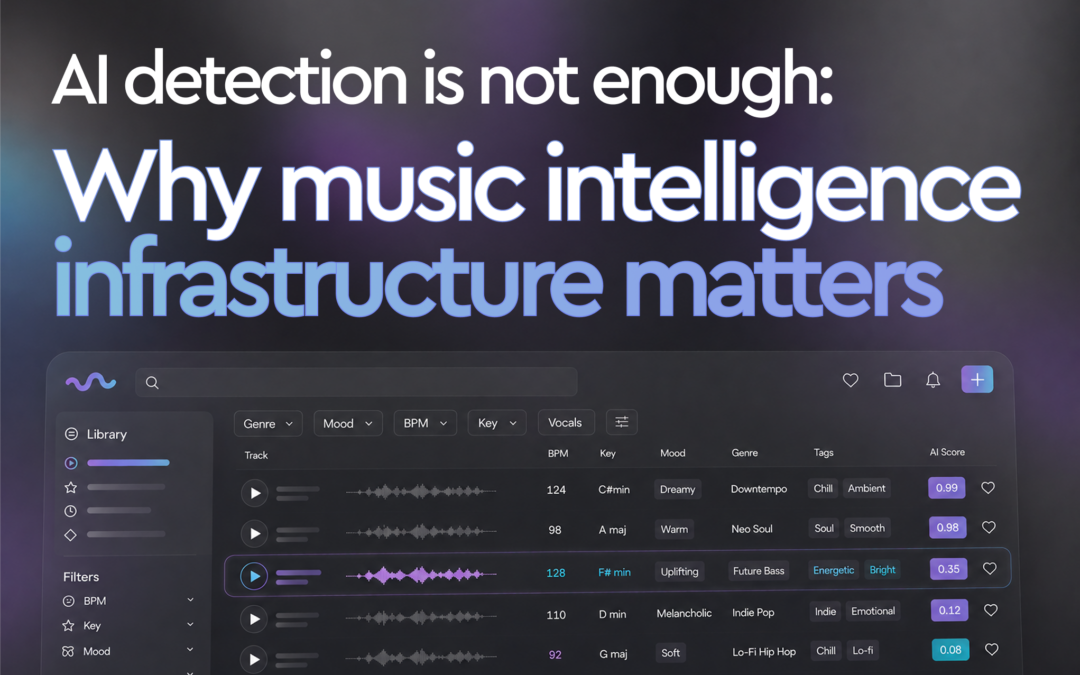
With this understanding in mind, Auto-Tagging, Similarity Search, and Free Text Search help turn detection into a richer layer of catalog intelligence. Instead of only identifying potential AI involvement, platforms can also understand how a track relates to the rest of the catalog, how it should surface in discovery, and how it connects to real search behavior.
That becomes especially relevant as AI starts appearing across different stages of music production. A track may contain AI-generated vocals, assisted mastering, or isolated generated elements layered into otherwise human-made recordings. In those instances, a detector that analyzes only the final file may return a limited signal, while a system that understands how the music is structured already has more context around the result.
Our approach to detection is deliberately conservative. We prioritize high-confidence results because incorrect labels can influence trust and shape how music moves through a platform.
No single signal can answer every question around AI-generated music. But combining detection with tagging and search gives platforms a much clearer understanding of the music they are managing.
Why detection needs infrastructure behind it
AI-generated music is entering the same catalogs and discovery environments as every other track. As AI-assisted production becomes harder to distinguish from human-made music, platforms need more than a system that simply applies labels.
The value of AI detection will come from the context surrounding the result. As upload volumes continue to accelerate and production methods become harder to trace, platforms need sufficient understanding of the music itself to keep their catalogs usable.
To learn more about Cyanite’s AI Music Detection and request early access, visit Cyanite AI Music Detection.
FAQs
Q: What is an AI music detector?
A: An AI music detector analyzes audio for characteristics commonly associated with generative music models. Most systems use machine learning to estimate whether a track was likely created with AI.
Q: How accurate are AI music detection tools?
A: AI music detection can be highly effective in certain cases, especially with fully generated tracks or synthetic vocals that closely resemble known generative outputs. However, detection is not a solved problem. Modern music production often combines human and AI-assisted workflows, which makes results more difficult to interpret. Reliable systems prioritize high-confidence signals and minimize false positives rather than attempting to label every track with a certainty that isn’t realistic.
Q: Can AI music detection tell the difference between fully and partially AI-generated tracks?
A: Not necessarily. Most detection systems analyze the final audio file as a whole, which makes it difficult to determine exactly where AI was involved within a track’s production. Cyanite combines detection with deeper audio analysis, helping platforms interpret results with more musical context.
Q: How does Cyanite combine AI music detection with tagging and search?
A: Cyanite combines AI music detection with Auto-Tagging, Similarity Search, and Free Text Search in the same system. This gives platforms more context around detection results by connecting them to the track’s musical characteristics, including genre, vocals, instrumentation, and similarity to the rest of the catalog.