
Why music discovery favors already visible artists and how to fix it
Why music discovery favors already visible artists and how to fix it

Ready to improve your music discovery workflows? Try Similarity Search in Cyanite.

Music recommendation systems tend to favor tracks that are already popular. This means they reinforce existing visibility rather than surfacing the best possible match.

For artists, getting their music on a platform is no longer the biggest challenge. It’s being findable.

Do smaller artists really have a fair shot at being discovered if they don’t have a big music label backing them up? In most cases, the honest answer most music platforms would give is no. And the infrastructure of discovery is a big part of the reason why.

Bias in collaborative filtering is one of the main reasons why many catalogs fail to unlock the full value of the music they already have.

AI tagging has the potential to turn this around. Sound-based discovery evaluates what a track actually sounds like, not its existing popularity. But getting this right takes deliberate work: building models that don’t encode existing biases, and layering contextual metadata to give platforms the tools to surface the artists that matter to their clients and communities.

Why standard discovery logic favors already-known artists

Most music platforms rely on a combination of popularity signals, manual editorial tagging, and keyword search to surface music. That may sound reasonable on the surface, but in practice, it creates a system that consistently favors what is already known.

  • Popularity-based signals like plays, engagement, and saves are inherently self-reinforcing. Tracks that have historically been surfaced more often are more likely to be surfaced again. A track from an established artist with years of placement history will surface in recommendations far more reliably than an equally strong track from a newer or lesser-known creator. Basically, your friend Katie’s latest release stands no chance against Taylor Swift.
  • Manual tagging is time-consuming and doesn’t scale, so it actually deepens the problem. When a platform’s editorial team has limited bandwidth, it tends to flow toward priority artists, those with more commercial history or more recent activity. Newer or smaller artists often get less attention, and therefore less metadata depth and, ultimately, less visibility.

Fixing this starts with changing how music is described and retrieved at the infrastructure level, not with better playlists or more editorial effort.

This is where sound-based AI tagging and Similarity Search offer a level playing field. Rather than asking who has the most plays or when a track was last touched by an editor, they ask a simpler question: what does this music actually sound like? 

This is exactly the problem Cyanite was built to solve: creating a discovery layer where music is evaluated based on its sound, not its history.

A track from an artist who joined the catalog three years ago and a track onboarded last month are evaluated and described consistently, using the same logic. They become equally visible to the same searches, making popularity an irrelevant factor.

But this only works if the underlying models are built and maintained carefully, because AI doesn’t automatically remove bias. In many cases, it can reinforce it.

Potential biases in AI music tagging

At this point, it’s tempting to assume that AI automatically creates a fairer system. If every track is analyzed objectively, shouldn’t discovery become neutral by default? Not necessarily.

If the AI used for music tagging was trained predominantly on certain types of music, it can quietly encode the biases already present in the industry. We know this from firsthand experience. It’s something we found when we looked at our own models at Cyanite.

We evaluated how the system represented artists of different genders by creating a baseline model that predicted the likelihood of female vocals being recognized based solely on genre and instrumentation. In male-dominated genres, the baseline model significantly underestimated the presence of female vocals. The model had learned from patterns in the training data that reflected existing structural imbalances.

AI isn’t inherently bad. It doesn’t replicate bias intentionally. But the trouble is that it doesn’t even know it’s doing it. If the data it learns from reflects a world in which certain artists are already underrepresented, the model will carry that forward and amplify it on a catalog-wide scale.

This is why model quality and regular auditing matter as much as the decision to use AI in the first place.

Read all our findings here: AI music search algorithms: gender bias or balance?

Fairer AI models are a start, but they’re not enough on their own

Our response to the gender representation findings was a combination of regular model audits and targeted updates. We launched a new Similarity Search, which achieved a female vocal presence of 51% across all propensity score bins. The model is now designed to maintain balanced representation across the board, not just in genres where female artists are already well-represented.

When the model is built and maintained well, AI tagging becomes a genuinely leveling force. Every track gets a fair description. Every search evaluates sound rather than status. And the catalog’s hidden depth becomes accessible to anyone with a brief.

But some platforms want to actively surface local artists. They may have clients with diversity mandates, broadcaster obligations to support independent music, or brand briefs that specifically call for underrepresented voices. An ethical AI model won’t do any of that on its own. It can create the conditions for fairer discovery, but it won’t define what that discovery looks like for any specific catalog or community. That requires a different layer.

The real role of contextual metadata

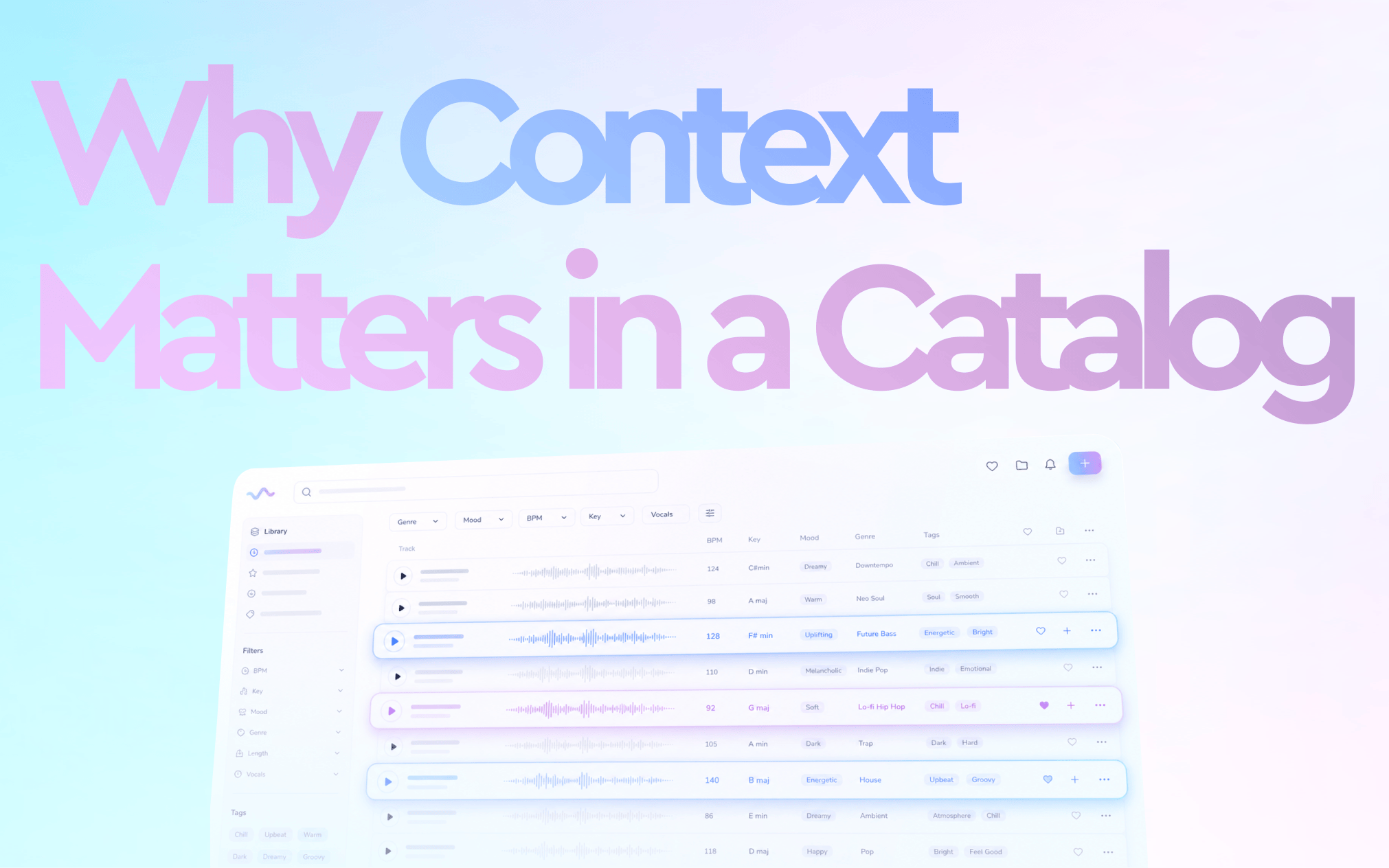
Sound-based tagging tells you what a track sounds like. It can describe mood, energy, instrumentation, tempo, and emotional arc with a level of consistency and speed that no manual process can match. However, some questions can’t be answered through sonic analysis alone. Who made the track? Where are they from? Are they an independent artist? 

That’s what contextual metadata is for.

Custom tags around artist origin and identity give platforms deliberate control over what gets surfaced. A platform can use them to translate its editorial values, or its client’s values, into something a user can actually filter by. They also shift discovery from a passive output of the algorithm to an active expression of what the platform stands for.

[Screenshot note: Show Cyanite Advanced Search with custom metadata filter options visible]

The demand for this kind of contextual layer is real, and it’s growing.

In a joint study we ran with MediaTracks and Marmoset—which surveyed 144 music licensing professionals, including music supervisors, filmmakers, advertisers, and producers—97% of respondents said they want AI-generated music to be clearly labeled. Transparency is becoming a determining factor in music search.

Check out the full study here: Why AI labels and metadata now matter in licensing

Professionals also rely on origin details and creator context to navigate briefs and explain their track selections to clients. The context behind a song is a core part of how licensing decisions are made. Contextual filtering is therefore becoming more and more essential for music platforms that want to facilitate smarter discovery and better brief alignment. This shift is already underway: 

  • Content requirements from broadcasters and government-funded media asking for local artists
  • Diversity briefs from brands and agencies that need to demonstrate commitment to independent or underrepresented artists
  • Publisher and library mandates to surface specific communities within a catalog
  • Music supervisors needing to justify selections to clients based on creator background or origin

In some cases, platforms also need to verify certain aspects of that context.

As AI-generated music becomes more prevalent, being able to distinguish between human-made and AI-generated tracks can add an additional layer of transparency. This is especially useful for platforms working with specific labeling requirements or client expectations.

Learn more about how AI music detection works in practice.

What fair music discovery looks like in practice

The combination of AI search and contextual filters is what makes fairer discovery scalable. Two of our partners show how this plays out across different dimensions of the same problem.

Marmoset: sound-based fairness in action

Marmoset is a full-service music licensing agency and, since 2019, the first certified B Corporation music agency in the world. Their catalog represents hundreds of independent artists and labels. Getting those artists found fairly, consistently, and without depending on their popularity history is central to Marmoset’s mission.

Before integrating Cyanite, Marmoset faced a familiar challenge: a growing catalog, limited bandwidth for manual tagging, and a discovery process that, despite their best intentions, tended to favor artists who had been in the system for longer.

Cyanite’s AI Auto-Tagging gave every track in the catalog a consistent metadata foundation, regardless of when it was added or how frequently it had been licensed.

Similarity Search took that further. As Alex Paguirigan, product manager at Marmoset, put it: “Using Cyanite, we provided a fairer game for our artists to play. At the end of the day, that means more money in their pockets.”

The key mechanism here is that Similarity Search surfaces tracks based on sonic match, not play counts, recency, or editorial prioritization. “The AI doesn’t care if you’re Ed Sheeran or a bedroom producer. If your track fits the reference, it will surface it,” as Jakob, one of our founders, likes to say.

Melodie: what contextual metadata can actually do

Where Marmoset demonstrates fairness through sound-based discovery, Melodie demonstrates how contextual metadata can surface artists by their identity and origin, a different dimension of the same goal.

Melodie is a music licensing platform based in Australia and built on a 50/50 revenue split with artists. It’s curated entirely by hand for quality and emotional resonance. As the catalog grew, the team needed a way to help clients navigate it at speed without losing the editorial integrity that already defined the platform.

Cyanite’s Similarity Search and Free Text Search handled the sonic layer. But what made Melodie’s approach distinctive is how they combined AI search results with contextual filters using Advanced Search

Their unique spin was including the “Show Australian artists only” tag. For Australian broadcasters, brands, agencies, and government bodies, supporting local artists is often a conscious mandate, and Melodie wanted to make this frictionless.

The workflow from a manager looking for a song to match their brief might look like this in Melodie:

  1. Using Similarity Search to find tracks that match the vibe of a reference song they had in mind 
  2. Applying the “Show Australian artists only” filter to narrow those results to local creators

Within seconds, they’re listening to tracks that fit both the creative brief and their mandate to support the local music economy.

Adding context to music could easily clutter up the catalog, but Evan Buist, Managing Director of Melodie Music, describes the design principle behind their approach:

“We only introduce tags when they serve a clear purpose for the user and the artist. Crucially, tags are optional pathways, not restrictive labels. They exist to empower choice—like finding tracks created by an Australian artist—not to define an artist by a single attribute. By working closely with our stakeholders, we ensure that our metadata adds value and visibility without diminishing the complexity of the artistry.”

Metadata should expand what’s possible for specific use cases, not constrain how an artist is understood across the rest of the catalog.

Want to create your own custom tags? Click the button below.

The business case for getting this right

Platforms that can surface the right artist for a specific brief have a genuine differentiator in an increasingly commoditized market. As clients bring more nuanced mandates, generic platforms that rely on popularity signals and keyword-only search will struggle to compete with those that can actually deliver on briefs.

Thematic’s creative community, built to connect the right track with the right creator at the right moment, offers another angle. Before integrating Cyanite, finding that match was slow. Creators cycled through tracks, guessing at genre labels and trying to articulate sounds they could hear in their heads but couldn’t describe. 

After integrating Cyanite’s Auto-Tagging and Similarity Search, Thematic saw a nearly 9% decrease in the number of times a creator plays a song before downloading it. They also reported a nearly 15% increase in creators downloading tracks directly from the personalized “For You” page, thanks to the Advanced Search functionality which enables song recommendations based on what a specific creator has already downloaded and used. Discovery became effortless: the right track would find a user before they even went looking for it.

For artists, this means better matching and therefore more placements, more exposure, and more income. As Audrey Marshall, co-founder and COO at Thematic, put it: “Discoverability can often be a visibility problem dressed up as a quality problem. A great song that isn’t tagged correctly can sit undiscovered for months.”

What platforms should be asking themselves

If you manage a catalog with a mix of established and emerging artists, a few questions are worth sitting with:

  • Do your least-known artists have the same structural shot at being discovered as your most popular ones? 
  • Have you audited your AI models for the kinds of bias your training data may have introduced? 
  • Which contextual dimensions matter most for your catalog and your client base?
  • How can custom tagging translate your editorial values into something a user can actually filter by?

A track added three years ago with incomplete metadata should not be permanently disadvantaged compared to one onboarded last month with a full tagging workflow. All artists should get a fair chance at discoverability.

AI tagging is a policy decision as much as a technical one

The platforms building a genuinely fairer discovery experience are those investing in consistent, foundational AI tagging, auditing their models regularly to catch the biases training data can introduce, and adding contextual layers that reflect what their catalogs and clients actually need.

When fairness becomes a priority, artists get found and platforms build the kind of trust that compounds over time.

If you want to see what ethical and smarter discovery looks like in practice, explore what Cyanite can do for your catalog.

How music platforms build personalized discovery with sound-based AI
How music platforms build personalized discovery with sound-based AI

Upgrade your music discovery. Sign up for Cyanite.

Spotify set a new benchmark for personalized music discovery in 2015 with the launch of Discover Weekly, which now has as many as 751 million monthly users. All streaming platforms are now expected to provide that same level of recommendation.

Spotify relies largely on collaborative filtering to deliver those recommendations at scale. The platform compares listening behavior across millions of users and predicts what someone might like based on similar listeners’ behavior. Running this feature requires enormous behavioral datasets, dedicated data science teams, and continuous optimization.

Few music libraries and streaming platforms have that volume of interaction data or the machine learning resources needed. But operating a personalized discovery system like this is made possible with Cyanite.

Why collaborative filtering alone is limiting

Collaborative filtering predicts what someone might like by comparing their listening behavior with other user activity, such as what they listen to, save, replay, or skip. Operating at this scale requires massive behavioral datasets.

Because recommendations depend on interaction signals, they tend to favor what already performs well. Popular tracks generate more activity and become easier to recommend, while less-played songs receive far less exposure.

The same limitation affects new releases. A track that just entered the catalog has little to no listening data, making it difficult to surface in recommendations.

A scalable alternative: sound-based personalization

Sound-based personalization uses the sound of the music itself as the signal. By measuring sound similarity using AI-powered analysis, platforms and music libraries can generate recommendations without relying on large volumes of user interaction data.

Signals they already collect, such as saved tracks, downloads, or favorites, can be used as reference points for personalization. Several tracks can also be combined to represent a listener’s taste and generate recommendations through multi-track similarity.

Because this approach doesn’t depend on massive engagement data, it scales more easily across platforms and catalogs of different sizes. The result is more sound-driven discovery, with reduced popularity bias and the ability to surface new releases even before they accumulate listening activity.

How this is made possible with Cyanite

Cyanite provides the audio intelligence layer to generate recommendations from the sound of the music itself. A track’s musical characteristics are made comparable across the catalog, allowing teams to start from one or several reference tracks and find similar songs.

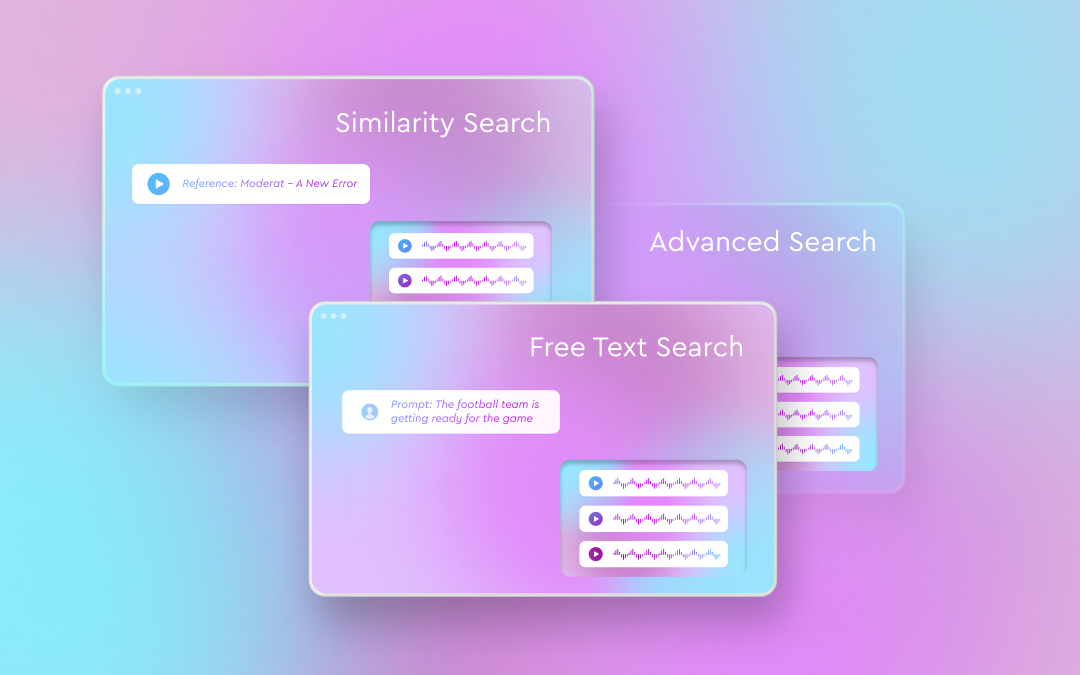
Two core capabilities make this music search possible: Similarity Search and Advanced Search.

Similarity Search lets teams search from a reference track, whether it comes from their catalog, an uploaded file, or an external source such as a YouTube preview.

This aligns closely with how listeners actually discover music. When someone searches for “something similar,” they are usually looking for a track that’s similar to a specific song. Similarity Search turns that reference into a starting point and retrieves matching tracks across the catalog.

To see how this works in practice, you can try it directly in the Cyanite Web App.

Advanced Search builds on Similarity Search, allowing platforms to generate recommendations from multiple reference tracks. Up to 50 tracks can be used together. 

It also adds filtering. Platforms can refine results using Cyanite tags or custom tags, giving them control over what appears in the recommendations. For example, results can be filtered to surface new releases or other catalog attributes while still matching the listener’s taste.

Advanced Search is available through the Cyanite API.

What makes multi-track personalization powerful

When it comes to a listener’s taste, a single track only reflects part of the picture. Using several reference tracks provides more information about what that listener tends to save and enjoy, making patterns easier to detect. With a clearer picture of taste, platforms can generate recommendations that feel more tailored and support playlist-style discovery.

How to personalize discovery without reinforcing popularity bias

Combining similarity with filtering allows platforms to shape discovery intentionally. Recommendations can still reflect a listener’s taste while prioritizing specific catalog segments, such as new releases or curated artist groups. This lets music libraries increase the exposure of new songs in the catalog and helps streaming platforms guide listeners toward new music.

Platforms like Melodie use Cyanite to generate recommendations and combine those results with editorial filters. Users can move quickly from a musical reference to relevant tracks while still surfacing artists and catalog segments Melodie wants to promote.

Read more: How Melodie uses Cyanite and contextual metadata to spotlight Australian artists

Inside a multi-track personalization workflow

Let’s look at how this works in practice.

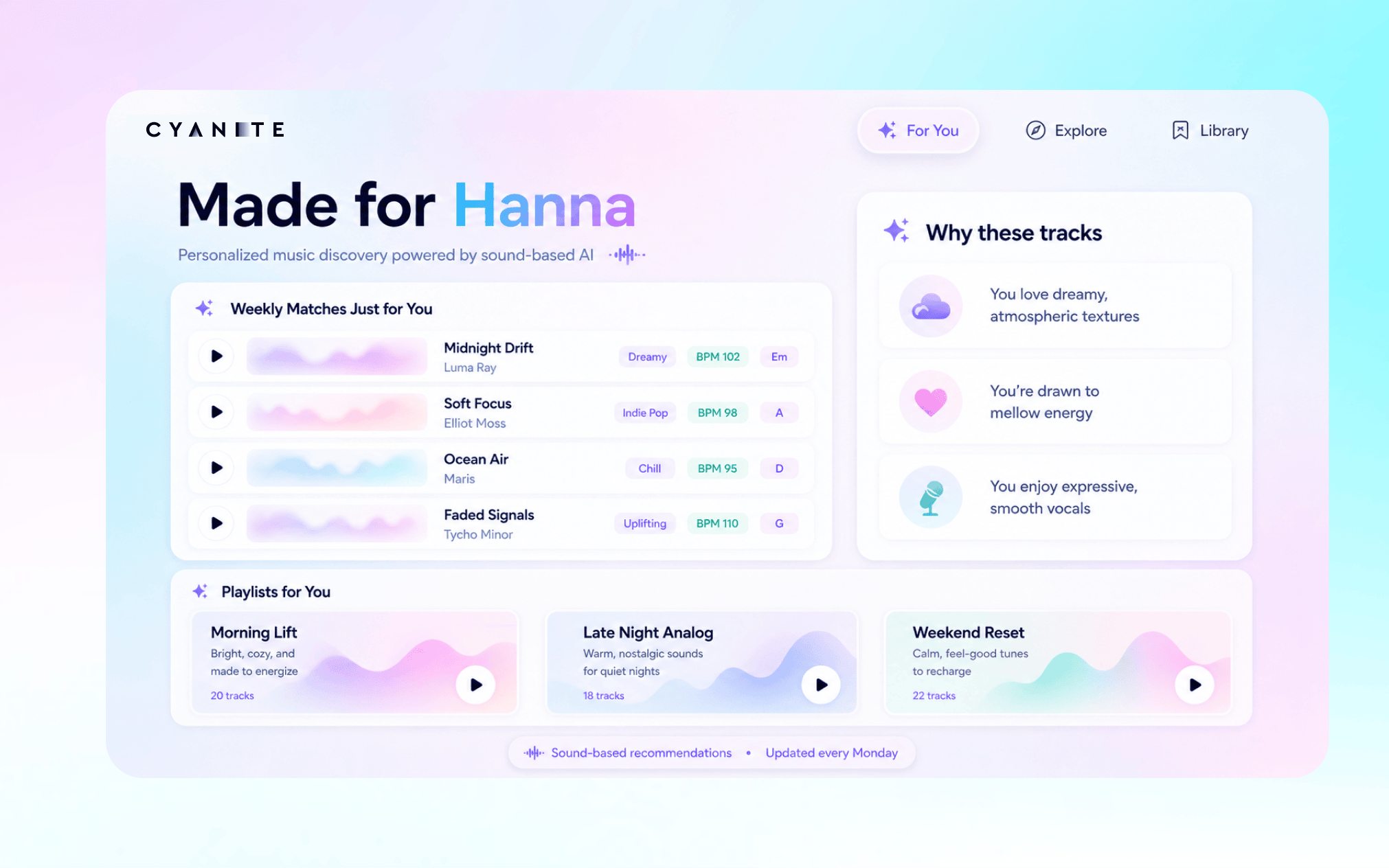
Picture a music library or streaming service that uses Cyanite to power discovery. A user, let’s call her Hanna, has saved 20 tracks as favorites over the past few weeks.

Instead of relying on other listeners’ behavior, the platform can use Hanna’s own listening history as the starting point for recommendations.


Step 1: Use Hanna’s favorites as the seed set

The last 20 tracks Hanna saved become the multi-track reference set. Together, they represent her taste far better than a single reference song.

Step 2: Run similarity search with Advanced Search

Using Cyanite’s Advanced Search feature, a similarity search is run with Hanna’s saved tracks as the reference set. Cyanite compares the sound of those tracks with the rest of the catalog and returns songs with comparable musical characteristics.

Step 3: Filter the results

Filters can then refine the results. For example, tracks tagged as “new releases” can be prioritized. Additional tags, such as genre, mood, or BPM, can narrow the results even further depending on the catalog structure. 

Step 4: Generate the playlist

The filtered results can become a personalized playlist for Hanna. The tracks reflect the sound of the music she already enjoys, but she’s also introduced to songs she hasn’t yet heard. The experience feels similar to a Discover Weekly-style playlist, but the recommendations are sound-based.

Sound-based personalization in practice: Thematic’s “For You”

Thematic is a platform that connects content creators with music for their videos, and Cyanite powers personalized recommendations inside its “For You” page.

The feature analyzes a creator’s download history and recommends tracks with similar sounds. It also lets creators quickly access their recently used music.

“Your personalized hub for music discovery. Get tailored song recommendations based on the music you’ve downloaded, your creative style, and your video themes. Plus, quick access to your recent activity means you’ll never lose track of your go-to tracks.”

This shows how sound-based personalization is already implemented in real discovery features.

What this means for music platforms

Sound-based personalization changes how platforms can design discovery experiences and manage their catalogs.

Music libraries

  • Engagement increases because recommendations reflect what listeners actually want to hear.
  • New releases are surfaced more effectively, helping artists gain visibility earlier.
  • Catalog exposure is more balanced. Attention is no longer concentrated on tracks that are already popular.
  • Personalization is scalable without maintaining complex machine learning infrastructure.

Streaming services

  • Platforms can deliver discovery experiences similar to features like Discover Weekly.
  • Users benefit from strong personalization logic built from their listening history.
  • There is less dependence on massive behavioral datasets.
  • Sound-based discovery becomes part of the platform’s recommendation infrastructure.

When implementing these workflows, platforms also need to ensure that audio and catalog data stay protected. Learn how Cyanite supports privacy-first workflows.

Explore sound-based personalization with Cyanite

Saved tracks, downloads, and favorites are signals music platforms already collect. With Cyanite, those signals can become the foundation of personalized discovery.

Similarity Search can identify tracks that sit close to a reference song in terms of sound. And with Advanced Search, multiple reference tracks and metadata filters can be combined to shape recommendation systems such as personalized playlists or discovery feeds.

As music catalogs grow and discovery becomes more complex, sound-based personalization offers a scalable alternative to behavior-driven recommendation systems.

This allows music libraries and streaming services to turn existing listening activity into meaningful discovery features, using sound as the underlying recommendation logic.

Start experimenting with Cyanite today to explore how sound-based personalization could work in your platform.

Why AI music detection is harder than it sounds

Why AI music detection is harder than it sounds

Wondering if a track is AI-generated or human-made? Sign up for early access to our AI music detection feature here.

An article by Roman Gebhardt, CAIO at Cyanite.

97% of music professionals want to know whether a track is AI-generated or human-made. That number alone, which comes from a survey we conducted with Marmoset and Mediatracks, tells you how urgent the matter of AI music detection has become.

But demand for detection is only half the story. We’re currently conducting an ongoing survey of artists, in which 80% of respondents have said they don’t trust self-disclosure, and more than 70% say they fear being wrongly labeled as AI-generated.

This highlights a core challenge the industry still needs to solve: how to provide detection signals that are reliable enough to be trusted in real-world decisions.

That’s what this article is about. We’ll look at why detection is genuinely hard, where the real risks lie, and how we’re approaching the problem at Cyanite.

AI music detection is not a simple classification problem

Detection is often framed as a binary issue question, as a track is either AI-generated or it isn’t. That framing suggests the solution is equally simple: just train a model on the right data and you’re done.

In practice, it’s far more complicated. The challenge lies in identifying which characteristics in the audio signal are reliable enough to support a confident conclusion. It’s not just about how a track sounds to a human listener. For instance, it could be partially generated, post-processed, or intentionally altered to remove detectable patterns. Different generation systems introduce different signatures. And as those systems evolve, so do the techniques designed to evade detection, a dynamic often called the “AI Arms Race.”

This means detection doesn’t always give us a clean yes or no answer. It involves assessing the strength of signals, and that strength varies depending on how a track was created. It also raises harder questions: can AI-generated elements be localized within a track? How should partial generation be represented in a meaningful way?

These are active areas of research. What they suggest is that AI music detection is not a fixed problem with a fixed solution.

No detection system can reliably identify all AI-generated music, and any system that claims otherwise should be treated with caution. The goal isn’t perfect recall across every model that exists. It should be trustworthy, reliable decision support under real-world conditions.

The real risk in AI music detection: false positives

The primary risk in AI detection is incorrectly labeling human-created music as AI-generated. These false positives directly impact artists and catalogs. They can lead to wrongful rejections and reputational damage, and ultimately, they can undermine trust in detection systems. 

This is why simple accuracy optimization alone is not enough. Detection systems must be designed to produce reliable, high-confidence signals and avoid overinterpretation.

A track should only be labeled as AI-generated when there is strong and consistent evidence to support that conclusion. When we developed our own detection models, that principle became the foundation: focus only on clear, well-understood indicators.

Cyanite’s conservative approach to AI music detection

We approach AI music detection as a reliable transparency issue. It’s not just about classification. Instead of trying to detect everything, we focus on identifying high-confidence signals that can support real-world decisions. Our position is deliberately conservative: we would rather withhold a label than apply one we can’t stand behind.

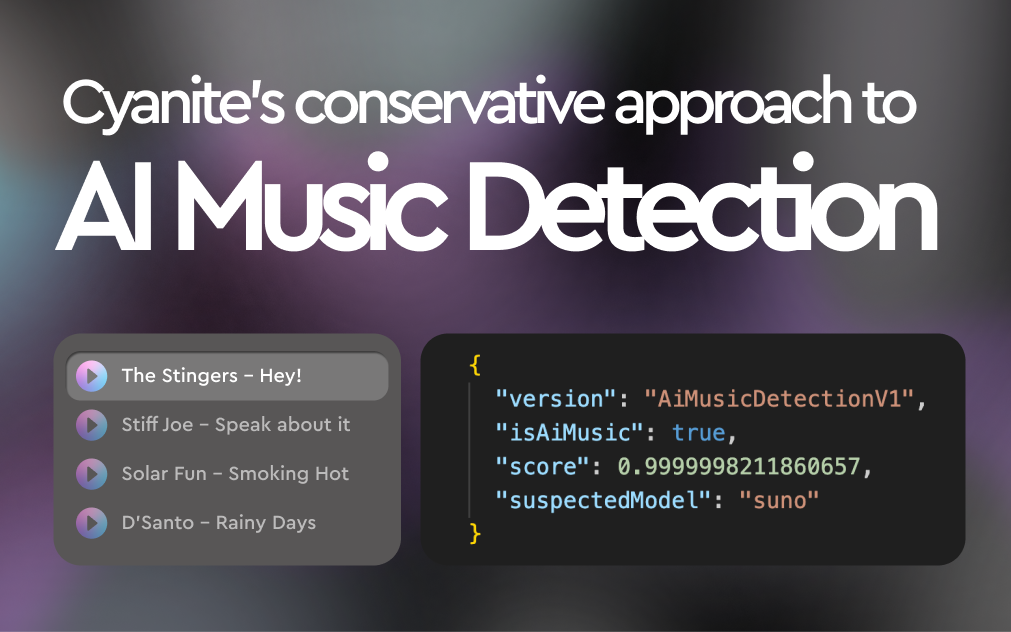
In practice, detection results are not binary flags. They are scores. Fully generated, unprocessed tracks tend to produce signals close to 1.0, indicating a very high likelihood of generated audio. Fully human-created material typically scores close to zero, reflecting the absence of detectable generation-specific patterns.

As content becomes more complex, through post-processing or mixing with human-created material, detection scores for AI-generated material can sit somewhere in between, and they need to be more carefully interpreted. Results should always be understood as signals to support decision-making, not definitive judgments.

Because AI generation is constantly evolving, our detection approach evolves with it. We continuously analyze new generation systems and develop methods based on signals we can validate and understand. In some cases that means model-specific detection. In others, we look for characteristics that generalize across different types of generative models. We combine approaches rather than relying on a single method.

In recent months, a growing ecosystem of tools and services has emerged that aim to obscure or remove detectable characteristics from generated audio. With this in mind, we test how our signals hold up under deliberate obfuscation. In our current testing, the signals we rely on remain detectable even after those modifications. This robustness is by design. It’s central to what makes detection trustworthy enough to act on.

Building independent detection the industry can trust

Detection systems will increasingly influence decisions with real legal and economic consequences: whether a track is accepted or rejected, whether an artist is flagged or cleared.

That kind of influence demands neutrality.

Detection shouldn’t be controlled by the same companies whose tools it’s meant to evaluate, or to any incentive that could quietly bias outcomes.

Independence is something we take seriously at Cyanite. It’s what allows the signals we produce to be relied on across platforms, catalogs, and workflows, by people who need to be able to trust the answer.

AI will continue to shape how music is created. The question is no longer whether it will be used, but whether the industry can build the transparency infrastructure to understand it responsibly. That requires continuous research, careful system design, and a commitment to getting it right rather than claiming to be able to detect everything.

It’s the approach we’ve taken with Cyanite AI Music Detection, and one we’ll keep developing as the landscape evolves.

Want to see our AI detection in action? Request early access here.

How Thematic uses AI-powered discovery to personalize music recommendations at scale
How Thematic uses AI-powered discovery to personalize music recommendations at scale

Ready to improve your music discovery workflows? Try Similarity Search in Cyanite.

AI-powered discovery is the engine that powers our community. When the right song finds the right creator, an artist gains a new fan, the next match gets smarter, and the creative process becomes that much more effortless.

Audrey Marshall

Co-Founder and COO, Thematic

Thematic is a creative community built for discovery, collaboration, and growth. Co-founded by Michelle Phan, a pioneering creator who helped define how influencers build and monetize audiences online, Thematic was optimized for the creative experience from the start and is now trusted by over 1 million creators.

When a creator features a Thematic song in their video, they create a promotional moment for that artist. The artist can track exactly which videos by which creators used their music and how many new fans they gained as a result.

Every interaction feeds back into the recommendation engine, creating a virtuous loop of value between creators and artists. It’s a collaborative ecosystem where both sides of the creative equation create, connect, and grow together.

Thematic’s goal was to turn music discovery into a win for all by giving creators better options. However, in practice, their growing catalog meant creators had to navigate an overwhelming amount of choice in a space already defined by decision fatigue. As Thematic continued to scale, so did the pressure to make discovery smarter.

When finding the right track becomes a problem

Before building anything new, the team listened carefully. One-on-one interviews, surveys, support ticket analysis, and community feedback all pointed to the same problem. Finding the right song was taking too long.

The size of the catalog wasn’t the issue. It was the mismatch between how creators think and how search tools work.

Tags and genres are a poor way to describe music. Creators don’t fall in love with a song because it’s ‘indie folk with a male vocalist at 120 BPM,’” explains Audrey. “They connect with it because of how it sounds, how it makes them feel, and the emotional resonance of the lyrics.”

Traditional keyword search asks users to translate a feeling into a music tag formula,” as Audrey puts it. Most creators know what they want when they hear it. Forcing people into a keyword search box creates a time-consuming cycle: sampling track after track, exploring a genre only to find it missed the mark, then starting over.

But Thematic serves both creators and artists, so improving discovery efficiency would have a double impact: saving creators time finding the perfect-fit song, while driving higher placement opportunities for artists.

“Think about the difference between flipping through cable channels versus opening a feed that already knows what you like,” says Audrey. “The channel count doesn’t matter. What matters is whether the right thing surfaces at the right moment.”

The new Thematic

Thematic homepage highlighting trending music from real artists, featured tracks, and call-to-action buttons

To address this, Thematic launched a rebuilt platform alongside a complete rebrand. The product had grown significantly since its initial launch, and the visual identity needed to catch up.

The rebuild focused on two areas: 

  • A personalized For You experience based on each creator’s usage history and music taste, updated tagging infrastructure to improve search and filtering accuracy, and the ability to find sonically similar songs to any track, whether on Thematic or Spotify.
  • Deepening the creator community through a points leaderboard, upgraded creator and artist profiles, and better visibility into the value exchange happening on the platform.

At the center of the smarter discovery experience was Cyanite.

AI as a workflow tool, not a replacement

Music search results in Thematic with filters for song type, genre, access, and keyword-based track results<br />

The decision to incorporate AI-based audio analysis came down to one thing: saving creators time.

We treat AI as a great workflow improvement tool for creators,” says Audrey.
Its ability to analyze large datasets and surface the most relevant information can be genuinely time-saving, especially when trying to identify songs that have a similar sound, not just similar music attributes and tags.”

Sound-based search has removed the need to translate intent into search terms. Instead of asking creators to describe what they’re looking for, it lets them start from a reference track and find cleared, licensed music on Thematic that matches that sonic profile. What used to take hours can now happen in seconds.

From there, creators can quickly build a full set of songs that fit their overall aesthetic by exploring complementary recommendations. What used to be a slow, trial-and-error process becomes fast, flexible, and far more creatively aligned.

Cyanite was the only solution that offered the full music infrastructure we needed, from song attribute tagging to AI analysis and similarity search.

Audrey Marshall

Co-Founder and COO, Thematic

Thematic playlist page showing songs similar to “forgiveness” with track list, search bar, and sorting options

The For You page: where it all comes together

Personalized Thematic dashboard showing weekly song matches, playlists, leaderboard, and music recommendations

When the right song finds you instead of the other way around, music can become an earlier, more integral part of how a video comes together, potentially shaping the edit, not just scoring it. That’s a meaningful shift in how creators work, and we think it’s just the beginning. The future of music discovery isn’t a better search bar. It’s a creative collaborator that already knows your voice.

Audrey Marshall

Co-Founder and COO, Thematic

PR: Anghami partners with Cyanite for AI-powered metadata across 2.5 million songs
PR: Anghami partners with Cyanite for AI-powered metadata across 2.5 million songs

PRESS RELEASE

Berlin 24.03.2026 -Anghami, the leading music and entertainment streaming platform in the MENA region with over 120 million registered users, has partnered with Cyanite to enrich 2.5 million songs using AI-generated music metadata.

By integrating Cyanite’s auto-tagging API, Anghami has enhanced its catalog with detailed audio-based metadata across mood, genre, energy, instrumentation, and more. This structured data layer feeds directly into Anghami’s internal recommendation systems, enabling more precise and scalable music discovery.

At a catalog scale of millions of tracks, metadata quality becomes a strategic driver of personalisation. Structured and consistent tagging enables streaming platforms to better match songs with listeners, surface long-tail content, and improve personalization across diverse repertoires.

For Anghami, the partnership also underscores its commitment to accurately representing the richness of Arabic music. A significant share of its catalog consists of regional content that is often underrepresented in Western-centric AI systems.

Because Cyanite analyses audio directly, rather than relying on behavioural signals or language-based metadata, its models operate consistently across musical cultures and languages.

Anghami operates one of the most culturally diverse music catalogs in the world. Ensuring that Arabic repertoire is tagged with the same precision as Western music is not trivial. We’re proud that our audio-based AI can support music discovery at this scale and across such a rich regional landscape.

Markus Schwarzer

CEO & Founder, Cyanite

Arabic music carries immense depth, emotion and cultural nuance. Through our partnership with Cyanite, we’re ensuring that this richness is understood at a data level, allowing us to power more accurate personalisation and elevate discovery for millions of listeners.

Elias El Khoury

VP Information & Content Systems, Anghami

About Anghami Inc. (NASDAQ: ANGH):

Anghami is the leading multi-media technology streaming platform in the Middle East and North Africa (“MENA”) region, offering a comprehensive ecosystem of exclusive premium video, music, podcasts, live entertainment, audio services and more. Since its launch in 2012, Anghami has led the way as the first music streaming platform to digitize MENA’s music catalog, reshaping the region’s entertainment landscape.

In a strategic move in April 2024, Anghami joined forces with OSN+, a leading video streaming platform, forming a digital entertainment powerhouse. This pivotal transaction strengthened Anghami’s position as a go-to destination, boasting an extensive library of over 18,000 hours of premium video, including exclusive HBO content, alongside 100+ million Arabic and International songs and podcasts.

With a user base exceeding 120 million registered users and 2.5 million paid subscribers, Anghami has partnered with 47 telcos across MENA, facilitating customer acquisition and subscription payment, in addition to establishing relationships with major film studios, entertainment giants, and music labels, both regional and international.

Headquartered in Abu Dhabi, UAE, Anghami operates in 16 countries across MENA, with offices in Beirut, Dubai, Cairo, and Riyadh.

To learn more about Anghami, please visit: https://anghami.com

For media inquiries, please contact:
Umar Gulamnabi – Associate, Integrated Media, Current Global
osncg@currentglobal.com
+971 56 827 1966

About Cyanite

Cyanite is an AI music intelligence platform that helps streaming services, publishers, and music platforms enrich and organize their catalogs. Its auto-tagging API analyzes audio directly to generate structured metadata across genre, mood, energy, instrumentation, and more. Cyanite has tagged over 40 million songs and is trusted by more than 200 companies worldwide, including Warner Chappell, BMG, Epidemic Sound, and APM Music.

Media contact
Jakob Höflich
CMO at Cyanite
jakob@cyanite.ai

For interview requests or additional data, please contact: jakob@cyanite.ai