
Last updated on September 4th, 2026 at 12:09 pm
See how Cyanite powers LLM-based music search. Try Free Text Search.
Teams across the music industry are rapidly adopting large language models (LLMs) in their workflows, and music search is one of the clearest use cases.
People already search for music by describing what they’re looking for in words, and LLMs are exceptionally good at interpreting those requests. Some models can even analyze audio directly, so using them for music search feels like the obvious next step.
But interpreting a request is only the beginning. Finding the right music in a catalog requires a different capability: a search system designed to retrieve relevant tracks.
How Epidemic Sound and Soundstripe approach this
Companies like Epidemic Sound and Soundstripe already use Cyanite to power conversational music search. Users describe the music they are looking for in natural language, while Cyanite provides the search and music understanding behind the experience.
At Epidemic Sound, a user might type a request like “slow-paced wedding music similar to Otis Redding.” From there, the workflow looks something like this:
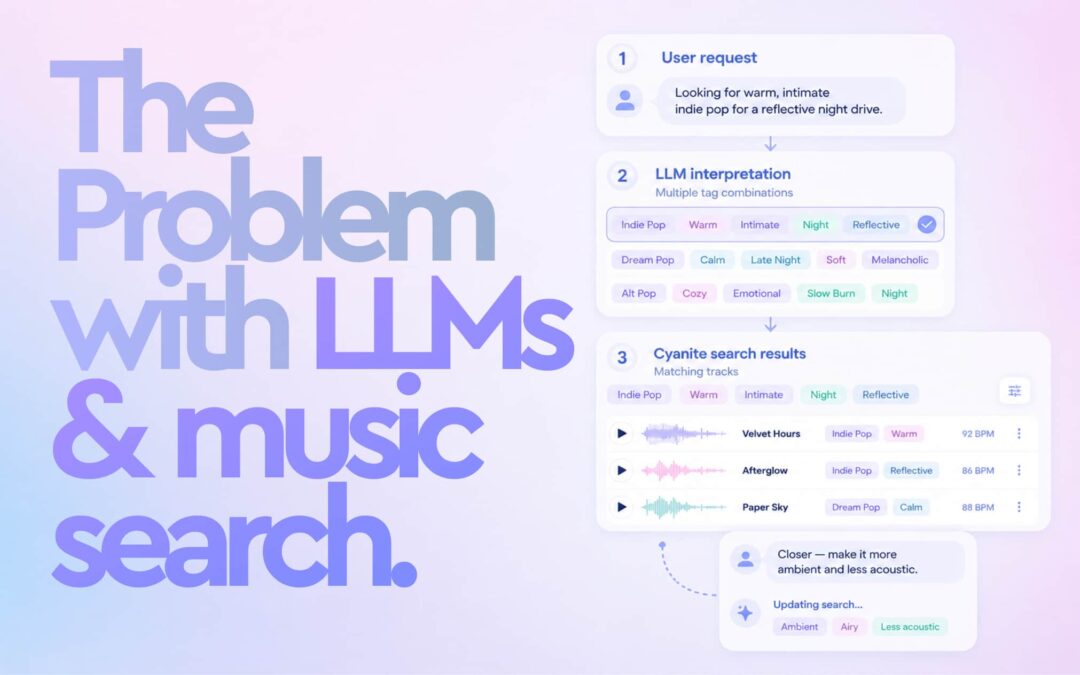
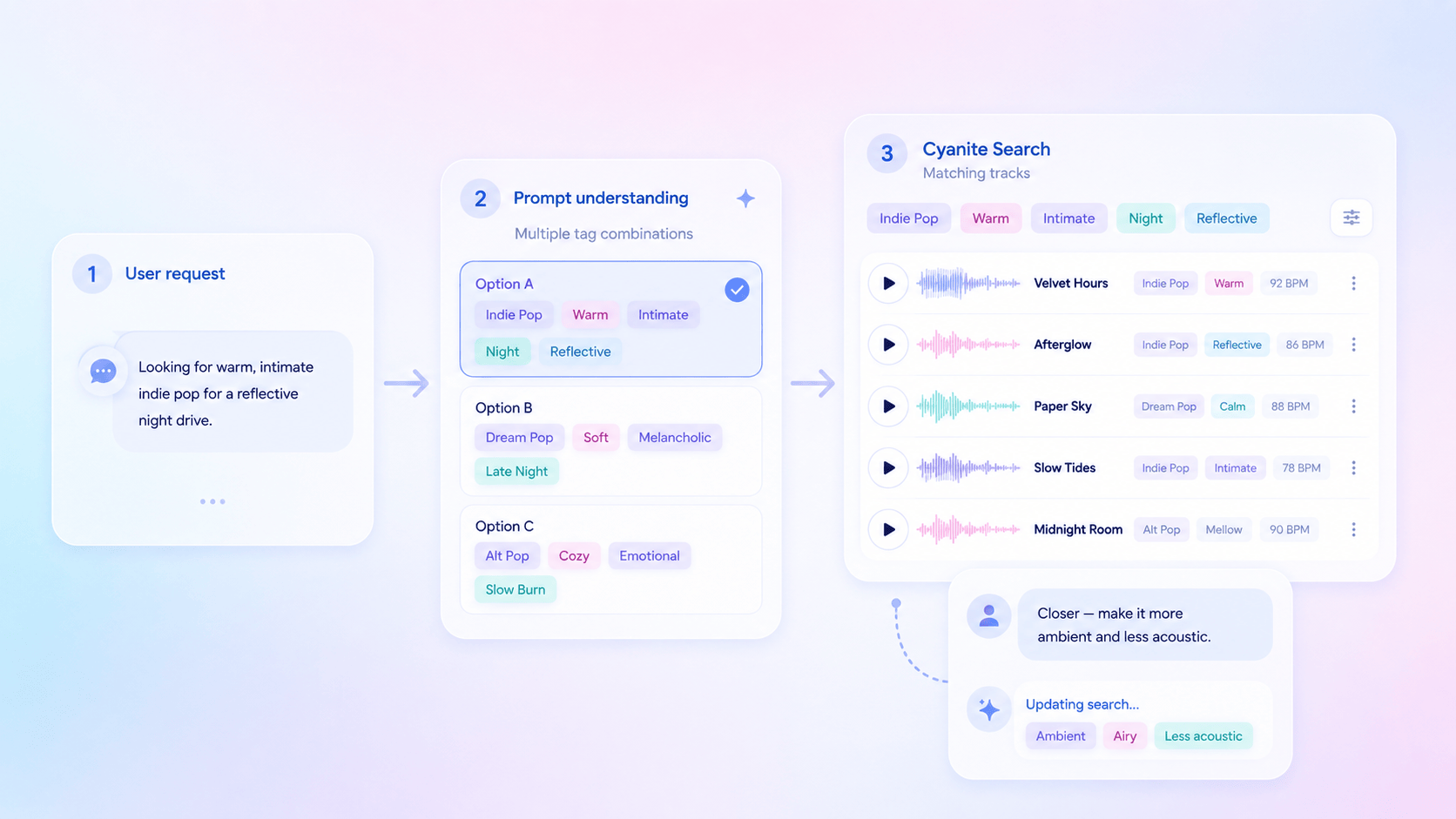
- The LLM interprets the user’s request and identifies the search intent.
- Cyanite’s Search returns a ranked list of matching tracks.
- Tagging provides structured information about those tracks, making it possible to explain why they match, apply additional filters, and refine the conversation.
- As the conversation evolves, the LLM keeps track of the user’s intent while Cyanite updates the results.
Soundstripe follows a similar approach, giving users a conversational way to search its catalog with Cyanite behind the experience.
These implementations show that conversational search depends on more than just an LLM. The LLM interprets intent, search gathers the right tracks, and structured metadata explains why they match and supports further refinement.
Why conversational music search needs more than an LLM
An LLM can’t query a music catalog on its own. Even if it understands exactly what the user wants, it still needs a way to search the catalog, compare that request against every track, and return the closest matches.
Retrieval uses prompt search to narrow the catalog to a relevant shortlist. Structured audio metadata gives the LLM a stable description of each result, grounded in verifiable attributes such as tempo, key, or vocal presence. Because the model reasons through language, it doesn’t need to analyze the audio itself. The structured description provides the information it needs to explain recommendations and refine the conversation without generating a new interpretation every time.
Learn more: How to prompt using Cyanite’s Free Text Search
Is music tagging obsolete because of AI?
Many people assumed that AI would make music tagging obsolete. If systems could search catalogs semantically and generate embeddings automatically, why would detailed tagging systems still exist?
As AI workflows grow more common, the need for detailed and audio-grounded metadata has grown with them. Embeddings are great at finding similar-sounding songs, but similarity alone doesn’t explain what a track is or what it can be used for.
Music search tools still need structured information like tempo, vocal presence, instrumentation, and mood to explain results and support filtering. Without those tags, systems have less reliable information to work from.
This becomes even more noticeable in large catalogs, especially with independent music where metadata is often incomplete or inconsistent. Structured tagging helps keep search and recommendation systems accurate as catalogs grow.
Rather than replacing music tagging, AI changes its role. Structured metadata becomes reliable context that applications can reuse across different workflows.
Where this is heading: agentic workflows and the metadata requirement
Music workflows are becoming more automated, with agentic systems starting to navigate catalogs on their own. Instead of serving information directly to people, music catalogs increasingly need to support software that searches, reasons about, and acts on the results.
Imagine an agent assembling a 40-track playlist for a licensing brief. It finds relevant tracks, filters them according to the brief, and prepares a shortlist for review. If one track is incorrectly tagged as instrumental when it contains vocals, that mistake can carry through the workflow without anyone noticing. As more decisions become automated, the output of one system increasingly becomes the input to the next.
That’s why metadata needs to be consistent. Agents build downstream logic on structured metadata, so the same track should return the same attributes every time. Stable, repeatable outputs prevent errors from propagating through automated workflows.
Those outputs also need to be verifiable. If someone asks why a track was selected, checkable attributes such as vocal presence, tempo, or key provide a clear explanation grounded in the audio itself. As agents take on more of the review process in licensing and rights workflows, that audit trail becomes increasingly important.
This also changes the economics of audio understanding. Each track is analyzed once at ingest, and that metadata can be reused across every search and AI workflow that follows. Instead of interpreting the same audio every time an agent needs information, the system queries a stable description that has already been computed.
Preparing your music catalog for AI
LLMs are changing how people interact with music catalogs, making music discovery more conversational and opening the door to increasingly agentic workflows. But to prepare a catalog for AI, you need to think beyond the chat interface.
Agents need to work with the catalog. That requires search and tagging to work together. Search surfaces the right music, while structured, audio-grounded metadata gives agents the context to work with it.
Epidemic Sound and Soundstripe already show what’s possible when a conversational interface is backed by real retrieval and grounded metadata.
Ready to build your own? Explore Cyanite’s Search and Tagging, and see what your catalog can do.
FAQs
How do platforms combine LLMs with music search?
Platforms combine LLMs with search and tagging. The LLM interprets the user’s request, search identifies the most relevant tracks, and structured metadata explains the results while supporting further filtering and refinement.
What tagging data does Cyanite provide for LLM workflows?
Cyanite generates structured metadata directly from the audio, including genre, mood, instrumentation, tempo, key, vocal presence, and other musical characteristics. AI applications use that metadata to explain recommendations, support filtering, and work consistently across music catalogs.
What is music prompt search and how does it relate to LLMs?
Music prompt search lets users describe the music they’re looking for in natural language. LLMs help interpret the request, while the search system retrieves matching tracks from the catalog. Structured metadata then helps explain the results and support follow-up prompts.
Can Cyanite be integrated with LLM-powered applications?
Yes. Cyanite’s Search and Tagging APIs provide the retrieval and structured metadata that LLM-powered applications need to build conversational music search, recommendations, and other AI-driven experiences.