
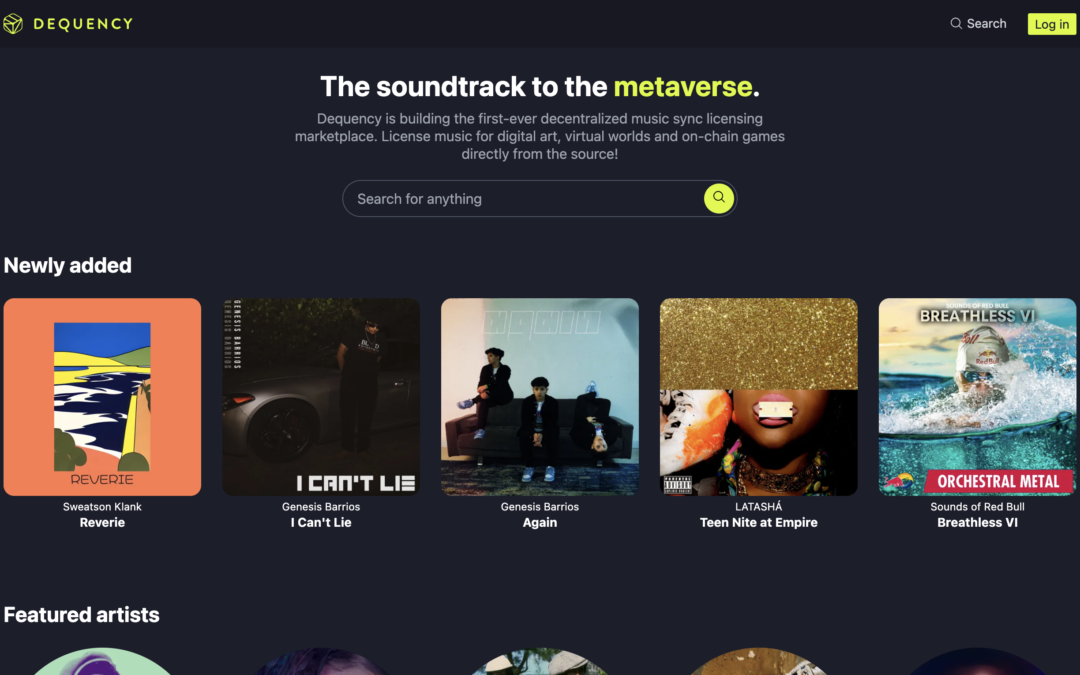
Cyanite Partners With Web3 Music Marketplace Dequency.io

Cyanite Partners With Web3 Music Marketplace Dequency.io

Cyanite’s AI integration in Dequency will enhance discovery on web3 sync licensing platform.

AI-powered music tagging and search firm Cyanite launches Free Text Search which provides users with a completely new and intuitive way of searching for music

Los Angeles/Berlin, April 27, 2023 – Dequency has partnered with AI music tagging and recommendation engine Cyanite, with a view to enhancing discovery on its own decentralized music licensing marketplace.

Launched in 2019, with headquarters in Berlin and Mannheim, Cyanite develops algorithms for music analysis, tagging, search and discovery. The company’s goal is to help clients better understand their repertoire and unlock its full value with artificial intelligence. It has a broad client base across publishing, record labels, production music companies and music tech, with big names including BMG, Nettwerk, UMPG Music Solutions, RTL, Pond5, APM Music and many more.

Built on Algorand, Dequency’s marketplace is the only option for on-chain sync licensing for blockchain-native content such as motion-visual digital art, NFT projects, games, and metaverse productions. Analogous to Bitcoin’s trustless digital payments, Dequency eliminates third parties from music licensing transactions to increase speed of payment, reduce fees, and give control of the system to market participants.

The platform’s v1.0 launch in July last year created a two-sided marketplace, allowing any music rightsholder that owns both the recording and publishing rights of a track to license their music directly without an intermediary in between the transaction. Music rights owners that use the Dequency marketplace are also able to set their own licensing fees, making this a first of its kind proposition for an online sync platform.

This new partnership with Cyanite will make discovering new, original works on the Dequency platform for use in content easier than ever.

Cyanite CEO Markus Schwarzer said: “We are really happy to partner with Dequency as we bring together the strengths of blockchain and artificial intelligence to make original music easier to license in the metaverse. We see huge potential for the music industry to further diversify its revenue streams and are proud to contribute with our algorithms to provide the best possible music search experience.”

Dequency CEO Keatly Haldeman said: “Were excited to bring Cyanites AI-enabled tagging to Dequencys growing library of licensable music. Not only does this mean licensees can find the perfect track for their project, but also it enables them to find those diamond in the rough’ tracks based off of their attributes — giving even more artists the chance to participate in the global market for sync. This is cutting edge technology for easy and accurate song recommendation that will benefit all Dequency users.


About Cyanite

Cyanite helps music companies to turn their catalogues into their own personal Spotify – powering music libraries with the simplicity, visibility, and functionality to perform how they and their users expect them to.

From its offices located in Berlin and Mannheim, Cyanite builds powerful AI-based analysis and recommendation solutions to efficiently tag and search music. This enables music, entertainment and advertising companies to quickly and cost-effectively deliver the right songs for their customers’ search queries.

Cyanite supports some of the most renowned and innovative players in the music and advertising industry via API or no code solutions. Among the music companies using Cyanite are the production music libraries APM Music, Pond5 and Far Music (RTL), the music publishers BMG, Nettwerk Music Group, NEUBAU Music and Schubert Music, and the sound branding agencies amp sound branding, Universal Music Solutions, and Human Worldwide.

Cyanite’s vision is to become the universal intelligence that understands, connects and recommends the world’s music – an intelligence that can translate music into anything and anything into music.

About Dequency

Launched in 2022, Dequency is a web3-powered, decentralised marketplace for on-chain sync licensing, allowing music rightsholders and visual creators to connect, collaborate, and transact directly with one another quickly, efficiently and transparently.

Initially servicing blockchain-native content such as motion-visual digital art, NFT projects, games and metaverse productions, Dequency’s arrival has implications on the broader music licensing space, with its technology enabling unprecedented speed and control around transitions, usage and payment.

Dequency allows any music rightsholder that owns both the recording and publishing rights of a track to license their music directly to a licensee without an intermediary in between the transaction. Music rights owners are also able to set their own licensing fees, making this a first of its kind proposition for an online sync platform.

Website: https://cyanite.ai/

Web App: https://app.cyanite.ai/register

API: https://api-docs.cyanite.ai/

LinkedIn: Cyanite.ai

Twitter: Cyanite.ai
PR: Cyanite launches technology that can find music based on full text for the first time

PR: Cyanite launches technology that can find music based on full text for the first time

PRESS RELEASE

Cyanite launches technology that can find music based on full text for the first time

AI-powered music tagging and search firm Cyanite launches Free Text Search which provides users with a completely new and intuitive way of searching for music

Mannheim/Berlin, January 25, 2023 – Cyanite, a tech company with various software solutions in AI-powered music tagging and search, has launched the first search engine that can instantly translate complex text input into its closest musical equivalent. Similar to image creation services like Dall-E and Midjourney, users can now find matching music by telling the AI exactly what they need – in their own language and unbound to a prefixed set of keywords. 

Now, users can insert a full scene description, a synch briefing or just a hunch about a sound, and Cyanite’s Free Text Search will provide a list of suitable tracks. The search requests may be as complex as “A city lost to time, its buildings half buried by the jungle that has claimed it” or as simple as “Walking down a dusty highway”. 

The technology empowers any user – regardless of their music knowledge – to delve deeper into huge music libraries to discover the perfect music for a specific application such as a movie trailer or YouTube video, vastly reducing the complexity of music search. It also opens up new licensing opportunities for music companies to a far wider range of potential music buyers.  

Markus Schwarzer, CEO, Cyanite, says: “We are seeing a steep increase in audiovisual content creation – both professional as well as user generated. Music rights holders are bombarded with requests from both sides of the professional spectrum, from branding agencies to DIY content creators. They cannot possibly meet all of them in a timely manner with a consistent high quality. With Free Text Search, we provide music companies with a tool that catches the first wave by giving a variety of music choices to broad requests for users to drill down from – or very targeted music recommendations to specific requests.” 

Joey Goldberger, Sync Manager at Canadian music publishing group Nettwerk agrees: “We’ve been lucky to get early access to Cyanite’s new Free Text Search and in this short period of time, songs which we found through this super intuitive system have already gotten licensing requests and one successful sale. We are big fans.“

Free Text Search may be applied to choosing music for a wealth of scenarios, from library music, gaming, film, sonic branding and advertising, to new developments in areas such as the metaverse and Point of Sale (POS) and takes a step closer towards the company’s goal of creating a universal intelligence that understands, indexes and recommends the world’s music. 

Markus Schwarzer: “There is a lot of interest in AI-generated music, mainly because of its applicability for specific use cases like concentration, sleep, and so on. We believe this is partly down to music discovery for human-created music being too one-dimensional. With Free Text Search, we aim to put the spotlight back on human-created music, by applying the cutting edge of artificial intelligence to music catalogues.”

Jeroen Vreugdenhil is Managing Director of Brilliant Classics, a music label working with original classical recordings. He adds: “It’s a huge challenge to set up a new YouTube channel with playlists for specific activities and situations like studying, sleeping, and relaxing with 100,000 songs from our catalogue, which consists entirely of classical music. For that, we seamlessly integrated Cyanite’s new Free Text Search into our workflows and I can already say that it’s never been easier to search for suitable music. It empowers my team to tap into the very deep layers of our repertoire and realise its full potential.“

Next to Brilliant Classics and Nettwerk Music Group, music agency Marmoset Music, and independent production music library MediaTracks are using Free Text Search. At the same time, many of Cyanite’s global customers are evaluating integration with their existing libraries.

William Saunders, Director Media & Creative at MediaTracks, says: “Our team was blown away by Cyanite’s new Free Text Search as it offers an intuitive and easy way to start a music search by simply typing in what you are looking for. We will deeply integrate it into our workflows to faster and better answer our clients’ requests for music.“

Cyanite’s Free Text Search is based on the latest Transformer technology, which is also used for current image generators or ChatGPT, for example. Cyanite fed its transformer technology with complex musical descriptions e.g. from music reviews, to teach the AI to understand any kind of written text input. This input is then translated into suitable music. The decisive advantage of such a model is the fact that it learns free text instead of discrete classes, which allows semantic relationships to be recognized.

Anyone who wants to try out Free Text Search with a showcase database of Spotify, can register for free here for Cyanite’s Web App and access the search via this link.

ENDS


About Cyanite

Cyanite helps music companies to turn their catalogues into their own personal Spotify – powering music libraries with the simplicity, visibility, and functionality to perform how they and their users expect them to. 

From its offices located in Berlin and Mannheim, Cyanite builds powerful AI-based analysis and recommendation solutions to efficiently tag and search music. This enables music, entertainment and advertising companies to quickly and cost-effectively deliver the right songs for their customers’ search queries.

Cyanite supports some of the most renowned and innovative players in the music and advertising industry via API or no code solutions. Among the music companies using Cyanite are the production music libraries APM Music, Pond5 and Far Music (RTL), the music publishers BMG, Nettwerk Music Group, NEUBAU Music and Schubert Music, and the sound branding agencies amp sound branding, Universal Music Solutions, and Human Worldwide.

Cyanite’s vision is to become the universal intelligence that understands, connects and recommends the world’s music – an intelligence that can translate music into anything and anything into music.


Website: https://cyanite.ai/

Web App: https://app.cyanite.ai/register

API: https://api-docs.cyanite.ai/

LinkedIn: Cyanite.ai

Twitter: Cyanite.ai
You are currently viewing a placeholder content from Default. To access the actual content, click the button below. Please note that doing so will share data with third-party providers.

More Information
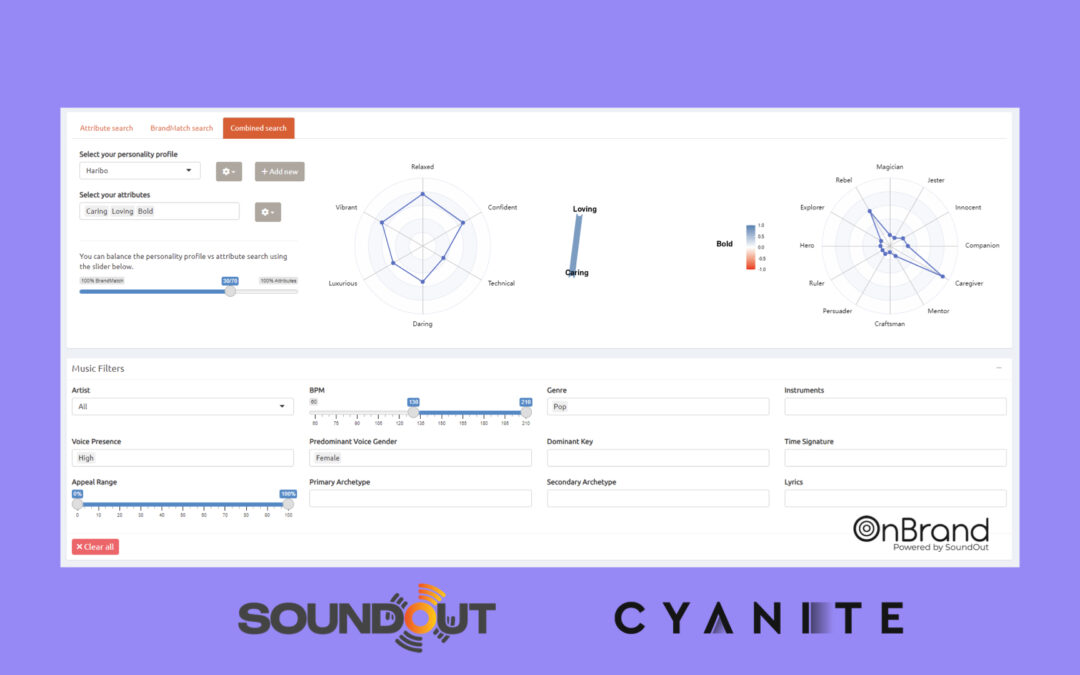
SoundOut launches OnBrand in cooperation with Cyanite

SoundOut launches OnBrand in cooperation with Cyanite

We are proud to share the latest press release by UK-based company SoundOut which is the world leader in sonic testing for audio branding.

In the announcement below, read about the new OnBrand platform developed by SoundOut and powered by the AI of Cyanite and how it empowers marketers to build certainty into every music choice for campaign.


Campaign music search for brands and agencies

October 26th, 2022, London: SoundOut launches OnBrand, an entirely new approach to music search that revolutionises the process of selecting music for marketing campaigns.

Hugely scalable AI-powered music search platform removes uncertainty from every brand campaign music decision

• OnBrand ensures music choices always match brand personality and campaign goals
• Increases certainty of ROI from music choices
• Launch partners include Unilever, Scholz & Friends (WPP) and Global Radio
• Combines leading SoundOut brand personality technologies with the scalability of German music AI company Cyanite to transform commercial music selection

SoundOut, the world leader in sonic testing, has launched a revolutionary AI-powered music search and testing SaaS platform named OnBrand. It enables marketers to build certainty into every music choice for campaigns. OnBrand is powered by AI algorithms that predict the granular emotional impact of music, trained on feedback from half a million people.

OnBrand enables marketers to search across any number of music catalogues to identify campaign music that is both on-brand and campaign appropriate, using a combination of over 200 brand attributes, plus self-defined brand personality and brand archetypes. In this way, OnBrand delivers greater certainty of immediate impact and sustained ROI from their campaigns, by reducing subjectivity and risk from music selection.

Global companies Unilever, Global, the Media & Entertainment Group, and Scholz & Friends – part of the WPP Network – are among the first users of the OnBrand platform.

Stephanie Bau, Global Assistant Brand Manager at Unilever, said: “With the growth of social media platforms like TikTok, sound has become the ultimate tool in a marketer’s arsenal. Choosing the right sound for our future campaigns has never been more important and this technology will enable brands to amplify their personality and have greater certainty of ROI from campaigns during these economically challenging times.

Julian Krohn, Director Music & Audio, Scholz & Friends (WPP), said: “From an agency perspective, OnBrand is a uniquely powerful tool that will enable us to add significant value to our clients’ campaigns. Ensuring that music is both brand and campaign appropriate has never been easier – and OnBrand can only increase their return on marketing investment. We’re looking forward to working closely with the tool!

Powered by a unique double-stacked AI layer of algorithms trained entirely on human derived data, OnBrand first automatically tags music with up to 500 separate attributes thanks to a partnership with Cyanite, the world-leading AI music tagging company. Then it uses a further AI layer to map these tags to SoundOut’s emotional DNA map of music, created with the input of over 500,000 consumer surveys and over 12 million datapoints.

Jo McCrostie, Creative Director at Global Radio, Europe’s largest commercial radio group, commented: “OnBrand represents a truly seismic revolution in how companies find brand appropriate music for commercial use. A previous lack of objectivity in music choices has restricted investment in audio marketing such as radio ads. I’ve seen for myself the positive reaction from brands to the new platform and it looks set to be transformational for the audio advertising industry.

OnBrand can automatically rate any track against over 200 emotional attributes in a fraction of the time taken by people. It enables catalogues of millions of tracks to be emotionally indexed in under 24 hours with over 95% precision compared to human indexation.

David Courtier-Dutton, CEO of SoundOut, said: “Until now, choosing music for marketing has been a largely subjective exercise, with little in the way of objective metrics to confirm brand fit and emotional resonance. At a stroke, OnBrand introduces an objective, hugely scalable solution for brands worldwide. It enables data-informed music choices and provides robust cost/benefit analysis for any commercial music investment. OnBrand is not only totally brand-centric but it speaks brand language; enabling brands to enhance campaign performance whilst simultaneously strengthening their emotional bonds with consumers.

Markus Schwarzer, CEO of Cyanite, added: “AI music tagging technology has advanced significantly over the past few years and has now been adopted by many of the world’s leading music and entertainment companies. The additional AI brand centric layer that OnBrand delivers truly democratises catalogue search for brands, enabling them to find the perfect track for any campaign using brand language rather than musical attributes.


About SoundOut

SoundOut is the world leader in strategic sonic branding and audio marketing testing. It has achieved this lead position by combining three powerful capabilities.

  • Working with world leading music psychologists and over 500,000 consumers, it has mapped the explicit emotional DNA of sound and used this as the foundation for a suite of tools, such as BrandMatch, that can be used at various stages of sonic branding development to increase the certainty of a return on investment.

  • The development of a wholly owned consumer panel of over 3.5 million people, which enables brands to test their sonic assets at scale.

  • The testing and analysis of almost 200 in market sonic logos with over 400,000 consumers (The SoundOut Index) that reveals the key criteria that are essential to audio branding and audio marketing success.

SoundOut works with many of the most iconic brands in the world (such as TikTok, Amazon, Toyota, DHL, Ford, Unilever and GSK) as well as all the major record labels and many leading radio groups. SoundOut specialises in helping organisations trigger the right emotional response from their customers by matching brand personality and attributes to music. As a result, SoundOut provides the data and insight needed by clients to increase the certainty of achieving a strong ROI from their audio branding and marketing investments.

Clients use SoundOut’s unrivalled strategic sonic testing capabilities to identify the effectiveness potential of new sonic identities before they are launched and ensure that they resonate with the core brand personality.

OnBrand now scales these capabilities to all use of music in brand marketing, enabling brands to index huge music catalogues and search them based on the personality, attributes or archetype of their brand.

AI Panel: Using AI Music Search in a Co-Creative Approach between Human and Machine

AI Panel: Using AI Music Search in a Co-Creative Approach between Human and Machine

In September 2022, Cyanite co-founder, Markus took part in a panel discussion at Production Music Conference 2022 in Los Angeles.

The panel topic was to discuss the role of AI in a co-creative approach between humans and machines. The panel participants included Bruce Anderson (APM Music), Markus Schwarzer (Cyanite), Nick Venti (PlusMusic), Philippe Guillaud (MatchTune), and Einar M. Helde (AIMS API)

The panel raised pressing discussion points on the future of AI so we decided to publish our takeaways here. To watch the full video of the panel, scroll down to the middle of the article. Enjoy the read! 

Human-Machine Co-creativity

AI performs many tasks that are usually difficult for people, such as analyzing song data, extracting information, searching music, and creating completely new tracks. As AI usage increases, questions of AI’s potential and its ability to create with humans or create on their own have been raised. The possibility of AI replacing humans is, perhaps, one of the most contradicting topics. 

The PMC 2022 panel focused on the topic of co-creativity. Some AI can create on their own, but co-creativity represents creativity between the human and the machine.

So it is not the sum of individual creativity, rather it is the emergence of various new forms of interactions between humans and machines. To find out all the different ways AI music search can be co-creative, let’s dive into the main takeaways from the panel:

Music industry challenges

The main music industry challenge that all participants agreed on was the overwhelming amount of music produced these days. Another challenge is reaching a shared understanding of music.

The way someone searches for music depends on their understanding of music which can widely differ and their role in the music industry. Music supervisors, for example, use a different language to search for music than film producers.

We talked about it in detail at Synchtank blog back in May 2022. AI can solve these issues, especially with the new developments in the field.

Audience Question from Adam Taylor, APM Music: Where do we see AI going in the next 5 years?

So what’s in store for music AI in the next 5 years? We’re entering a post-tagging era marked by the combination of developments in music search. Keyword search will no longer be the main way to search for or index music. Instead, the following developments will take place: 


  • Similarity Search has shown that we can use complex inputs to find music. Similarity search pulls a list of songs that match a reference track. It is projected to be the primary way of searching for music in the future. 


  • Free Searches – Search in full-text that allows searching for music in your own words based on natural language processing technologies. With a Free Search, you enter what comes to mind into a search bar and the AI suggests a song. This is a technology similar to DALL-E or Midjourney that returns an image based on text input.


  • Music service that already knows what to do – in a further perspective, music services will emerge that recommend music depending on where you are in your role or personal development. These services will cater to all levels of search: from an amateur level that simply gives you a requested song to expert searches following an elaborate sync brief including images and videos that accompany the brief or even a stream of consciousness.

Audience Question from Alan Lazar, Luminary Scores: Can I decode which songs have the potential to be a hit?

While some AI companies attempted to decode the hit potential of music, it is still unclear if there is any way to determine whether the song becomes a hit.

The nature of pop culture and the many factors that compile a hit from songwriting to production and elusive factors such as what is the song connected make it impossible to predict whether or not a song becomes a hit. 

The vision for AI from Cyanite – where would we like to see it in the future?

AI curation in music is developing at a lightning speed. We’re hoping that it will make music space more exciting and diverse, which includes in particular: 


  • Democratization and diversity of the field – more opportunities will become available for musicians and creators, including democratized access to sync opportunities and other ways to make a livelihood from music. 


  • Creativity and surprising experiences – right now AI is designed to do the same tasks at a rapid speed. We’re hoping AI will be able to perform tasks co-creatively and produce surprising experiences based on music but also other factors. As music has the ability to touch directly into people’s emotions, it has the potential to be a part of a greater narrative.

You are currently viewing a placeholder content from Default. To access the actual content, click the button below. Please note that doing so will share data with third-party providers.

More Information

Video from the PMC 2022 panel: Using AI Music Search In A Co-Creative Approach Between Human and Machine

Bonus takeaway: Co-creativity between users and tech – supplying music data to technology

It seems that we should be able to pull all sorts of music data from the environments such as video games and user-generated content. However, the diversity of music projects is quite astonishing.

So when it comes to co-creativity from the side of enhancement of machine tagging with human tagging, personalization can be harmful to B2B. In B2B, AI mainly works with audio features without the involvement of user-generated data.

Conclusion

To sum up, AI can co-create with humans and solve the challenges facing the music industry today. There is a lot in store for AI’s future development and there is a lot of potential.

Still, AI is far away from replacing humans and should not replace them completely. Instead, it will improve in ways that will make music searches more intuitive and co-creative responding to human input in the form of a text search, image, or video. 

As usual with AI, some people overestimate what it can do. Some tasks such as identifying music’s hit potential remain unthinkable for AI.

On the other hand, it’s not hard to envision the future where AI can help democratize access to opportunities for musicians and produce surprising projects where music will be a part of a shared emotional experience.

We hope you enjoyed this read and learned more about AI co-creativity and the future of AI music search. If you’re interested to learn more, you can also check out the article “The 4 Applications of AI in the Music Industry”. If you have any feedback, questions, or contributions, please reach out to markus@cyanite.ai.

I want to integrate AI search into my library – how can I get started?

Please contact us with any questions about our Cyanite AI via mail@cyanite.ai. You can also directly book a web session with Cyanite co-founder Markus here.

If you want to get the first grip on Cyanite’s technology, you can also register for our free web app to analyze music and try similarity searches without any coding needed.

PR: Cyanite signs up BMG to use AI tagging across entire catalog

PR: Cyanite signs up BMG to use AI tagging across entire catalog

PRESS RELEASE

Cyanite signs up BMG to use AI tagging across entire catalog

AI-powered music tagging and search firm Cyanite will categorise BMG’s catalog of three million tracks to unlock new value for Synch

Mannheim/Berlin, September 27, 2022 – Cyanite, a tech company with various solutions in AI-powered music tagging and search, has signed a global deal with music giant BMG to unlock new value from its three-million-track catalogue.

Bertelsmann-owned BMG, the world’s largest music company outside the three ‘majors’, has appointed Cyanite with the aim of making its entire repertoire more searchable and accessible for Synch – i.e. placing music in movies and advertising. Cyanite’s automatic tagging will support BMG’s internal and external creatives to identify “hidden gems” in the search for the perfect song for film, TV, games and advertising usages. Before deciding on Cyanite, BMG tested all available technologies extensively.

BMG’s catalogue has grown exponentially through acquisitions and organic growth since its formation in 2008. Cyanite’s tech will allow BMG to easily integrate newly acquired catalogues such as that of Telamo, the largest independent record label in Germany. 

Cyanite’s technology is being integrated into BMG’s internal content management system BMG Songs, the market-leading repertoire, creative and licensing platform used by BMG’s synch teams around the world. BMG’s tagging team can now focus their efforts away from manual tagging, while the company gets on with exploiting its entire catalogue.

The BMG development team is currently overseeing the integration of Cyanite’s Application Programming Interface (API), which will enable employees to leverage Cyanite’s creative metadata. Once integrated, BMG’s repertoire will be processed by Cyanite’s AI technology and the results delivered back via the API to BMG’s software. 

BMG VP Group Technology Gaurav Mittal said, “BMG is committed to using AI technologies to optimize our revenues so we can speed the flow of royalties to artists and songwriters. We are delighted to be working with Cyanite to enhance our Synch services.”

BMG SVP Global Synch Licensing Allegra Willis Knerr said: “In a world in which there are literally tens of millions of tracks available to Synch, AI offers the ability to simultaneously improve the accuracy of pitches and level the playing field for artists and songwriters. AIready, wherever the brief allows it, BMG has abandoned the distinction between ‘frontline’ and ‘catalogue’. Our objective with Cyanite is to maximise the chances for every single song in our repertoire to be licensed.”

Markus Schwarzer, CEO, Cyanite, said: “We are very proud to announce this deal with BMG, a company which shares our vision of a universal intelligence that understands, indexes and recommends the world’s music. Working together, BMG and Cyanite will uncover the potential of every single track in the catalogue.”

The news comes after Cyanite announced in August that it has closed an €800,000 seed investment round to further expand its AI-based solution for the music industry. This investment was led by former finetunes founders Oke Göttlich and Henning Thieß. The goal is to sustain the company’s vision of universal music intelligence to revolutionise how music is selected in entertainment and advertising.

BMG is the second division of Bertelsmann to sign a deal with Cyanite, following RTL Group, the Luxembourg-based international media conglomerate.

About Cyanite

Cyanite helps music companies to turn their catalogues into their own personal Spotify – powering music libraries with the simplicity, visibility, and functionality to perform how they and their users expect them to. 

From its offices located in Berlin and Mannheim, Cyanite builds powerful AI-based analysis and recommendation solutions to efficiently tag and search music. This enables music, entertainment and advertising companies to quickly and cost-effectively deliver the right songs for their customers’ search queries.

Cyanite supports some of the most renowned and innovative players in the music and advertising industry via API or no code solutions. Among the music companies using Cyanite are the production music libraries APM Music and Far Music (RTL), the radio station SWR, the music publishers Nettwerk, NEUBAU Music and Schubert Music, and the sound branding agencies amp sound branding, Universal Music Solutions, and Human Worldwide.

Cyanite’s vision is to become the universal intelligence that understands, connects and recommends the world’s music – an intelligence that can translate music into anything and anything into music.

About BMG

BMG – est. 2008 – is the world’s fourth-biggest music company, the first new global player in the music business of the streaming age, and a record label and music publisher in one. Named in 2020 one of the world’s Most Innovative Companies by Fast Company, BMG’s pitch is unique – a relentless focus on fairness and transparency and service to its artist and songwriter clients. BMG’s 21 offices across 12 core music markets now represent over three million songs and recordings, including many of the most renowned and successful catalogs in popular music history. BMG’s fresh approach includes production music, films, books, artist management, merchandise, neighboring rights, and live as well as music publishing and recordings off the same service platform. BMG is owned by international media, services and education company Bertelsmann, whose other content businesses include the entertainment company RTL Group and the trade book publisher Penguin Random House. With its multi-platform perspective, integrated technology platform and commitment to help artists maximize their income, BMG aims to be the best company in music to do business with. www.bmg.com 

Website: https://cyanite.ai/

Web App: https://app.cyanite.ai/register

API: https://api-docs.cyanite.ai/

LinkedIn: Cyanite.ai

Twitter: Cyanite.ai