
PR: Cyanite announces new investors to support vision of universal music translation

PR: Cyanite announces new investors to support vision of universal music translation

PRESS RELEASE

Cyanite announces new investors to support vision of universal music translation

New investment round fuels Cyanite’s goal to develop universal intelligence that understands, connects, and recommends the world’s music

Berlin, July 27, 2022 – Cyanite, a tech company with various solutions in AI-powered music tagging and search, has closed an investment round with leading entrepreneurs from the music and technology industries. The goal is to sustain the company’s vision of universal music translation. 

The investment round was led by former finetunes founders Oke Göttlich and Henning Thieß. Other experienced music and tech experts, such as Michael Shmilov (former COO of Viber), Patrick Joest (former EVP Global Content Partnerships & Sync at BMG), as well as Lars Ettrup (CEO and co-founder of Linkfire) support the round with their deep market expertise. 

In addition, family office Lioncorn Capital and other tech business angels (Daniel Kondermann, Oliver Lesche, Andrea Kranzer, Edmund Ahrend) invested in this round. The round builds on earlier investments in which BWM GmbH also participated.

The investors support Cyanite’s vision to provide the entertainment and advertising industries with an AI-powered universal music translation engine capable of finding the objectively appropriate music for any desired emotional target. 

The news follows considerable consolidation in the AI-powered music tagging and search market, as many competitors such as Musiio, Musimap and Musicube have been acquired by larger companies in 2021 and 2022.

Cyanite was launched in 2019 with the purpose of connecting everyone with the right music at the right time. The AI is used by different leading music rights holders, music tech companies and brand agencies to gain deeper insights and understanding about individual songs. Cyanite makes it easy for them to take control of their repertoire by offering intuitive AI solutions that provide better ways to sort, search, and match songs.

Markus Schwarzer, CEO, Cyanite, said: “The investment demonstrates the excitement in the worlds of music and technology about our objective of making it possible for any input – be it keywords, sounds, free text, or images – to be understood by AI and translated into music.

“Our investors recognise that we are closing in on our goal, and that trust shows us that we are in the right place at the right time. At this time when competing companies are being bought out, we’re excited to continue our journey towards creating a universal intelligence that understands, indexes and recommends the world’s music.”

Investment round leader Oke Göttlich, former finetunes founder, said: “I am excited to be playing a part in the future of Cyanite. They have the right team and a powerful plan for the future of music recommendation, one that has the potential to transform the way that music’s emotional power is understood, quantified and monetised.


About Cyanite

Cyanite helps music companies to turn their catalogues into their own personal Spotify – powering music libraries with the simplicity, visibility, and functionality to perform how they and their users expect them to. 

From its main office located in Berlin, Cyanite builds powerful AI-based analysis and recommendation solutions that enable effective tagging and music search to improve the ability of music, entertainment, and advertising companies to deliver the right songs for the right search.

Cyanite helps companies to unlock the full potential of their music catalogues to leverage their full depth at a time when more music is accessible than ever before. Their goal is to let everybody find the right music for any use case – and the right use case for any song.

Cyanite supports some of the most renowned and innovative players in the music and advertising industry. Among the music companies using Cyanite are the production music libraries APM Music and Far Music (RTL), the radio station SWR, the music publishers Nettwerk, NEUBAU Music and Schubert Music, and the sound branding agencies amp sound branding, Universal Music Solutions, and Human Worldwide.

Cyanite’s vision is to become the universal intelligence that understands, connects and recommends the world’s music – an intelligence that can translate music into anything and anything into music.

Website: https://cyanite.ai/

Web App: https://app.cyanite.ai/register

API: https://api-docs.cyanite.ai/

LinkedIn: Cyanite.ai

Twitter: Cyanite.ai

How to Create Mood- and Contextual Playlists With Dynamic Keyword Search

How to Create Mood- and Contextual Playlists With Dynamic Keyword Search

In the last article on the blog, we covered how Cyanite’s Similarity Search can be used in music catalogs. In this article, we explore another way to search for songs using Dynamic Keyword Search and how to leverage it to create mood- and contextual-based playlists. 

Rather than relying on a reference track, Dynamic Keyword Search allows you to select and combine from a list of 1,500 keywords and adjust the impact of these keywords on the search. This is especially helpful to create playlists where songs match in mood, activity, or other characteristics. 

But before we explain how this feature works, let’s explore how playlists are created. What makes a perfect playlist? Why are playlists so essential when utilizing a music catalog? And how can the Dynamic Keyword Search help with that?

How are playlists created?

There are three techniques for playlist creation:

  1. Manual creation (individually picking songs) 
  2. Automatic generation and recommendation 
  3. Assisted playlist creation. 

Historically, manual creation has been the most basic and old approach. It involves picking songs individually for playlists. It might be the simplest technique but the amount of time and effort that goes into it can be overwhelming. Imagine you are working 100,000 audios in a catalog and have to create an “Energetic Workout” and “Beach Party” playlist. 

Automatic generation uses various algorithms to create playlists with no human intervention. One of the most famous ones is, for example, “Discover Weekly” by Spotify. 

Assisted playlist creation uses music technology to guide and support manual playlist creation. 

In the research by Dias, Goncalves, and Fonseca, manual playlist creation was found to be most effective in terms of control, engagement, and trustiness. This means that people trust handmade playlists. Also, manual creation provides the most amount of control over the outcome and it engages editors in the creation process. 

Automatic creation was found to be the most effective in adapting to the listeners’ needs. There is no manual control involved, so automatic tools can adapt and change playlists in no time. 

Assisted techniques were found to be most effective in terms of engagement and trustiness whilst being quick to create. They also performed well on the song selection criteria. Song selection has been defined as the most critical factor in the playlist creation process according to this study. However, while song selection is considered very important, the question of what makes a song right for the particular playlist is still open. Apart from that, assisted techniques proved to be optimal in control, and serendipity and they also can adapt to listening preferences rather easily. 

To anticipate things already: The Dynamic Keyword Search is exactly such an assisted technique in playlist creation.

Why are search tools for playlist creation important in a catalog?

Playlists have been known to be the ultimate tool for promoting music. We already covered the ways artists can get on Spotify and other people’s playlists in other articles on the blog. But creating playlists can also be beneficial for catalog owners and catalog users, be it professional musicians or labels. Here is why: 

  • You can realize new and passive modes to exploit and monetize your catalog. If you make it easier for your users and/or customers to explore your catalog, you directly increase its value.
  • Playlists are used as a promotional tool to showcase the works of an artist or the inspirations behind the artist. This article recommends creating two playlists: a vibe playlist and a catalog playlist for brand engagement and streams. 
  • Playlists help organize music by theme or context
  • With playlist creation features, users save time on finding the right fitting songs
  • Playlists can be indexed separately in search results. This helps music get discovered. 

So playlist creation tools in a catalog are pretty important. Similarity Search is one of these tools. Another one, which we focus on in this article is Dynamic Keyword Search.

How does Dynamic Keyword Search Work?

Cyanite’s Dynamic Keyword Search allows for searching tracks based on multiple keywords simultaneously where each keyword can be weighted for its impact on the search. This feature leads to more relevant search results with less time-effort spent on search.

Usually, the keywords you choose represent your idea of what you’re searching for. But you don’t have full control over the search. With Dynamic Keyword Search, you can increase the precision of the search results by adjusting the impact of the keywords on the search. So you can express exactly what you’re looking for. There are 1,500 keywords to choose from representing such characteristics of the song as mood, genre, situation, brand values, and style. These keywords’ impact on search can then be adjusted on the scale from -1 to 1 from no impact at all to “heavy impact”.

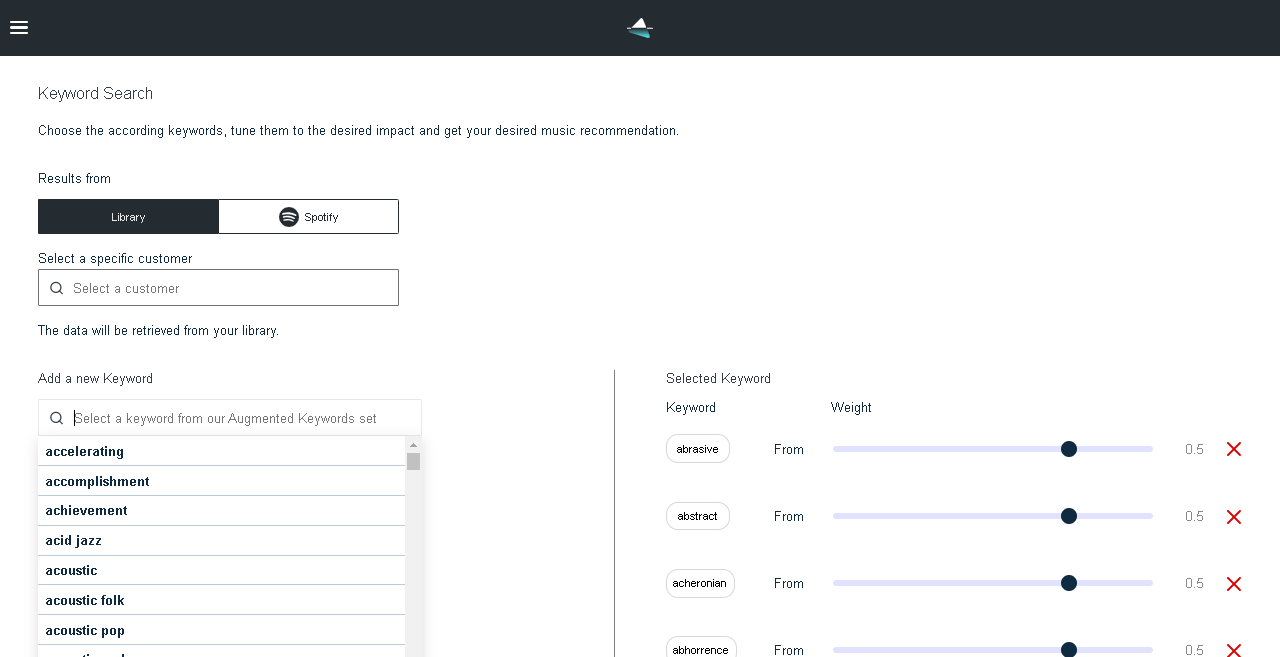
Cyanite Dynamic Keyword Search interface

What playlist features can be improved with Dynamic Keyword Search?

Not all playlists are created equal. Some are better than others. This study outlines 5 characteristics of playlists that can indicate a good or bad playlist. The authors of the study assumed that user-generated playlists could be an indicator for the algorithms to create good playlists. Here are the 5 playlist characteristics they outlined: 

  • Popularity – most user-generated playlists feature popular tracks first. This, however, is not too obvious though but grabbing the attention spans of the listeners from the start is important. 
  • Freshness – playlists should contain recently released tracks. Most playlists in the study contain tracks released on average in the last 5 years.
  • Homogeneity and diversity –  playlists on average cover a very limited number of genres so playlists should be rather homogenous. However, diversity plays a significant part in listeners’ satisfaction so it should be incorporated into the playlist as well.
  • Musical Features – in terms of energy, playlists with a narrow energy spectrum with a low average energy level are preferred, but there can be some high-energy tracks in the list. 
  • Transition and Coherence – the similarity between the tracks defines the smoothness in transition and coherence of the playlist. Usually, user-generated playlists have a better similarity in the first half and a lesser similarity in the second half. 

As the study deals with a variety of user-generated playlists, it can’t be said that all of them were equally good playlists. But the criteria outlined above can help improve playlists by understanding the character of the playlist. With Dynamic Keyword Search, you can control such criteria as homogeneity and diversity, musical features such as energy level, and similarity between the tracks to ensure transition and coherence

PRO TIP: To improve a playlist’s transition and coherence you can combine the Dynamic Keyword Search with our Similarity Search to further filter music on Camelot Wheel. The Camelot Wheel indicates which songs transition harmonically well giving you an extremely powerful tool to perfect the song order. You can find a deeper explanation of that in this article.

Creating Playlists with Dynamic Keyword Search – Step-by-step

Here is how to access Dynamic Keyword Search in the Cyanite app. This feature is also available through our API

  1. Go to Search in the menu and select the Keyword Search tab. Choose whether to display results from the Library or Spotify. 
  2. Select keywords from the Augmented Keywords set. For example, these are some of the keywords in the list: joy, travel, summer, motivating, pleasant, happy, energetic, electro, bliss, gladness, auspicious, pleasure, forceful, determined, confident, positive, optimistic, agile, animated, journey, party, driving, kicking, impelling, upbeat. We recommend selecting up to 7 keywords out of 1,500. 
  3. Adjust the weights for each keyword from 1 to -1 to define their impact on search. For example, let’s set  the search input as sparkling: 0.5, sad: -1, rock: 1, dreamy: 1 
  4. Scroll down for search results. The search results will return tracks from the library that are dreamy, slightly sparkling, and not at all sad. They will also all be rock songs.

Dynamic Keyword Search can be requested from our support team.

Conclusion

There are various ways to create playlists from manual creation to automatic and assisted techniques. An assisted approach that combines automatic and manual creation has proved to be the most effective in playlist creation. It meets almost all the editors’ needs such as providing control over the process, maintaining a high level of engagement and trustworthiness, and offering a good selection of songs. However, the automatic approach is fast developing and algorithms might substitute human work completely in the future. 

Our Dynamic Keyword Search feature can help you create playlists as one of the assisted techniques. It can provide search results that take into account the search intent  in terms of keywords and the impact of those keywords on search. This doesn’t mean that Dynamic Keyword Search replaces the manual work completely, but it can help artists, labels, and catalog owners do the creative work and engage fans and listeners with the support of the right tools to save time, money, and effort. This is what we’re striving to achieve here at Cyanite – to help you fully unlock your catalog’s potential.

Let us know if this article has been helpful and stay tuned for more on the Cyanite blog! 

I want to try Dynamic Keyword Search – how can I get started?

Please contact us with any questions about our Cyanite AI via mail@cyanite.ai. You can also directly book a web session with Cyanite co-founder Markus here.

If you want to get the first grip on Cyanite’s technology, you can also register for our free web app to analyze music and try similarity searches without any coding needed.

Jazzahead! 2022 Video: How AI Unlocks New Opportunities for Music featuring Jay Ahern from Cyanite

Jazzahead! 2022 Video: How AI Unlocks New Opportunities for Music featuring Jay Ahern from Cyanite

jazzahead! is a professional jazz industry event and a place to listen to contemporary jazz music that takes place every year in Bremen. This is where all the participants of the jazz music scene from professional musicians to media representatives meet and take part in the trade fair and a festival.

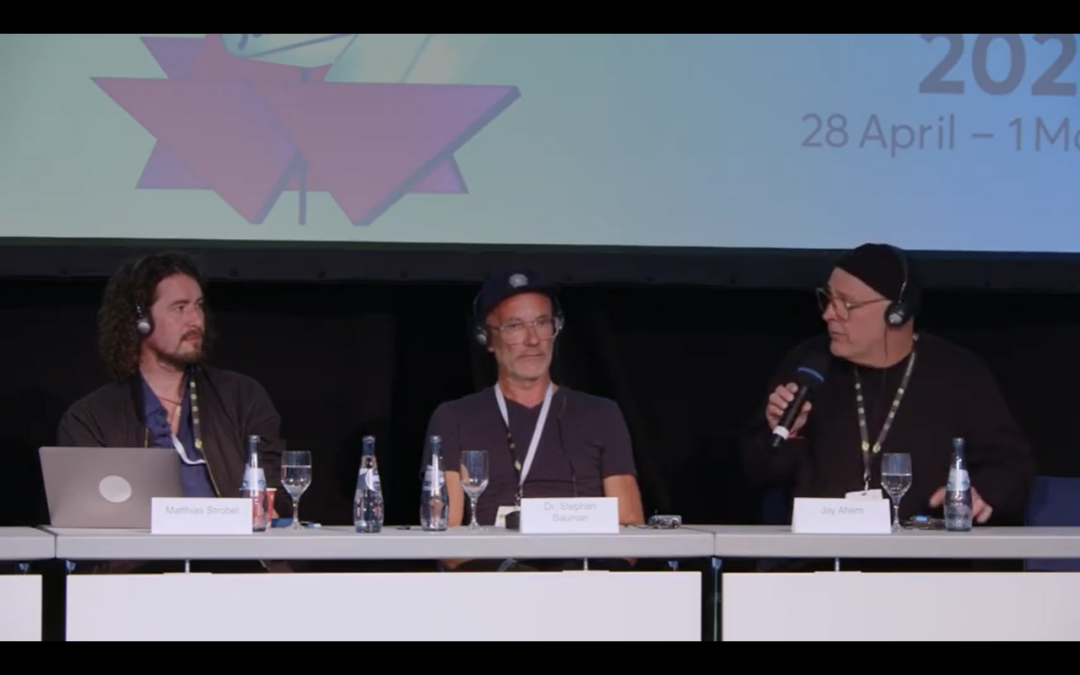
This year, jazzahead! introduced the first-ever AI panel into its program. On April 30th, 2022, our Director of Music Industry Relations, Jay Ahern, joined the “How AI unlocks new opportunities for music” panel to discuss the rise of Artificial Intelligence in the music industry and AI music projects alongside Dr. Stephan Bauman, Benoit Carré, and Celine Garcia.

You are currently viewing a placeholder content from Default. To access the actual content, click the button below. Please note that doing so will share data with third-party providers.

More Information

The conversation revolved around the present uses and future developments of AI in music. AI was discussed as a tool to help artists, labels, and publishers advance in their fields rather than replace humans. The panel participants looked into the advantages of AI for music businesses such as metadata generation, advanced music searches such as the search by emotions or character, increased understanding of the back catalogs, and streamlining of the time-consuming processes.

The current threats to the industry such as the overflow of musical content (user-generated content) were also thoroughly explored bringing forward the AI’s ability to handle unlimited amounts of data and analyze hundreds of songs at once.

To see the highlights from the fascinating jazzahead! panel discussion featuring Jay Ahern watch the video above or on Youtube.

Also, see our recently updated article on emerging technology in the music industry where we discuss opportunities for music companies to advance their offerings and monetize their catalogs with the help of AI and other technologies.

We are grateful to have been invited to Jazzahead! 2022 by MusicTech Germany.

Further participants of the panel included:

• Dr. Stephan Baumann, Senior Researcher @ DfKI 

• Benoit Carré, Musician ‘Skygge

• Celine Garcia Publisher and Innovative Project Manager @ Puppet Master

I want to integrate AI in my service as well – how can I get started?

Please contact us with any questions about our Cyanite AI via sales@cyanite.ai. You can also directly book a web session with Cyanite co-founder Markus here.

If you want to get the first grip on Cyanite’s technology, you can also register for our free web app to analyze music and try similarity searches without any coding needed.

AI looks into the Sound of Iconic Fabric Club Compilations

AI looks into the Sound of Iconic Fabric Club Compilations

One year ago, we analyzed the sound of 9 iconic German clubs and tried to uncover representative elements behind the musical curation of each club using Cyanite’s music analysis algorithms.

Today we ask ourselves if our AI can shed light on how electronic music has evolved over the last 20 years. Which club would be better suited for this than London’s Fabric? Its legendary club compilations hand-picked by popular and emerging DJs boast almost 20 years of history.

We look into all the main characteristics of Fabric compilations such as genre, mood, and energy level to show how the sound of the club progressed over the years.

Our Methodology
Fabric compilations feature two series – fabric and Fabriclive. Friday nights at the club are known as Fabriclive. These albums feature such artists as James Lavelle, Tayo Popoola, and Daniel Avery. The live element of Fabriclive nights doesn’t mean they were recorded live. Saturday nights bear the name of fabric. Fabric albums feature such artists as Craig Richards, Omar-S, Shackleton, and many more.

Although the two series are clearly different from each other, we will try to find out if our AI can find common elements that could be characteristic and representative of Fabric’s sound and its development over time.

Our approach was to narrow the analysis down to the most favorite Fabric compilations. For this, we used the best-of lists from media outlets such as DJ Mag, Mixmag, and the Fabric team itself. In total, we selected 25 compilations and limited the analysis to them. You can find the full list at the end of the article.  

Our findings include: 

  • fabric series progressed from house to techno
  • Fabriclive exhibits a strong tendency toward breakbeat/drum and bass
  • Fabriclive series has more albums with uplifting vibes than fabric
  • fabric’s sound is robotic and bouncy and Fabriclive is pulsing and driving
  • Common elements of fabric and Fabriclive compilations are high energy and a cool character.

And many more interesting insights, so keep reading to find them out.

Genre and Sub-genre

fabric compilations are dedicated to electronic dance as the main genre. Fabriclive is more diverse in its genre featuring electronic dance and other sub-genres such as funk-soul, rap/hip hop, and rock.

The sub-genre feature in Cyanite provides 48 sub-genres from abstract IDM / leftfield to trap. The Drill and Grime popular within the UK scene are likely to be classified as trap.

Each sug-genre has a score from 0-1 where 0 indicates that the track is unlikely – 0% – to represent the sub-genre, and 1 indicates that the track by 100% represents the given sub-genre. 

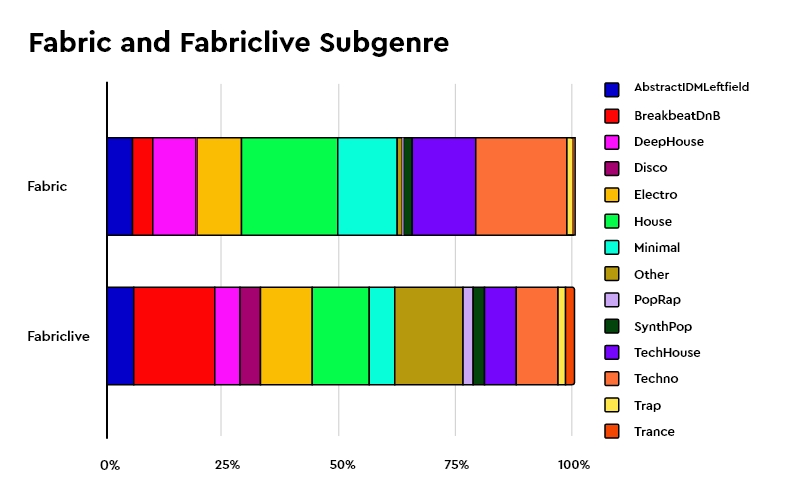
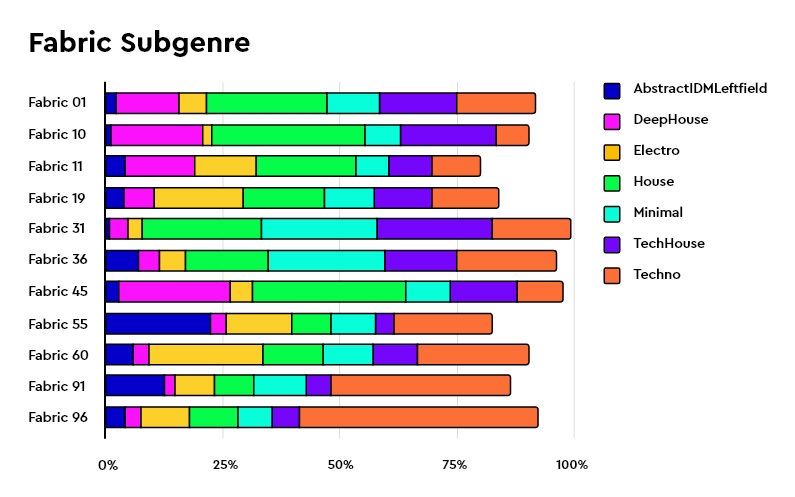
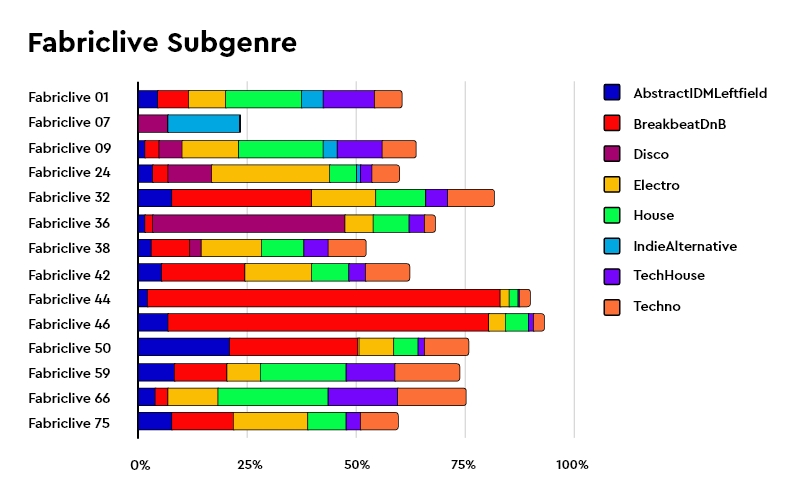
Insights from the sub-genre analysis: from house to techno for fabric, and drum and bass for Fabriclive

On the graphics below, you’ll see the development of main sub-genres over time for fabric and Fabriclive. 

The first fabric compilations (fabric 01, fabric 10, fabric 11, and fabric 31) are heavily focused on house music. In fabric 36, Ricardo Villalobos delivers an album that is consistently minimal and house. Finally, in the latest years, fabric compilations gear toward techno with fabric 96 being the most (50%) techno album of all.

In the Fabriclive series, albums change sub-genres from one album to another, sometimes rather abruptly. Some albums have one dominant sub-genre, others are a mix of various sub-genres in relatively similar proportions. It starts with house as a sub-genre for Fabriclive 01 and Fabriclive 09. And then we practically don’t see another house album till Fabriclive 59 and Fabriclive 66.

Meanwhile, breakbeat / drum and bass takes over, Fabriclive 32 is 32% breakbeat / drum and bass and Fabriclive 44 and Fabriclive 46 are fully breakbeat / drum and bass with 80% and 73% respectively. Finally, Fabriclive 75 restores a bit of a balance with a combination of drum and bass, electro, and house

Finally, the odd ones out are Fabriclive 07 by John Peel which is indie / alternative at the core, Fabriclive 24 by Diplo which is mainly electro, and Fabriclive 36 by LCD Soundsystem which is 39% disco. There is definitely more variety and experimentation within the Fabriclive series.

Mood
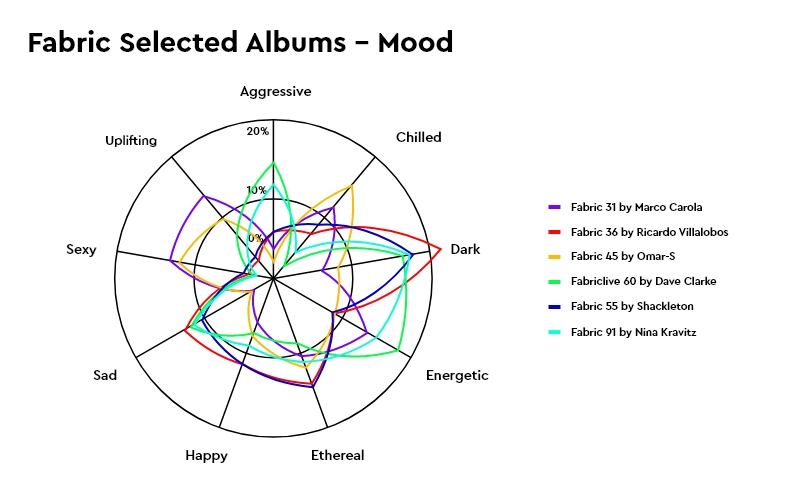
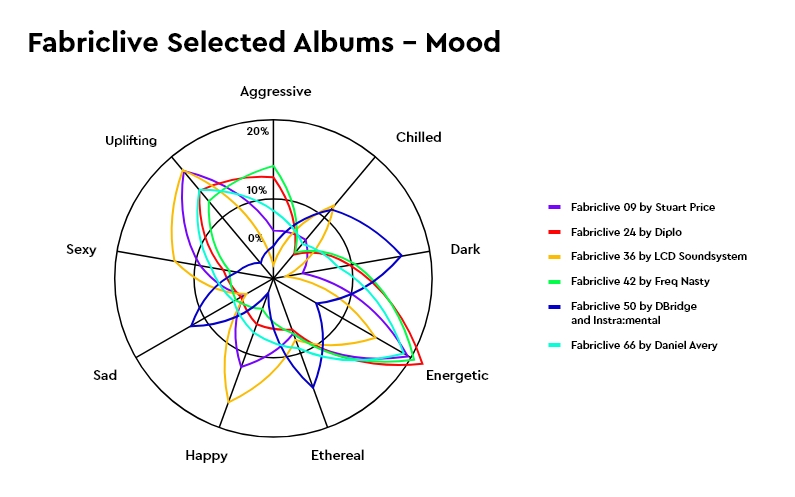
Let’s see how the moods played out in the fabric and Fabriclive series. The moods work the same way as genre and sub-genre in Cyanite and represent the emotion of the track on a scale from 0 to 1 (0-100%). 

Insights from the mood analysis: fabric – dark, energetic, and ethereal, Fabriclive – energetic and uplifting

Both fabric and Fabriclive are quite energetic. fabric series tend to be more dark and ethereal, while Fabriclive is uplifting.

The more detailed analysis reveals the difference between individual compilations:

The darkest compilation – fabric 36 featuring Ricardo Villalobos.

The most energetic and aggressive one – fabric 60 by Dave Clarke.

The most ethereal album – fabric 55 by Shackleton.

The most energetic Fabriclive compilations are Fabriclive 09 by Stuart Price, Fabriclive 24 by Diplo.

Most uplifting albums – Fabriclive 36 by LCD Soundsystem and Fabriclive 09 by Stuart Price.

The happiest album is Fabriclive 09 by Stuart Price.

Fabriclive 09 by Stuart Price is an album with a lot of extremes being one of the most energetic, uplifting, and happiest albums.

Looking at the results, if you want to get or expend some energy during the weekend both fabric and Fabriclive nights are a great choice. If you want a bit of happier and uplifting vibes, Friday Fabriclive nights are probably your best bet. On the contrary, Saturday fabric nights tend to be on the dark side. 

But the results vary across the compilations with some odd figures in between. So you might become a witness to the Fabriclive night where dark, ethereal, and sad moods are prevalent similar to Fabriclive 50 by DBridge and Instra:mental.  

Character
The character describes qualities distinctive to a track and is one of the newer features in Cyanite. It contains such classifiers as warm, playful, heroic, luxurious, and more, which depicts the expressive form of music and describes its appearance rather than mood. 

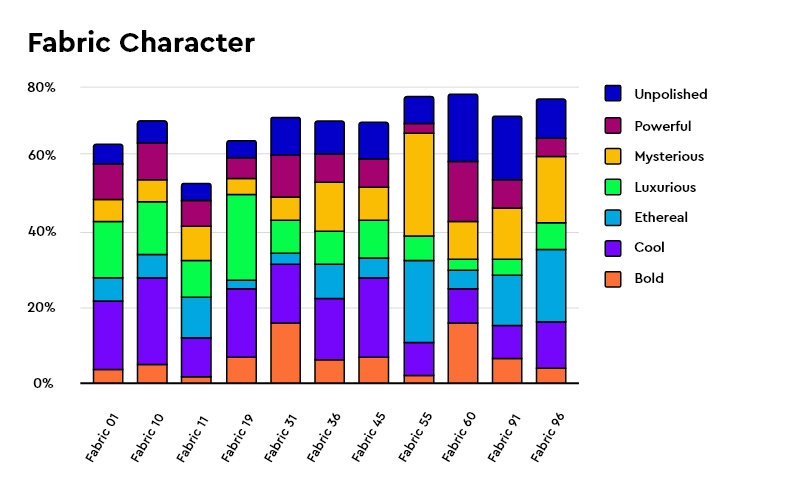
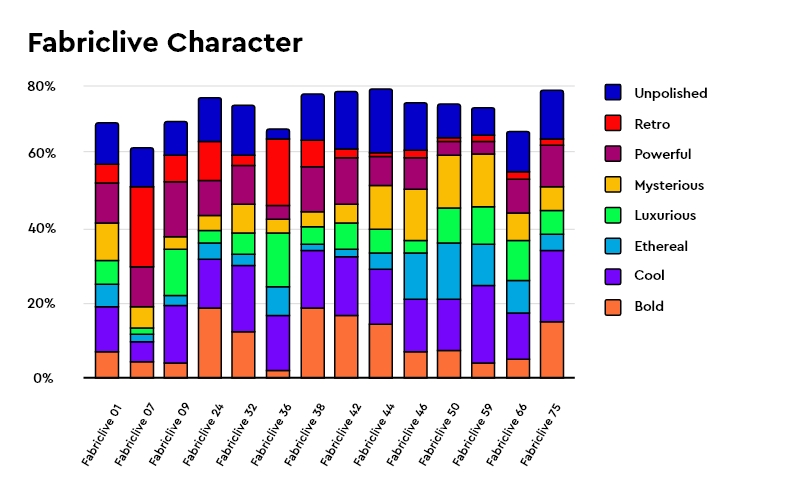
Insights from the character analysis: fabric – luxurious, cool, and mysterious, Fabriclive – cool, unpolished, and powerful. 

fabric compilations have a cool and luxurious character but only at the start in fabric 01, fabric 10, and fabric 19 albums. In later compilations, the sound continues to be cool with a touch of mysterious and bold, which makes sense with Techno being more present in these albums. Finally, fabric 55 breaks through with an ethereal character but it still maintains a bit of mystery. fabric 60 and fabric 91 introduce unpolished character while the last one, fabric 96, is mysterious and ethereal.

Fabriclive compilations also have a strong cool character across almost all albums. The cool character of some albums is often complimented with unpolished vibes. Such are Fabriclive 32, Fabriclive 42, and Fabriclive 44.

In Fabriclive 24, Fabriclive 38, and Fabriclive 42, bold accompanies the cool character. Overall, our data shows bold, cool, unpolished, and powerful as overarching themes for Fabriclive with no clear skew in one direction. 

Movement
Movement is another new feature in Cyanite. It describes the overall manner of how the sound changes or “moves” across the track. Movement in music can be described as bouncy, driving, flowing, groovy, nonrhythmic, pulsing, robotic, running, steady, or stomping.  

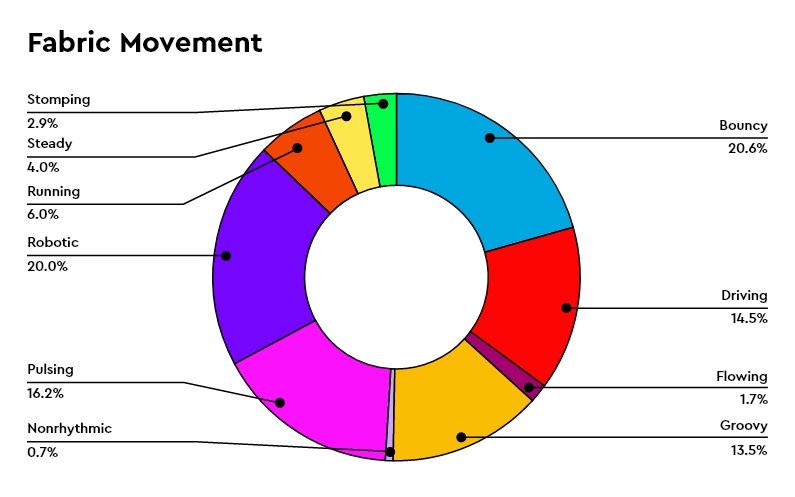
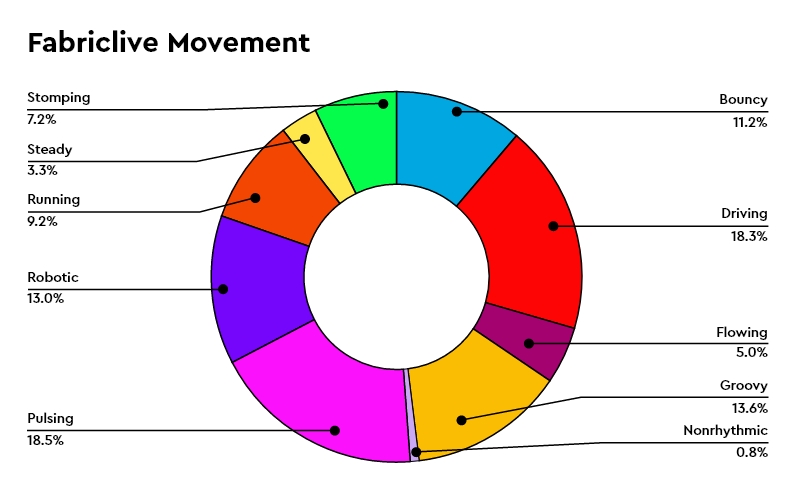
Insights from the movement analysis: Fabric – robotic and bouncy, Fabriclive – pulsing and driving

This is an average across the compilations and individual albums’ values may vary.

Energy Level
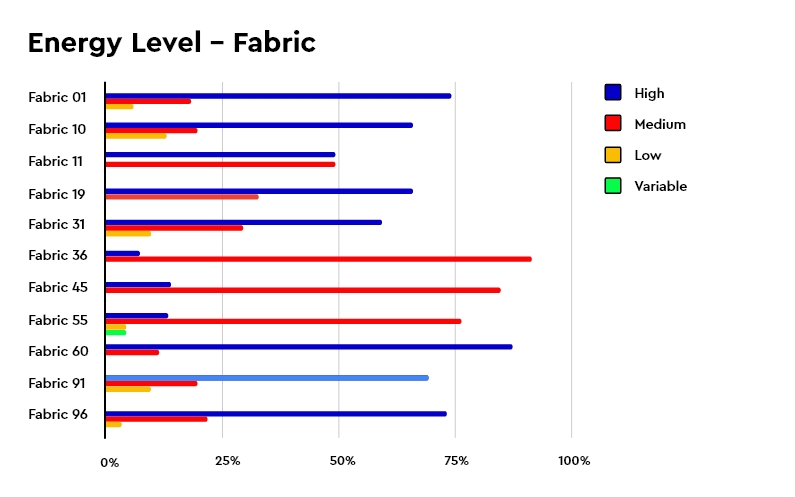
Out of all fabric albums, Dave Clark’s fabric 60 has the most tracks with a high level of energy. fabric 36 stands out with a lot of medium energy tracks, while low energy is not really characteristic of any of the fabric compilations. Out of 11 fabric albums, 7 have high energy.

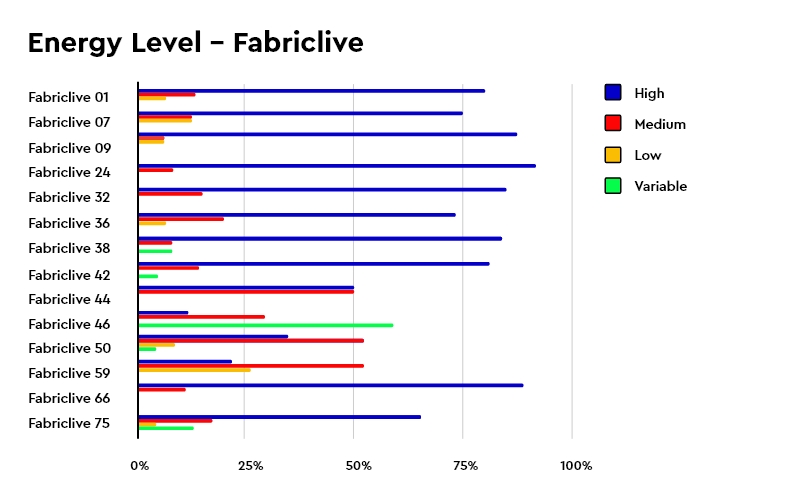
Insights from the energy analysis: both fabric and Fabriclive compilations are high energy overall

dBridge and Instra:mental’s Fabriclive 50 is probably the lowest energy album of all Fabriclive compilations. Out of 14 Fabriclive albums, 10 have the majority of tracks with high energy, so the Fabriclive series is also high energy overall.

Conclusion
What does all this data mean? It shows the development of Fabric sound across the years and paints a picture of a club that pretty much remained true to its goals and mission from the start. While there are some variations across fabric and Fabriclive compilations, both are dedicated to the electronic dance genre, with house and techno as sub-genres for fabric, and breakbeat / drum and bass, techno, house, plus some rap/hip hop, rock, and soul for Fabriclive. 

The differences in mood and movement between fabric and Fabriclive are where the club brings some experimentation within the series as well as between the series. With fabric delivering the darkest vibes, it is hard not to appreciate the uplifting nature of Fabriclive sound. With movement also, the differences between the series are apparent. While fabric’s movement values are robotic and bouncy, Fabriclive is characterized by pulsing and driving vibes. 

As for the character and energy levels, they are pretty consistent. The club maintained its cool character on Friday and Saturday nights throughout the years, additionally introducing more mysterious sound for fabric and unpolished sound for Fabriclive in the latest years. 

It appears that it might be possible to detect how the club sound changed over time as well as explore the differences between the club nights. For a legendary club such as Fabric, it is an opportunity to decide whether to stay on a well-known path or steer in a different direction in the future.

I want to analyze my music data with Cyanite’s AI – how can I get started?

If you want to get a first grip on how Cyanite works, you can also register for our free web app to analyze music and try out similarity searches without any coding needed

Contact us with any questions about our frontend and API services via mail@cyanite.ai. You can also directly book a web session with Cyanite co-founder Markus here.

Video Interview – How Cinephonix Integrated AI Search into Their Music Library

Video Interview – How Cinephonix Integrated AI Search into Their Music Library

A music library stands out by its content but also by how fast, intuitive and easy the users can find the music they need. In other words: A unique catalog + an outstanding user experience = key factors for success. So how can you optimize the user experience to attract new customers and retain existing ones?

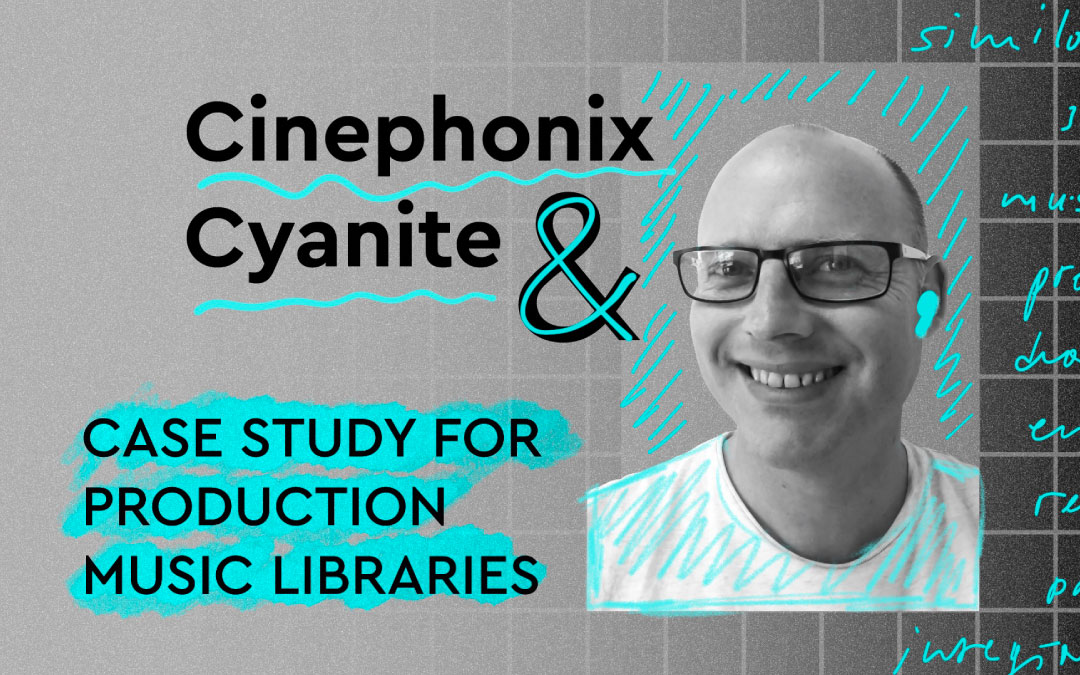
In our case study video interview with Cinephonix, we explore how the UK-based production music library successfully expanded their business with AI-powered search tools using Cyanite’s unique API.

You will learn about:

  • Cinephonix’s specific challenges with music search
  • How the Cyanite API integration went
  • And how it benefited their business.

Hear about the experience firsthand from Anthony Walters, Managing Director of Cinephonix. To watch the case study video, click the play button below. 

I want to integrate AI in my service as well – how can I get started?

Please contact us with any questions about our Cyanite AI via business@cyanite.ai. You can also directly book a web session with Cyanite co-founder Markus here.

If you want to get the first grip on Cyanite’s technology, you can also register for our free web app to analyze music and try similarity searches without any coding needed.