
Last updated on September 4th, 2026 at 12:09 pm
Cyanite’s AI music detector is live. Request access and try it on your catalog.
AI-generated music is entering commercial catalogs on a massive scale. At the same time, demand for transparency around AI-generated content continues to grow, and increasingly, platforms want a way to identify it.
That said, detecting AI-generated music can be more challenging than it seems. Not every AI music detector is built for the same use case, and not every platform is trying to answer the same question.
Scale adds another layer of complexity. A lightweight AI song detector might work well for small libraries or for individuals checking a single track, but platforms handling millions of uploads need infrastructure that can operate reliably inside larger catalog workflows.
We’ve put together this guide to help you explore these nuances. It breaks down how the leading AI music detection platforms in 2026 compare, where they fit, and what teams should evaluate before making a decision.
What to look for in an AI music detection tool
AI music detection tools are trained on different datasets and designed for different operational environments. Here’s what we recommend looking for before comparing platforms.
Detection capabilities
- Detection scope: Can the tool detect music generated by several AI models or only a limited set of systems? Coverage should extend beyond major generators like Suno or Udio, and detection models should be updated as new tools emerge. Otherwise, platforms risk missing newer forms of AI-generated music.
- Accuracy and false positive rate: How precise is detection, and how often are human-made tracks flagged incorrectly? False positives can slow moderation workflows and damage trust with artists or rights holders.
- Confidence scoring: Some AI music detectors return a confidence score instead of a simple yes-or-no label. This gives platforms more flexibility when reviewing flagged tracks. High-confidence detections can move through automated workflows more quickly, while low-confidence results can be reviewed manually before action is taken.
- Partial generation detection: Can the system identify AI-generated components inside tracks that are otherwise human-made? Many releases now combine AI-generated and human-made elements, so tools that only detect fully AI-generated tracks may miss part of the picture.
Operational fit
- API availability and integration depth: Most platforms already have established workflows and internal infrastructure. Detection tools need to integrate into those systems without creating operational friction. Flexible APIs and clear documentation make implementation easier, especially at scale. If your team doesn't have developer resources on hand, it's also worth checking whether there's a way to test detection or run smaller batches outside the API.
- What happens after detection: Detection should connect to the rest of the catalog workflow. Flagged tracks may still need to be reviewed, categorized, filtered, or routed through moderation systems.
- Scalability: Detection systems should scale with catalog growth and rising upload volumes without disrupting existing workflows or slowing processing times.
Privacy and data handling
Teams should understand exactly how uploaded audio is handled before integrating a platform into production workflows, especially when catalog material may be confidential or commercially sensitive. A strong detection system is not enough if the surrounding infrastructure creates uncertainty around ownership, storage, or data usage.
AI music detection tools at a glance
Tool-by-tool breakdown
Not all AI music detection tools are built for the same purpose. Here’s a closer look at the leading platforms and where they fit.
Cyanite
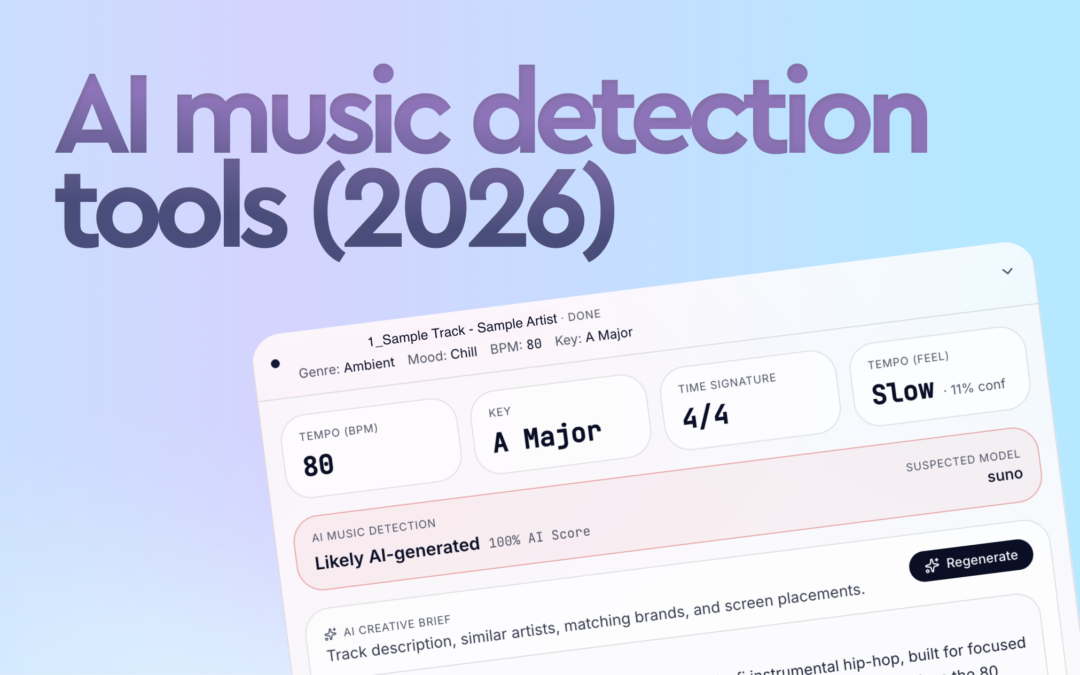
Cyanite’s AI Music Detection estimates whether a track may be AI-generated by analyzing patterns associated with generative AI models.
It supports models such as Suno, Udio, ElevenLabs, Lyria, and Mureka with continuous updates as new technologies are introduced. Our approach prioritizes minimizing false positives over maximizing detection rates.
AI Music Detection is available through a full REST API for production workflows, plus a WebApp for teams that want to test detection or process smaller batches without engineering setup. Detection results appear alongside Cyanite’s tagging output, so a flagged track arrives with the metadata needed to decide what happens next.

Key features:
Besides detection, our platform provides the structure needed to understand AI-generated music within a larger catalog context. This enables platforms to assess where flagged tracks fit within the catalog instead of treating detection as an isolated moderation step.
- Auto-Tagging: Analyzes each track’s full audio and generates structured metadata across categories such as genre, mood, instrumentation, BPM, and key, to name a few.
- Similarity Search: Finds tracks that are sonically similar to a reference.
- Free Text Search: Lets teams search for music using natural language descriptions.
- Advanced Search: An API-only add-on that extends Similarity Search and Free Text Search with multi-track similarity, similarity scores, custom metadata filters, and expanded result sets.
Who it’s for:
- Distributors, DSPs, publishers, and record labels managing large or fast-growing catalogs and reviewing incoming music at scale
- Music licensing platforms, libraries, and music tech companies that want AI music detection to work within a broader catalog intelligence, search, and discovery workflow
Limitations:
- Detection results are designed to indicate the likelihood of AI generation. The system returns a probability score rather than identifying exactly which part of a track may have contributed to the result.
Ircam Amplify
Ircam Amplify’s AI Music Detector focuses on large-scale AI music detection and catalog transparency.
The company emphasizes transparency, verification, processing speed, and scalability, with infrastructure designed for high-volume catalog audits and ingestion workflows.
Key features:
- AI music detection: Detects tracks generated with models such as Suno, Udio, Riffusion, and ElevenLabs.
- Segment-level detection: Can identify AI-generated sections within a track rather than only labeling full songs.
- Probability scores: Returns probability scores to support moderation and review workflows.
- API and SDK integrations: Designed for integration into existing platforms and workflows.
- High-volume processing: Ircam Amplify states that its infrastructure can scan more than 250,000 tracks per hour depending on server capacity.
Who it’s for:
- Platforms managing large music catalogs
- Teams that need scalable AI music detection integrated into existing systems
Limitations:
- The platform’s primary focus is AI music detection. Teams looking for broader catalog intelligence capabilities will need additional tools.
Tintap
Tintap is an API-first AI music detection platform built for enterprise-scale moderation and verification workflows. It’s designed for teams integrating AI music detection directly into existing infrastructure, with encrypted processing, zero data retention, and continuous model updates as new generators are released.
Key features:
- AI music detection: Detects AI-generated music across major generation models.
- Confidence scores: Returns confidence scores to support moderation and verification workflows.
- Segment-level analysis: Analyzes individual sections of a track rather than only the full recording.
- Batch and real-time processing: Designed to analyze large volumes of music efficiently.
- SDK integrations: Supports integrations across multiple programming environments.
Who it’s for:
- Teams integrating AI music detection directly into existing infrastructure
- Platforms handling sensitive audio material that require encrypted processing and zero data retention
Limitations:
- Tintap’s scope is limited to detection. Teams looking to manage and explore their catalogs will need separate solutions.
Deezer for Business
Deezer for Business developed its AI music detection system from inside a streaming platform already dealing with large volumes of AI-generated uploads. The technology is designed to identify fully AI-generated tracks during the upload process and support transparency around how that content is managed. Deezer says it has identified millions of AI-generated tracks on its own platform.
Key features:
- AI music detection: Detects fully AI-generated music from models such as Suno and Udio.
- Moderation workflows: Supports review processes for AI-generated content.
- Reporting and audit trails: Links detection results to platform policy and moderation decisions.
- Recommendation controls: Allows AI-generated tracks to be excluded from recommendation systems.
Who it’s for:
- Streaming platforms managing large volumes of music uploads
- Organizations that need AI music detection tied to moderation, reporting, and policy workflows
Limitations:
- The technology is offered through Deezer’s broader business infrastructure. It is not positioned as a standalone developer product.
- The system focuses on fully AI-generated tracks. Organizations looking to evaluate more complex AI-assisted production workflows may require additional tools.
Sightengine
Sightengine approaches AI music detection as part of a broader content moderation system rather than a standalone music platform. Originally focused on image and video moderation, the company expanded into audio AI detection for platforms already reviewing large volumes of user-generated content across different media types.
Key features:
- AI music detection: Detects AI-generated music from models such as Suno, Udio, Riffusion, MusicGen, and ElevenLabs.
- Audio-based analysis: Analyzes audio directly without relying on metadata or watermarking.
- Privacy-focused processing: Processes audio without human review.
- API integrations: Designed for automated moderation workflows at scale.
Who it’s for:
- Platforms reviewing large volumes of user-generated content
- Services already using moderation infrastructure across text, images, video, or audio
Limitations:
- Sightengine is a content moderation platform, not a music platform.
ACRCloud
ACRCloud is an audio recognition and fingerprinting company. Its AI Music Detector extends that recognition infrastructure into AI-generated music detection.
Key features:
- AI music detection: Detects AI-generated music from models such as Suno, Udio, Sonauto, and Riffusion.
- Component-level analysis: Analyzes full tracks, vocals, and instrumental components separately.
- AI model identification: Estimates which AI model was used.
- Probability scores: Returns probability scores and source-level confidence signals to support moderation and review workflows.
- API integrations: Designed for scalable integration into existing systems and workflows.
Who it’s for:
- Streaming services, apps, broadcasters, and rights management teams
- Teams already working with audio matching, fingerprinting, or content identification systems
The platform is available through scalable API integrations and is especially relevant for teams already working with audio matching, fingerprinting, copyright management, or content identification systems.
Limitations:
- ACRCloud is built around audio recognition and fingerprinting. Its AI music detector extends those workflows rather than acting as a standalone music platform.
Other detection tools
Resemble AI: Resemble AI focuses on synthetic voice and deepfake audio detection. While relevant for AI-generated vocals, it is not designed primarily for AI music detection across large music catalogs.
Vobile/Pex: Vobile and Pex are best known for content identification and copyright protection technologies. Vobile also offers AI music detection, which sits alongside a broader set of rights management and compliance tools.
MatchTune: MatchTune focuses on music compliance and rights monitoring. Its platform scans social media, websites, and digital content for unauthorized music usage, while also offering AI-generated music and deepfake voice detection. AI detection is one component of a broader auditing and copyright compliance workflow.
SubmitHub: SubmitHub includes AI music detection within its music submission workflow. The feature helps curators identify potentially AI-generated submissions and is aimed primarily at independent artists and playlist pitching rather than platform-scale operations.
Beyond detection: why platforms need more than a flag
AI music detectors can estimate whether a track was likely created with AI, but that information alone is rarely enough. Once a catalog is a certain size, platforms need more than a label. They also need to understand what the music sounds like, how it fits within the catalog, and how it should appear across search and discovery workflows.
This is where broader audio analysis becomes important. Detection is much more useful when it’s combined with the tools used to organize and navigate large music catalogs.
We explore this idea further in “An AI music detector is not enough: why platforms need music intelligence infrastructure.” The article examines why detection becomes more useful when combined with deeper audio understanding and catalog intelligence.
Detection alone won’t manage a catalog
AI-generated music is becoming so common in commercial catalogs that platforms need a reliable way to identify it.
Once AI-generated tracks enter a catalog, they move through the same systems as every other track. They still need to be reviewed, searched, recommended, and connected to the right users and workflows. This is why comparing AI music tools on detection accuracy alone can be misleading. They solve different problems, and the right fit depends on the operations around the detection step.
At Cyanite, AI Music Detection is part of a broader catalog intelligence system. Alongside detection, Auto-Tagging, Similarity Search, and Free Text Search help platforms work with music after it has been identified.
Disclaimer: This buyer’s guide was researched and written in July 2026. Our goal is to provide a fair and factual comparison based on publicly available information. As products and features evolve, some information may change over time. We strive to keep this guide accurate and up to date. If you notice any inaccuracies or outdated information, please let us know at content@cyanite.ai
FAQs
What is an AI music detector?
An AI music detector is a tool that analyzes audio to determine whether a track was generated by an AI model. Most tools currently detect output from major generation models like Suno, Udio, ElevenLabs, Lyria, and Mureka.
How accurate are AI music detection tools?
Accuracy varies significantly between tools and depends on which generation models are being detected. Tools with transparent accuracy claims and low false-positive rates are generally more reliable for production use. Be cautious of tools that make no verifiable accuracy claims or that have not published information about their false-positive rates.
Can AI music detectors identify partially AI-generated tracks?
Partially AI-generated tracks (for example, human-played instrumentals with AI-generated vocals) are more challenging to detect than fully AI-generated music. Cyanite can analyze the track’s components and identify whether AI was used for the instrumental layer, the vocal layer, or both. This provides a more detailed view of AI involvement than a single overall score.
What is the best AI music detection tool for music platforms?
The best tool depends on your use case. If you only need detection, Ircam Amplify and Cyanite both offer strong API-based options. If you need detection plus catalog intelligence (tagging, search, and the ability to work with flagged content after the fact), Cyanite is currently the only tool that combines all three in a single system.
How do AI music detectors work?
AI music detectors analyze audio signals using machine learning models trained on known AI-generated and human-created music. They look for patterns in the audio—frequency characteristics, production artifacts, structural regularities—that distinguish AI output from human recordings. Detection accuracy improves as models are updated to keep pace with new generation tools. Read more about Cyanite’s approach here.
Is AI music detection the same as music recognition?
No. Music recognition identifies a specific track by matching it against a database of known recordings. AI music detection analyzes whether a track was generated by AI, regardless of whether it has been heard before. They answer different questions and use different methods.