
How to Turn Music Data into Actionable Insights

How to Turn Music Data into Actionable Insights

Decisions in the music industry are increasingly made based on data. Services like Chartmetric, Spotify for Artists, or Facebook Business Manager among others are powerful tools to enable music industry teams to back up their work with data. This process of collective data generation is called datafication, pointing at the fact that almost everything nowadays can be collected, measured, and captured either manually or digitally. Data can be used by recommendation algorithms to recommend music. This data is also an opportunity for the stakeholders to make business decisions, reach new audiences in the market, and find innovative ways to do business. 

However, decision-making from data also requires a new level of analytical skills. Simple statistical analysis is not enough for data-based decision-making. The amount of data, its complexity, and challenges associated with storing and synchronizing large data require smart technologies to help manage the data and make use of it. 

This article explains the general framework for data-based decision-making and explores how Cyanite capabilities can lead to actionable business insights. It is specifically tailored to music publishers, music labels, and all types of music businesses that own musical assets. This framework can be applied in a variety of ways to areas such as catalog acquisitions, playlist pitching, and release plans.

Data Pyramid

So how are data-based decisions made? The framework for decision-making is based on the Berklee University Data Pyramid model by Liv Buli. In the next parts we outline the 4 steps of the model and add a certain Cyanite layer to it:

  1. Data Layer
  2. Information Layer
  3. Knowledge Layer 
  4. Intelligence Layer

1. Data Layer

At the very first layer, the raw data is generated and collected. This data includes user activity, information about the artist such as social media accounts and usernames, album release dates or concert dates, and creative metadata. Among others, a technology like Cyanite generates creative metadata such as genre, mood, instruments, bpm, key, vocals, and more.  

At this stage the data is collected in a raw form, so limited insights can be made out of it. This step is, however, crucial for insight generation at the next layers of the pyramid. 

It’s also important to remember a general rule of thumb: the better the input, the better the output. That is, the higher the quality of this initial data generation, the better insights you can derive from it at the top of the pyramid. Any mistakes made in the crucial data layer will be carried in the other layers biasing insights and limiting actionability.

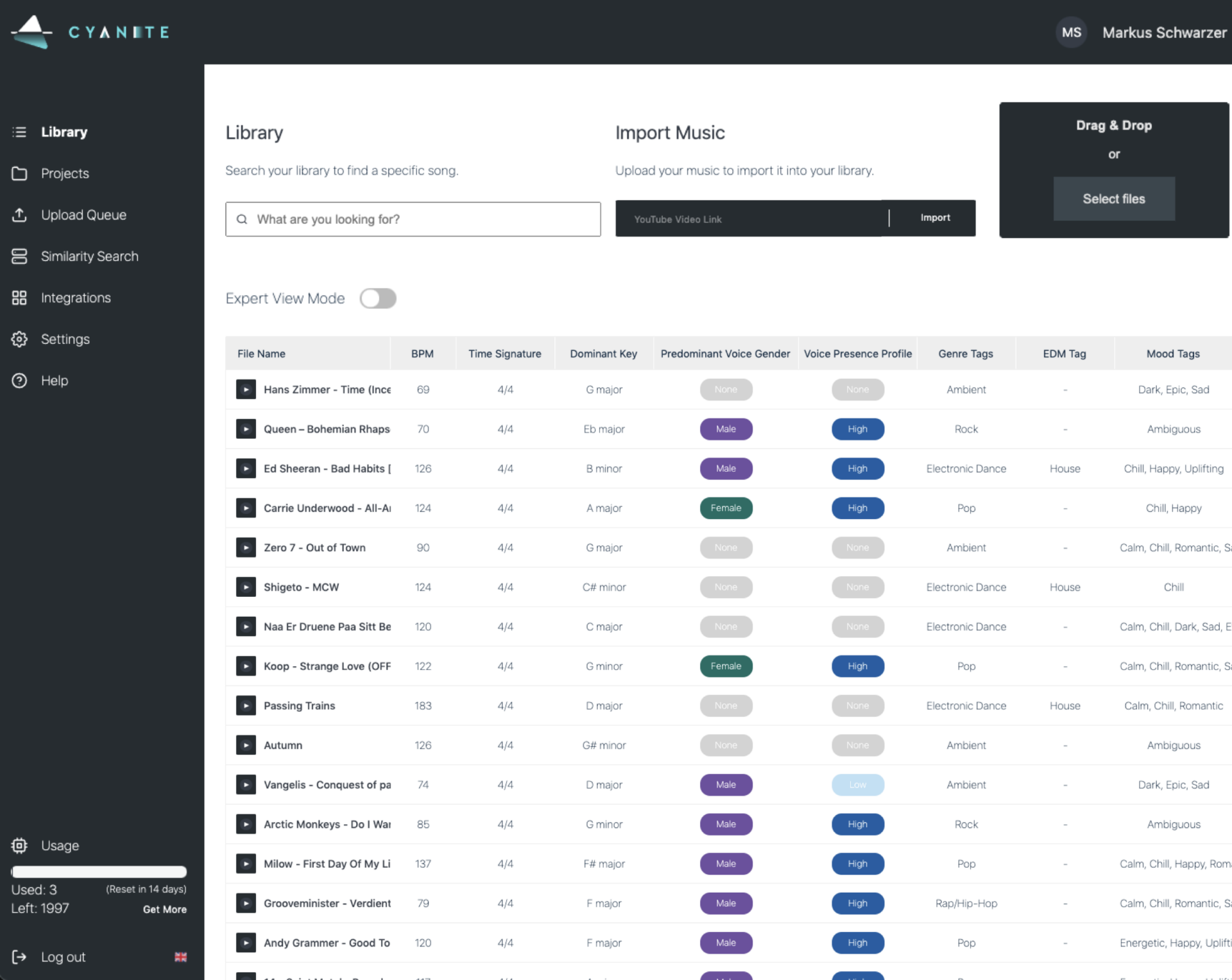
Our philosophy at Cyanite is to have a  reduced set of data output in the first layer to help accuracy and reliability. The data is presented in readable form in the Cyanite interface. You can see what kind of data Cyanite generates in this analysis of Spotify’s New Music Friday Playlist

Cyanite Interface

2. Information Layer

At the information level, the data is structured and visualized, often in a graphical form. A first glance at data in a visual form can already bring value and enable the company to answer questions such as: “What happened with the artist, playlist, or a chart?” 

At each stage of the pyramid, an appropriate analytical method is used. The visualization and reporting methods among others at the information stage are called descriptive analytics. The main goal at this stage is to identify useful patterns and correlations that can be later used for business decisions. 
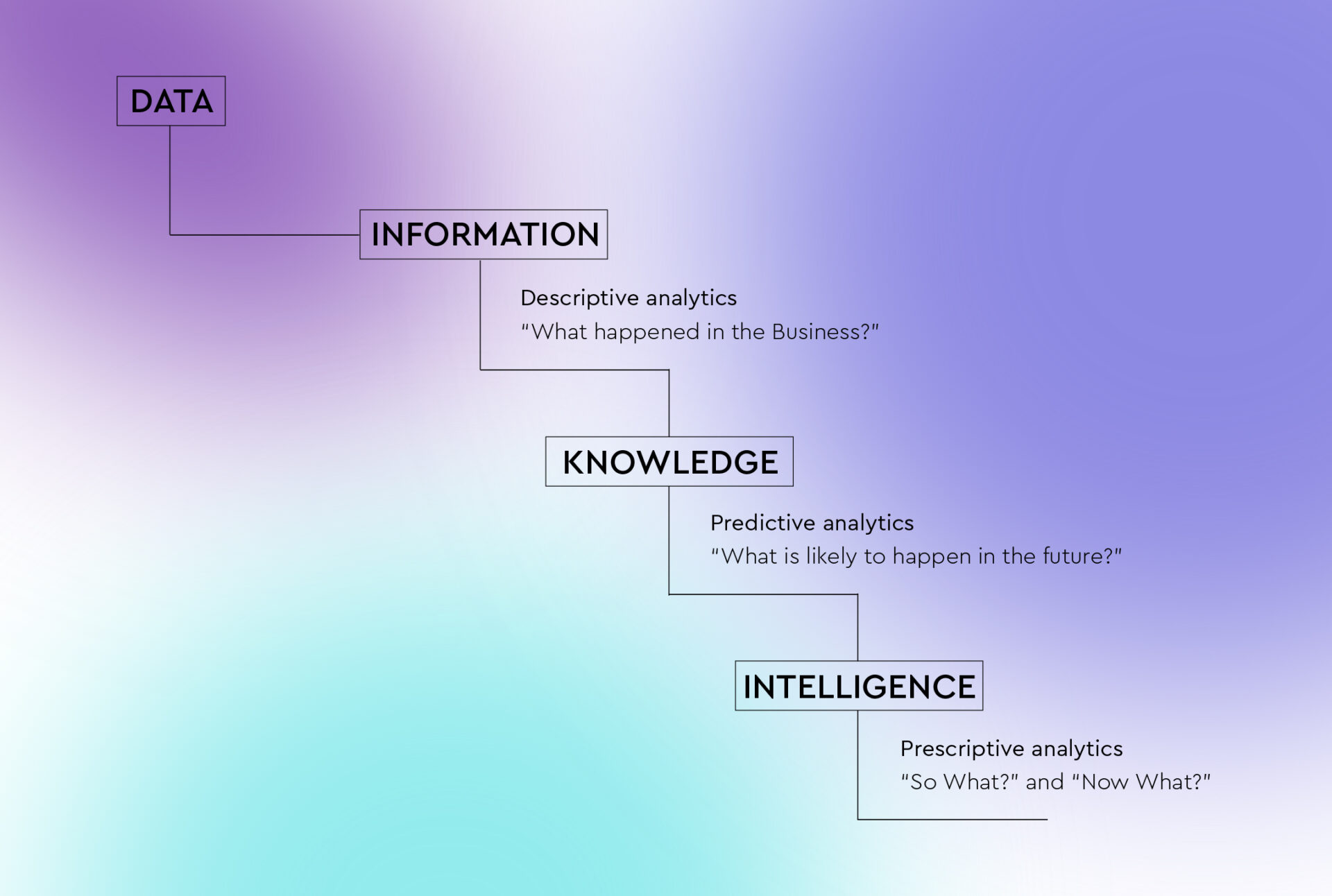
Analytical methods used at each stage of the data pyramid

(based on Sivarajah et al. classification of data analytical models, 2016)

At this level, there are two main techniques: data aggregation and data mining. Data aggregation deals with collecting and organizing large data sets. Data mining discovers patterns and trends and presents the data in a visual or another understandable format. 

This is the simplest level of data analysis where only cursory conclusions can be made. Inferences and predictions are not made on this level. 
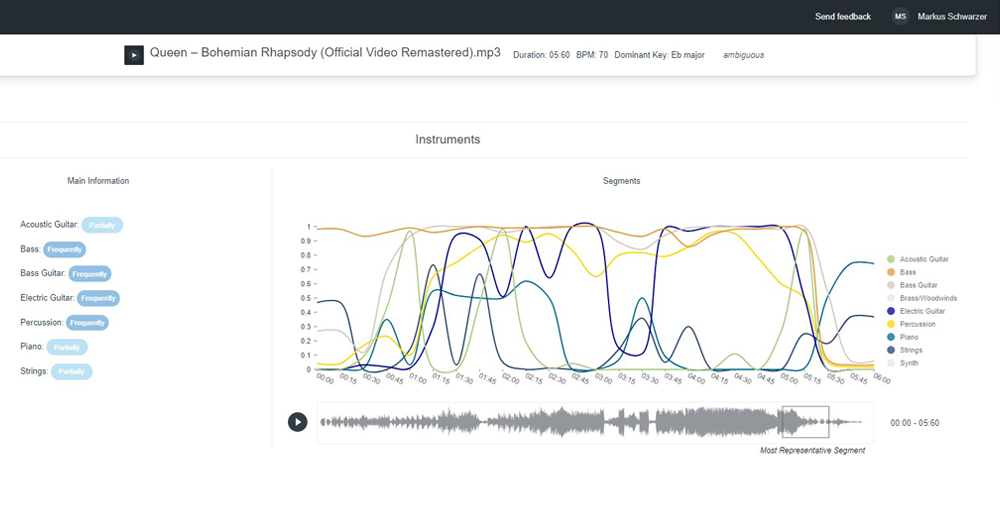
Instruments in Detail View

One of many ways to visualize music via Cyanite’s detail view

3. Knowledge Layer

The knowledge layer is the stage where the information is converted into knowledge. Benchmarking and setting milestones are used at this stage to derive insights from data. For example, you can set expectations for the artist’s performance based on the information about how they performed in the past. Various activities such as events and show appearances can influence the artist’s performance and this information too can be converted into knowledge, indicating how different factors affect the artist’s success

This stage employs the so-called predictive analytics that answer the question: “What is likely to happen in the future?” This kind of analytics captures patterns and relationships in data. They can also deal with historical patterns, connect them to future outcomes, and capture interdependencies between variables. 

At the knowledge level, such techniques as data mining, statistical modeling, and machine learning algorithms are used. For example, machine learning methods can try to fill in the missing data with the best possible guesses based on the existing data. More information on the techniques and advantages and disadvantages of each analytical method can be found here

Here are some contexts in which the data generated by Cyanite could create knowledge:

  • Analyzing a “to-be-acquired” catalog of music rights and benchmarking it into the existing one;
  • Analyzing popular playlists to predict matches;
  • Analyzing trending music in advertising to find the most syncable tracks in the own catalog.

4. Intelligence Layer

The intelligence layer is the stage where questions such as “So What?” and “Now What?” are asked and possibly answered. This level enables the stakeholders to predict the outcomes and recommend actions with a high level of confidence. However, decision-making at this level is risky as the wrong prediction can be expensive. While this level is still very much human-operated, machines, especially AI, are moving up the pyramid levels to take over insights generation and decision making

Prescriptive analytics deal with cause-effect relationships among knowledge points. They allow businesses to determine actions and assess their impact based on feedback produced by predictive analytics at the knowledge level. This is the level where the truly actionable insights that can affect business development are born. 

Intelligence anticipates what and when something might happen. It can even attempt to understand why something might happen. At the intelligence level, each possible decision option is evaluated so that stakeholders can take advantage of future opportunities or avoid risks. Essentially, this level deals with multiple futures and evaluates the advantages of each option in terms of future opportunities and risks. For further reading, we recommend this article from Google revealing the mindset you need to develop data into business insights.  

Cyanite and Data-Based Decision

At the very base of the Data Pyramid lies raw data. The quality and accuracy of raw data is detrimental in decision making. 

Cyanite generates data about each music track such as bpm, dominant key, predominant voice gender, voice presence profile, genre, mood, energy level, emotional profile, energy dynamics, emotional dynamics, instruments, musical era, and other characteristics of the song. This data is then presented in a visual format such as graphs with dynamic and the ability to choose the custom segment.

Based on different audio parameters, the system determines the similarity between the items, and lists similar songs based on a reference track. From Cyanite analytics, it can be derived, for example, what the overall mood of the library is and different songs can be added to make the library more comprehensive. Branding decisions can also be made using Cyanite, to ensure all music employed by the brand adheres to one mood or theme

I want to integrate AI in my service as well – how can I get started?

Please contact us with any questions about our Cyanite AI via sales@cyanite.ai. You can also directly book a web session with Cyanite co-founder Markus here.

If you want to get the first grip on Cyanite’s technology, you can also register for our free web app to analyze music and try similarity searches without any coding needed.

How to Use Cyanite to Optimize Your Playlists and DJ Sets for Harmonic Mixing and Similarity

How to Use Cyanite to Optimize Your Playlists and DJ Sets for Harmonic Mixing and Similarity

If you’re a DJ or playlist curator, you know exactly how much time goes into finding, curating, and maintaining your playlists and DJ crates. But many DJs and curators don’t know about the Camelot Wheel. The Camelot Wheel can help assess which tracks mix well together harmonically. In this article, we give DJs and playlist curators a step-by-step guide on how to pair Cyanite’s Similarity Search with the Camelot Wheel’s key-detection to find out which tracks go well together in sound and harmony, and further how to find inspiration on Spotify. 

Harmonic mixing means mixing “​​two pre-recorded tracks that are most often either in the same key, or their keys are relative or in a subdominant or dominant relationship with one another” (Wikipedia). Harmonic mixing, next to BPM matching, ensures that cross-fades into a new track in the set will be as smooth and natural as possible. 

In addition, tracks need to match in terms of their vibe and feel, and it can take many years of practice and club experience to master these skills.

If you’re keen to learn how to engage AI to support your work, we’ll show you how to combine Camelot Wheel’s harmonic mixing logic with Cyanite’s similarity search in 4 easy steps.


1. Register for a Cyanite account

  1. Upload your songs to the Library
  2. Perform Similarity Search
  3. Filter on Camelot Wheel
1. Register for a Cyanite account

Step one is easy. Just go to the sign up page of the Cyanite web app and create an account. You are set up in less than a minute and will directly land in the Library view to continue with step two.


2. Upload your songs to the library


There are two options to ingest your tracks into the library. 

  1. Upload your MP3s via the drag and drop button
  2. Or import music via a YouTube link

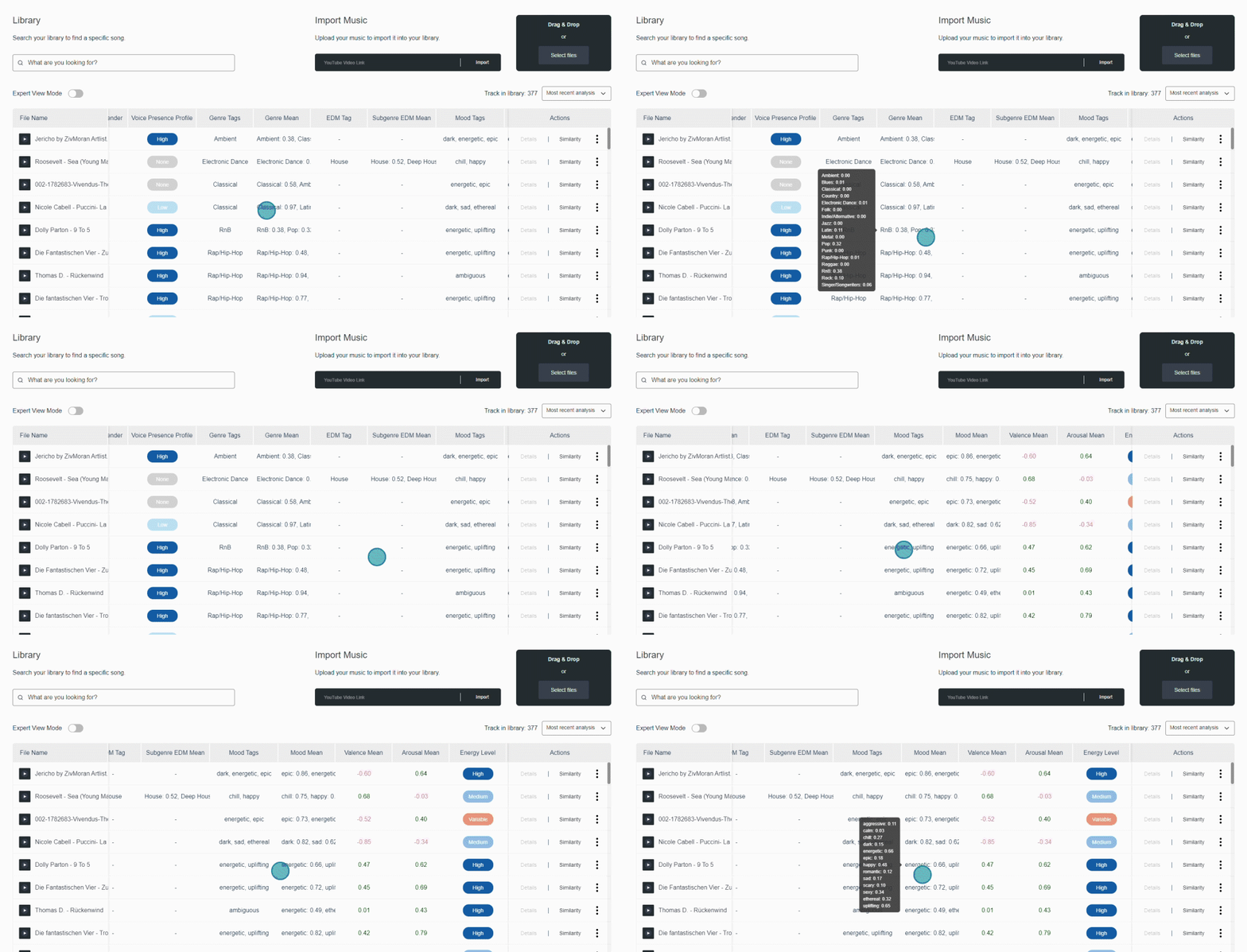
Once you upload your songs, the Cyanite AI analyzes their genre, mood, key, bpm and much more. The results will be available in your Library in a very short time. If you want to dive deeper into the analytics of one specific song you can do that via the Detail View. But let’s move on to the Similarity Search and Step 3.


Mood Numerical Value

Cyanite’s Library View

3. Perform Similarity Search


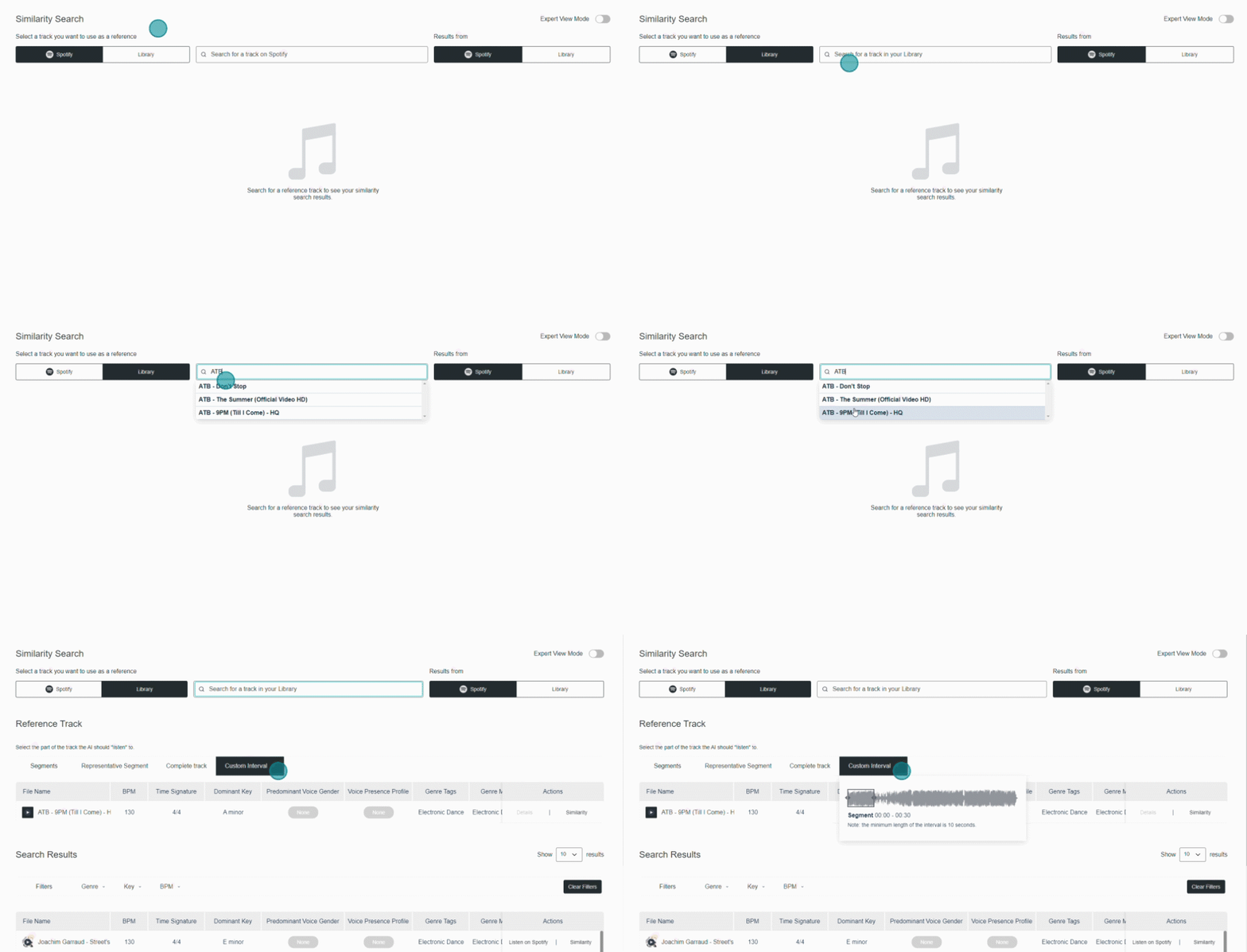
Ok, now it’s starting to get exciting. Imagine you’re at a point in your set where you need to keep the energy high but don’t have enough of these songs in your library. Just click on “Similarity” next to your reference song in the Cyanite Library at the right. This will get you to the Cyanite
Similarity Search in the web app.

The Cyanite Similarity Search gives you two options where to source similar sounding tracks from:

  • From your own music library 
  • From Cyanite’s showcase database with some example songs from Spotify

Cyanite will display up to 100 similar song suggestions. Either go through your own music library or let Cyanite suggest new songs from a Spotify database. 


Custom Interval

Cyanite’s Similarity Search

4. Filter by Camelot Wheel


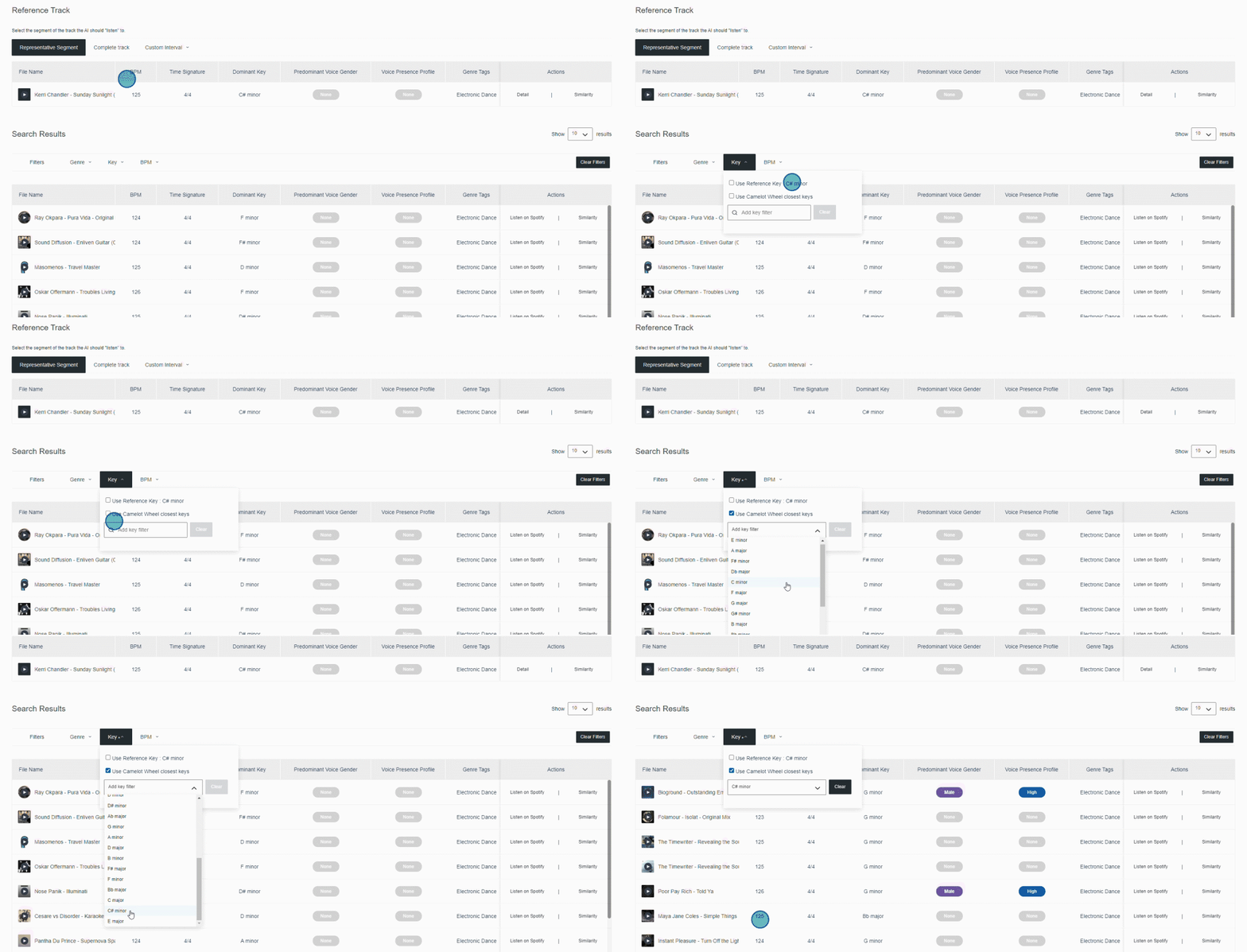
Drumroll, now it’s time to filter the results by the Camelot Wheel. To do so, follow these three simple steps.

  1. Select Key as a Filter
  2. Tick the box “Use Camelot Wheel closest keys” 
  3. Select the Key of the reference track from the dropdown menu

You will then see how your library refreshes and displays only songs with a neighboring Camelot Wheel key! To also see songs available in the Spotify database just switch to Spotify in the top right corner. 


Custom interval

Cyanite Similarity Search

Summary
Ok, you got it. Now you know how to filter your playlists and DJ crates by Camelot Wheel and similarity. We are constantly improving our web app and one feature in the pipeline is an automatic detection of the reference track’s key in the  “Use Camelot Wheel closest keys” menu. With that, you don’t need to manually select it.

We would love to hear your ideas and thoughts, so please reach out to one of us with any suggestions. We will consider every single one. 

If you need to bump up your analysis limit, reach out to Markus or Jakob, tell them how many analyses you need and they will get back to you shortly. You can also directly book a web session with Cyanite co-founder Markus here.

PR: APM Music Partners with Cyanite to Enhance Music Tagging

PR: APM Music Partners with Cyanite to Enhance Music Tagging

PRESS RELEASE

APM Music partners with Cyanite to Enhance Music Tagging

Mannheim/Berlin/Los Angeles, September 9, 2021 – APM Music, the largest production music library in North America, and Cyanite, a technology company developing a suite of AI-powered music search products announced today a strategic partnership that will provide users with improved tagging and metadata to enhance their search queries.

A superior music discovery experience begins with content that is comprehensively, consistently, and accurately tagged. With an ever-growing music library such as the one APM Music has been providing the marketplace for nearly four decades, maintaining high-quality tagging and precise metadata at a large scale is a primary concern. Incorporating Cyanite’s AI will allow APM Music to introduce human-assisted auto-tagging to the music submission and review process, thus increasing the quality and consistency of tagging.

APM Music’s President/CEO Adam Taylor comments: “For APM Music, accurate and reliable music tagging has always been of the utmost importance and we are aligned with Cyanite on this constant strive for quality. Markus and the team have proven that they are able to quickly react to our feedback and improve their algorithms at a rapid speed. We are excited to integrate artificial intelligence into APM and create the best possible support for our team.

Cyanite’s artificial intelligence listens to and categorizes songs, helping to deliver the right music content, no matter the use case. Integrating this technology will benefit the end user by ensuring search queries continue to yield accurate and tailored results as APM’s music library expands in depth and breadth.

Markus Schwarzer, CEO of Cyanite: “We look forward to working with such a prestigious and renowned partner as APM Music. Everyone on their team is a unique expert in their field. Being the chosen AI partner for the important and extensive transition into this new age of music distribution fills our entire team with pride.

The addition of Cyanite’s technology extends APM’s commitment to continually increasing the quality and performance of its search engine, thereby delivering a superior quality discovery experience to match its richness of catalog.

Anyone wishing to try Cyanite’s technology can register for the Web App free of charge and upload music or integrate Cyanite into an existing database system via their API.

Full press material including German press release can be found via this link.

Background to APM Music:
APM Music is located in Hollywood, California, and is the premier go-to source for production music. Founded in 1983, APM Music is the largest production music library in North America. To find out more, please visit www.apmmusic.com. 

Background to Cyanite:
Cyanite believes that state-of-the-art technology should not be exclusive to big tech companies. The start-up is one of Europe’s leading independent innovators in the field of music-AI and supports some of the most renowned and innovative players in the music and audio industry. Among the music companies using Cyanite are the Mediengruppe RTL, the record pool BPM Supreme. the radio station SWR, the music publishers NEUBAU Music and Schubert Music, and the sound branding agencies Universal Music Solutions, TAMBR, and amp sound branding.

Press Inquiries 

Jakob Höflich

Co-Founder

+49 172 447 0771

jakob@cyanite.ai

Headquarter Mannheim

elceedee UG (haftungsbeschränkt)

Badenweiler Straße 4

68239 Mannheim

Berlin Office

Cyanite

Gneisenaustraße 44/45

10961 Berlin

How BPM Supreme enriched their music services with AI-generated moods and search algorithms from Cyanite

How BPM Supreme enriched their music services with AI-generated moods and search algorithms from Cyanite

BPM Supreme is a digital music service delivering a wide choice of music for professional DJs, producers, and artists through an online platform and mobile app. The catalog features thousands of tracks that are DJ-ready, come in different versions – clean, dirty, extended, and can be downloaded. BPM Latino, a sister brand of BPM Supreme, is a leading record pool for Latin music. The BPM Supreme brand also includes BPM Create – a sample library for producers and music makers.

Looking back at the history of BPM Supreme, it becomes clear why the company is the spearhead of the digital DJ pools. Since the time of its foundation, CEO Angel “AROCK” Castillo recognized the great technological advantage that a digital record pool brings to its users. Looking at various reviews of record pools, BPM Supreme stands out for its great usability with reviews like “the only record pool I always keep my subscription live with is BPM Supreme”.

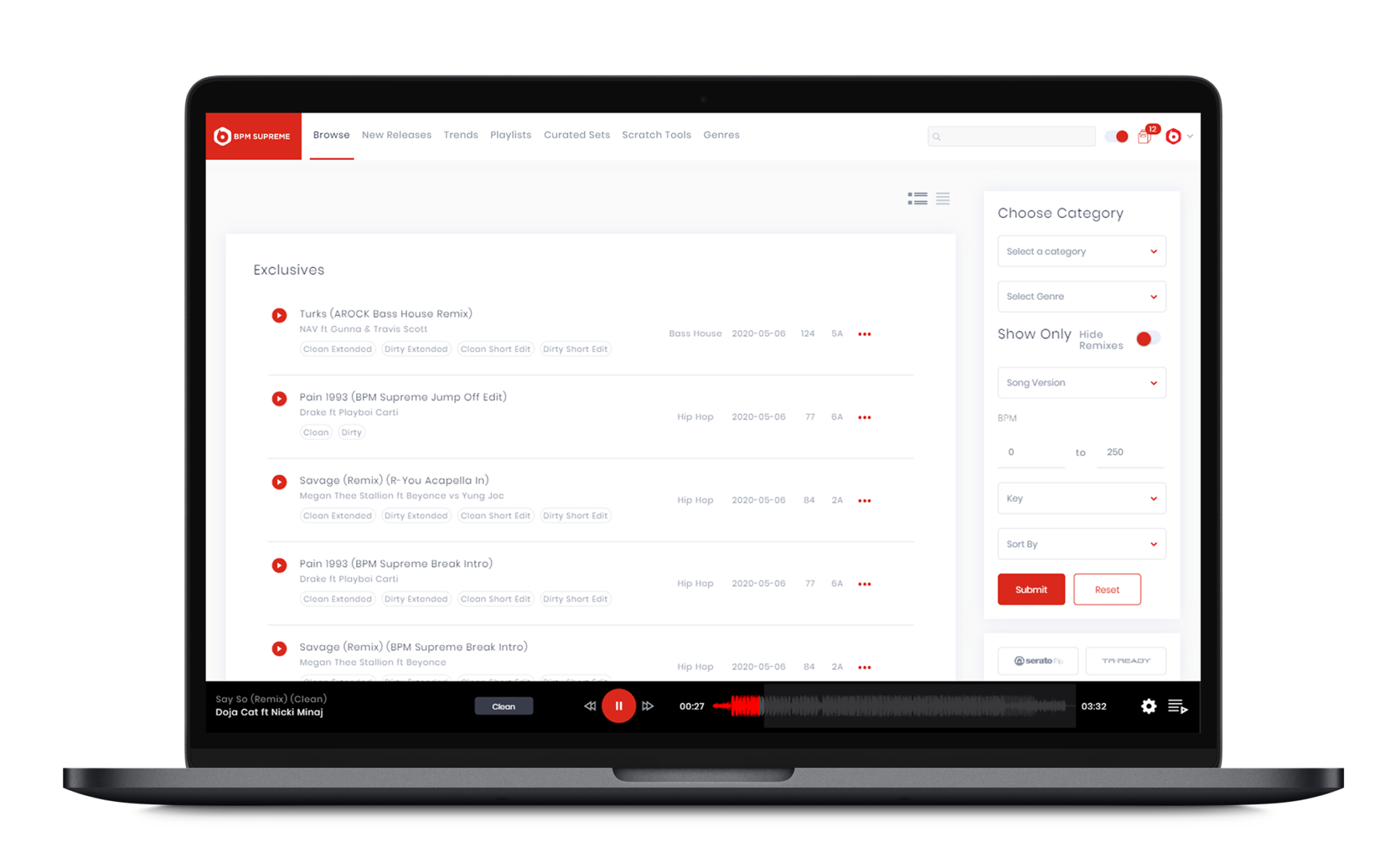
BPM Supreme Interface

BPM Supreme’s music search interface before the Cyanite integration

The challenges that come with being a pioneer

Being a pioneer in the market usually means leading with innovations. With the increasing popularity of mood and sound-based music search like the one by Spotify, BPM Supreme saw an opportunity to stay ahead of the market by introducing cutting-edge search features allowing the user to find music more intuitively.

The two major challenges for BPM Supreme were as follows:


    Step-by-step integration of Cyanite’s AI system into BPM Supreme

    After agreeing on the partnership, BPM Supreme started to integrate Cyanite’s technology via its API into their platform. This process went as follows:

    Step 1: Technical onboarding

    Every Cyanite project starts with a kick-off meeting of the companies’ CTOs. In this meeting, important questions are discussed, workflows determined, and the best communication channels are identified.

    Step 2: Bulk uploading of the entire back catalog

    To ensure the fast onboarding and analysis of the entire catalog, BPM Supreme was given an S3 bucket where they could upload their entire catalog as Mp3s (either via AWS CLI or web browser). The files were processed and analyzed by Cyanite.

    Meanwhile: API integration

    One of Cyanite’s key resources is the API documentation. The flexible GraphQL API allows the exceptionally granular shipment of classifiers. It took the BPM Supreme development team less than a week to fully integrate the API. 

    Step 4: Analysis and similarity search creation of the back catalog and providing results via API

    After the tracks were analyzed and a Similarity Search environment was created by the Cyanite team, all results were made accessible via the API and Web App to the BPM Supreme team. We then provided mapping for all the tracks and the respective Cyanite IDs so that Tagging results or Similarity Search results could be retrieved with one quick API call. 

    Step 5: Displaying moods and Similarity Search within BPM Supreme

    As a final step of the integration, BPM Supreme decided how to display the data provided by Cyanite API in their frontend.

    Step 6: Building on a healthy and long-lasting partnership

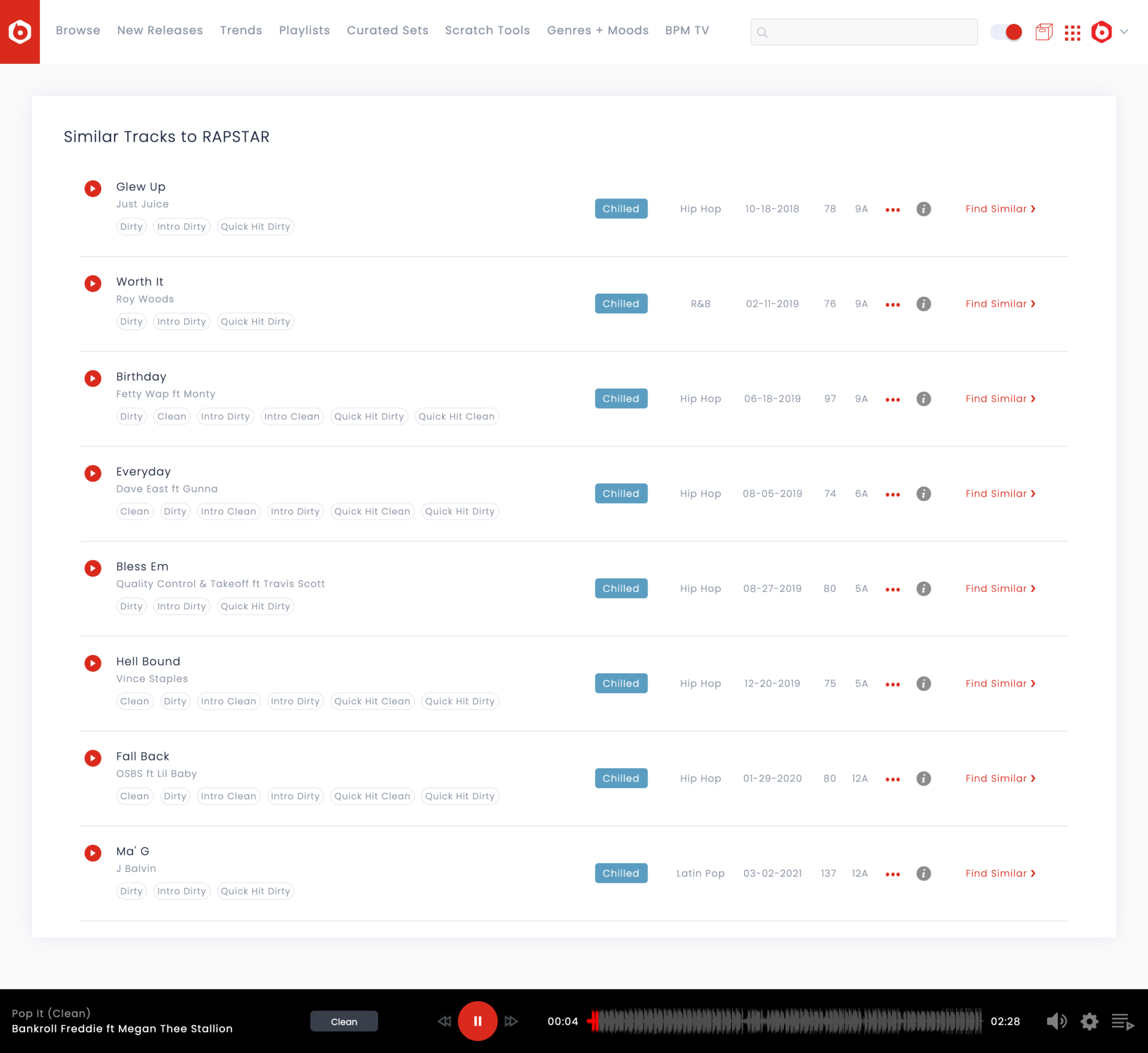
    To date, the Similarity Search feature has been used more than 300,000 times by BPM Supreme’s users leading to a significant increase in user satisfaction. Furthermore, the new Mood search brought the BPM Supreme team a storm of positive feedback decreased search time for DJs, giving them more time to work on their material.

    Achievements and benefits

    This growth over the period of 6 months shows that more and more users use Similarity Search and find it useful.

    BPM Supreme’s Similarity Search

    The founders of BPM Supreme had very positive feedback. Here is how AROCK evaluates the integration of Cyanite moods and improved search functionality.

    Moods has made it even faster for our community of DJs to find the music they need. We’ve received positive reviews from all types of DJs, saying that our search functionality remains strides ahead of other similar music services. Since the integration of moods, we’ve found that DJs are spending less time searching for music, which allows them more time to focus on other aspects of their business.

    Angel "AROCK" Castillo

    CEO, BPM Supreme

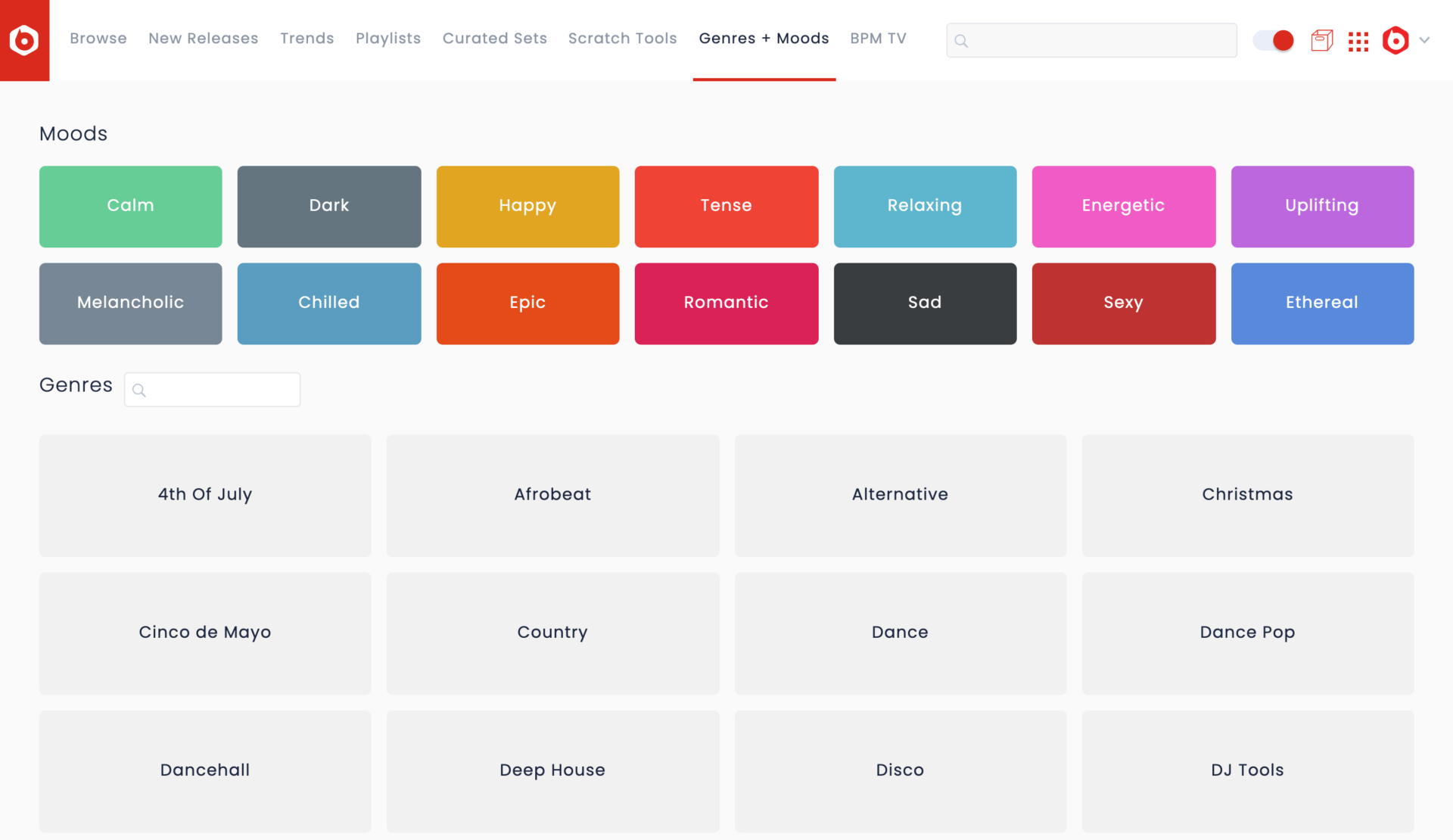
    BPM Supreme & Cyanite Moods

    Raj Thomas, Director of Operations BPM Supreme: “We’ve had a great uptick in positive feedback since adding Moods to the BPM Supreme platform. Our members are enjoying the additional search functionality that the Moods feature provides. We’ve also received feedback that by using Moods to find similar energy level and overall vibe, it has assisted them in putting their DJ sets together much more quickly and effortlessly.”

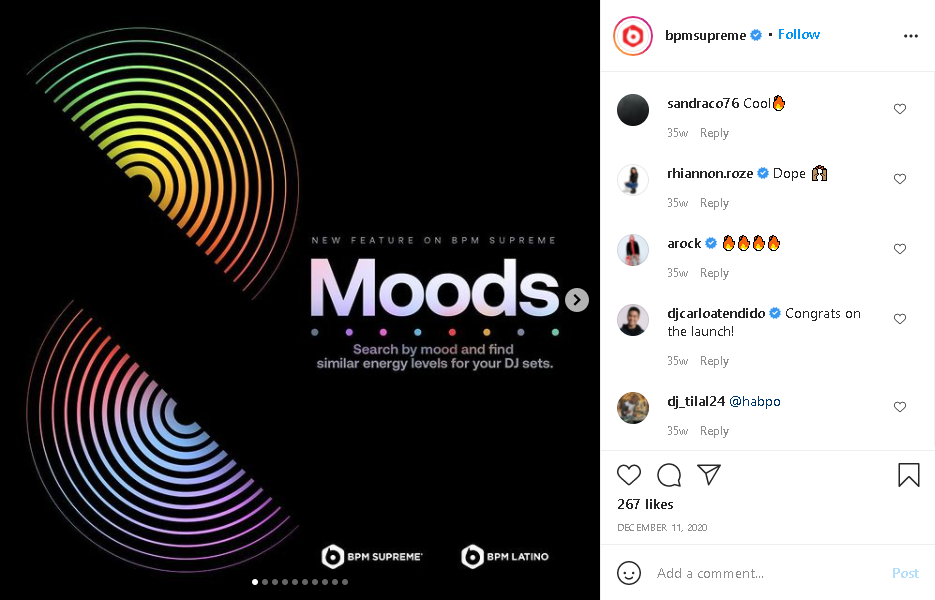
    The shared press release titled “BPM Supreme to be the first record pool worldwide to integrate Cyanite” in December 2020 was picked up by many international music and DJ magazines such as Decoded Magazine, EDM Nomad, and Record of the Day. The Instagram announcement by BPM Supreme was received very positively by the community of DJs and musicians.

    Moods Instagram BPM Supreme

    What’s coming next?

    BPM Supreme and Cyanite are already developing new features together and constantly sharing ideas in regular meetings. It’s not uncommon for certain features that were developed independently to unexpectedly fit together, which is a great sign that the working philosophies of delivering the best music discovery experiences are aligned. More news and insights on that soon!

    I want to integrate AI in my service as well – how can I get started?

    Please contact us with any questions about our Cyanite AI via sales@cyanite.ai. You can also directly book a web session with Cyanite co-founder Markus here.
    If you want to get the first grip on Cyanite’s technology, you can also register for our free web app to analyze music and try similarity searches without any coding needed.
    Case Study: How SWR uses Cyanite’s recommendation algorithms for their new radio app

    Case Study: How SWR uses Cyanite’s recommendation algorithms for their new radio app

    About SWR

    SWR is not only Germany’s 3rd biggest radio station but also investing heavily in the future of radio via its own innovation entity SWR audiolab. Their goal is to develop new radio experiences to attract audiences who no longer listen to traditional radio. For instance, the new SWR mobile app enables users to skip songs – a concept completely revolutionary to linear radio.

    Weekly listeners of SWR owned radio stations in Germany: 7,07 million

    Visits of SWR online services in 2019: 218,3 million

    “Our aspiration is to create the future of radio for tomorrow and beyond by combining media trends and technologies with the demands of our users.”

    Challenge

    By providing on-demand content, SWR steps out of their radio license and have to pay royalties for every song stream like Spotify or Apple Music. Every skip means additional costs.

    Shall I skip or shall I go?

    Solution: Bespoke recommendation system

    SWR implemented Cyanite’s music intelligence and user insight systems to automate song recommendations and personalized playlists based on listener preferences significantly lowering skips and increasing session times. The technology is delivered via the Cyanite API and seamlessly integrated into SWR’s new radio app.

    This is a screenshot of Cyanite’s library view which easily turns a catalogue into an accountable database

    Results

    + 60% lower skip rate

    + Annual cost saving of >60,000 €

    + 46% increase in session time

    + Valuable data on user behaviour and personal music preference

    Christian Hufnagel

    Christian Hufnagel

    Co-Founder of SWR audio labs

    Christian Hufnagel is the co-founder of SWR audio labs and drives the innovation activities of SWR forward.

    Cyanite recommendation algorithms help us to develop a personalized radio station of the future that better attracts and engages listeners.”

    I want to integrate AI in my service as well – how can I get started?

    Please contact us with any questions about our Cyanite AI via mail@cyanite.ai. You can also directly book a web session with Cyanite co-founder Markus here.

    If you want to get the first grip on Cyanite’s technology, you can also register for our free web app to analyze music and try similarity searches without any coding needed.