
Last updated on September 24th, 2026 at 11:22 am
Start building AI workflows on your catalog. Try Cyanite for free.
People are getting used to asking AI for exactly what they want. They no longer expect to navigate complex interfaces or translate ideas into filters and keywords, so they’ll come to expect the same from your music catalog.
Delivering that experience depends on music understanding. AI needs to know what exists in your catalog before it can connect a request to the right song. That creates the foundation for AI agents that can search, recommend, and explain music. Many of those capabilities are already finding their way into music products.
What catalog owners can build with AI
To explore what’s possible today, we’ll look at production implementations from Cyanite customers alongside prototypes from Hackatune 2026. At the event, we partnered with Munich Music Labs to challenge five independent teams to build AI-powered music products using our Search and Tagging API. Together, these examples highlight six workflows catalog owners can build today or explore for future implementation.
1. Conversational search
People naturally describe the music they’re looking for in plain language. So even if your catalog has a rich taxonomy, there’s no guarantee users will think in those terms. They’ll simply describe what they want to hear, like “tense chase scene, no vocals, fast tempo.”
Conversational search makes that interaction the search experience. Like any conversation, new ideas can be added as they come to mind, while the search carries the context forward.
“More cinematic.”
“Keep the tempo, but make it less dark.”
Each follow-up prompt builds on the last, narrowing the results without losing the original intent.
What becomes possible
- Anyone can search your catalog naturally. Users don’t need to learn your metadata or translate their ideas into genres and filters. Even a vague description is enough for the agent to retrieve relevant music.
- Long-tail and niche tracks gain visibility when they match the request, giving deeper catalogs and niche repertoire more opportunities to be discovered.
- Search abandonment drops. A dead-end search, whether it returns no results or the wrong kind of music, often ends the session. Conversational search lets users correct meaning, rather than starting over or giving up.
How to apply it
Epidemic Sound and Soundstripe already offer conversational music search powered by Cyanite. An LLM interprets the user’s request, Search retrieves matching tracks from the catalog, and Tagging provides the structured descriptions that help explain the results and support follow-up refinements.
At Hackatune 2026, the Diversify team implemented conversational search through its Brief and Chat features. Brief translated natural-language descriptions into audio queries, while Chat let users continue the search without losing context.
As the team described it, “the LLM is a translator, not the recommender.” It turns language into audio queries, while the audio model does the finding.
2. Catalog pre-curation
Music teams often develop their own ways of organizing a catalog over time. A sync manager might have folders for “Beach Vibes,” “Late Night Drive,” “Luxury,” or “Uplifting,” each filled with tracks selected through years of experience.
The logic behind those collections is often intuitive rather than explicitly documented. The person who created them knows what belongs where, but sharing that knowledge with someone else or applying it consistently to new music can be difficult.
AI can help turn that accumulated knowledge into a repeatable workflow. By analyzing the tracks already assigned to each collection, an AI system can identify the musical characteristics they have in common. When new music enters the catalog, it can then compare those tracks against the existing collections and suggest where they fit best.
What becomes possible
- Existing curation becomes reusable knowledge. Years of manual sorting give an AI system examples it can learn from, rather than leaving knowledge with one person.
- New music can be pre-curated automatically. Incoming tracks can be matched against existing collections before someone reviews them manually.
- Personal taxonomies can scale. Teams don’t need to replace their own way of organizing music with a standardized taxonomy. AI can help apply the logic they’ve already developed to new tracks.
How to apply it
Start with the collections your team already uses. Analyze the music within each collection with Cyanite Auto-Tagging to create a structured representation of its genre, mood, instrumentation, tempo, energy and other musical characteristics.
An LLM can then use that information to identify the patterns that distinguish one collection from another. For example, what makes a track belong in “Beach Vibes” rather than “Summer Party”?
When new music enters the catalog, analyze it in the same way and let the system compare its characteristics with the profiles of your existing collections. The result becomes a pre-curation layer that can suggest where each new track belongs, while leaving the final decision with your team.
3. Taste-driven discovery
Every track someone likes reveals something about the music they enjoy. Taste-driven discovery identifies the audio characteristics shared by those tracks, such as mood, instrumentation, movement, and energy, and uses them to build a profile of the listener’s taste.
The agent can use the taste profile across different discovery tasks, like finding similar tracks, building playlists, or recommending music. As the collection of liked music grows, the profile becomes a richer representation of their taste.
What becomes possible
- Discovery becomes personal. A taste profile gives the agent a consistent understanding of the listener’s preferences, helping it surface unfamiliar tracks that genuinely fit and improve recommendations as those preferences evolve.
- Music discovery moves beyond popularity. Audio-based recommendations give tracks the opportunity to be discovered because they fit a listener’s taste, not because they already have an audience.
- Discoverability becomes a competitive advantage. As a catalog understands each listener’s taste on a deeper level, it can introduce them to more music they will genuinely enjoy. That helps more tracks reach the right listeners while creating an experience they want to return to.
How to apply it
Thematic demonstrates this workflow through its personalized For You experience, where a dynamic sound profile built from each creator’s listening and download history guides future recommendations.
At Hackatune 2026, the winning team built its recommendation system around what it called a “sound profile,” a continuously evolving representation of each listener’s taste.
The Diversify team explored the same idea through its Taste feature. It built a listener profile from the sound of the music people liked, identifying recurring characteristics such as valence, mood, and instrumentation to drive future recommendations.
4. Feedback-driven recommendations
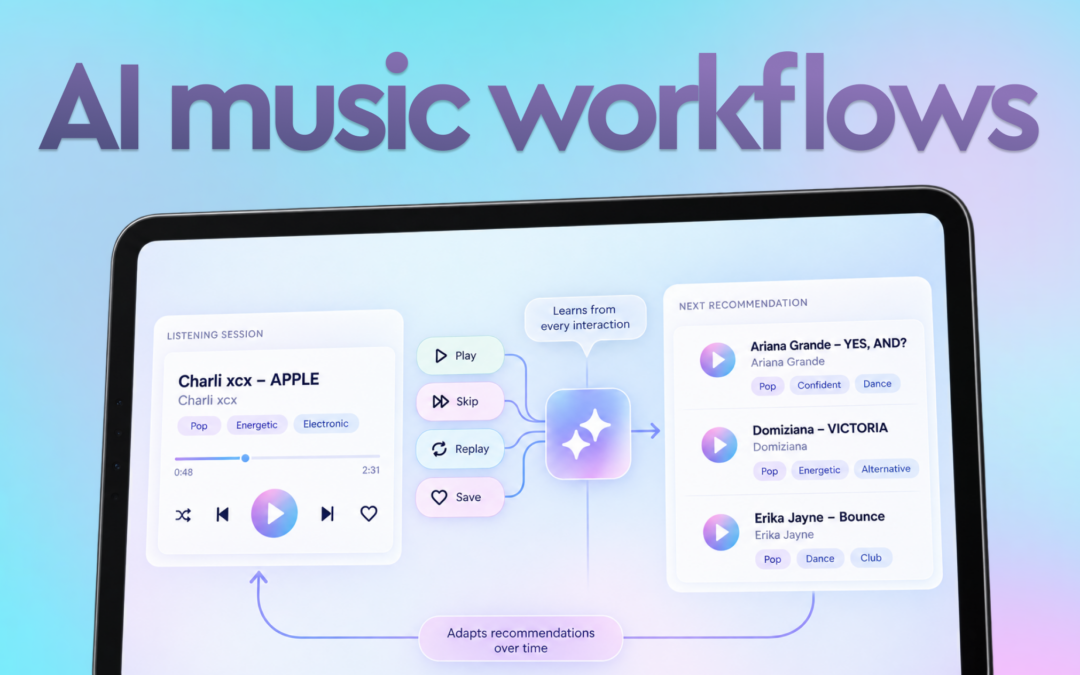
Feedback-driven recommendations treat every listener interaction as part of the recommendation process. Plays, skips, replays, and saves become new inputs that help the agent decide what to recommend next.
Instead of following a predefined sequence, recommendations adapt throughout the listening session as the agent responds to each new signal.
What becomes possible
- Recommendations become more responsive over the course of a session. Each interaction helps shape what the system suggests next.
- Recommendation strategies become more intentional. Because the system understands both the listener’s current goal and their broader listening profile, it can choose when to stay close to familiar music and when to introduce something new.
How to apply it
Design recommendations as continuous discovery instead of a static ranked list. Each listener interaction provides new context that the agent carries into the next retrieval, allowing recommendations to evolve throughout the session instead of following a predetermined path.
The winning Hackatune team applied this through a self-evolving recommendation loop. As listeners responded to recommendations, the agent continuously updated its understanding of the session before deciding what to recommend next.
5. Explainable discovery
“Why this track?” is the first question we ask when we get a recommendation. If we can’t understand why it was selected, it’s difficult to judge whether it’s worth our attention. “Because the algorithm said so” isn’t a good enough explanation.
Explainable discovery gives the listener their answer. It grounds every recommendation in the musical characteristics that made it relevant, making the reasoning behind each result clear.
What becomes possible
- Recommendations become easier to evaluate. Instead of guessing why a track appeared, listeners can quickly decide whether it fits the task at hand, whether that’s building a playlist or selecting music for a project.
- Confidence grows with every recommendation. Listeners can judge recommendations on their own terms instead of treating them as a black box.
- Discovery becomes easier to refine. Listeners have a clear starting point for adjusting the next search.
How to apply it
Build explanations into the recommendation workflow. Whenever a track is surfaced, show the musical characteristics that led to that recommendation so users can understand why it fits before deciding what to do next. Explanations should be part of the experience, not something users have to ask for after the recommendation is given.
The Diversify team explored this approach through its Similar feature. They combined Cyanite’s music understanding with similarity calculations built using Librosa, then surfaced the musical characteristics behind each recommendation so listeners could understand why two songs belonged together.
Contextual metadata can complement those musical explanations, giving listeners a fuller understanding of each recommendation.
Read more: Why context matters in a crowded music catalog
6. Creative brief matching
Creative teams use briefs to communicate what the music needs to accomplish. Before anyone starts searching a catalog, the brief defines the role music should play in the project, whether that’s supporting a story, reinforcing a brand, or shaping the audience’s emotional response.
Creative brief matching uses that direction to search the catalog. Instead of someone needing to translate the brief into search terms, the system interprets the creative intent, translates it into musical characteristics, and retrieves tracks that fit the brief.
What becomes possible
- Creative briefs become actionable. Instead of interpreting a brief and deciding where to start, teams can immediately explore music that reflects its creative direction.
- Early-stage music discovery becomes faster. Teams can explore suitable directions before narrowing their choices, even when the brief contains no musical terminology.
- Non-musical references become useful search inputs. Campaign ideas, visual concepts, and story descriptions can all guide music discovery.
How to apply it
Diversify explored this workflow through two features. MoodBoard let users upload an image and receive music that matched its visual direction, showing how creative references can become searchable without users needing to describe the music itself.
Brief let users describe a scene or creative objective in natural language, such as “music for a Nike ad.” The LLM interpreted that request as musical intent and surfaced tracks that matched it.
The common thread
Although these workflows solve different problems, they all rely on the same interaction between Search and Tagging. Search retrieves the most relevant music for each request. Tagging turns those results into structured descriptions that AI can understand and use throughout the interaction.
That’s why conversational search, recommendations, creative brief matching, and other AI-powered experiences don’t require a different music system for each use case. They draw on the same understanding of the catalog, adapting it to different products and user needs.
Ready to explore these workflows with your own catalog?