
Last updated on October 6th, 2026 at 10:16 am
Bring deeper music understanding into your catalog. Request access to Auto-Tagging 2.0.
To leverage agentic AI workflows in your music catalog, you first need audio-derived information that can be used for reasoning.
Modern LLMs seem like an obvious way to generate that information. They can listen to a recording, describe what they hear, and reason about that information. But when those capabilities become part of professional workflows across thousands or millions of tracks, there’s another requirement: consistency.
In fact, MuChoMusic, a benchmark study co-authored by Cyanite Senior Research Engineer Benno Weck, found that current audio-language models hallucinated instruments that weren’t in the recording, answered around the question being asked with generic statements, fell back on uninformative responses learned from their training data, and in many cases barely registered when the audio changed at all.
You can’t build reliable catalog workflows on information that changes from one query to the next or isn’t consistently grounded in the recording. That consistency needs to hold across the entire catalog, whether it contains thousands or millions of tracks.
So what does music understanding you can actually build on look like?
What music understanding infrastructure actually means
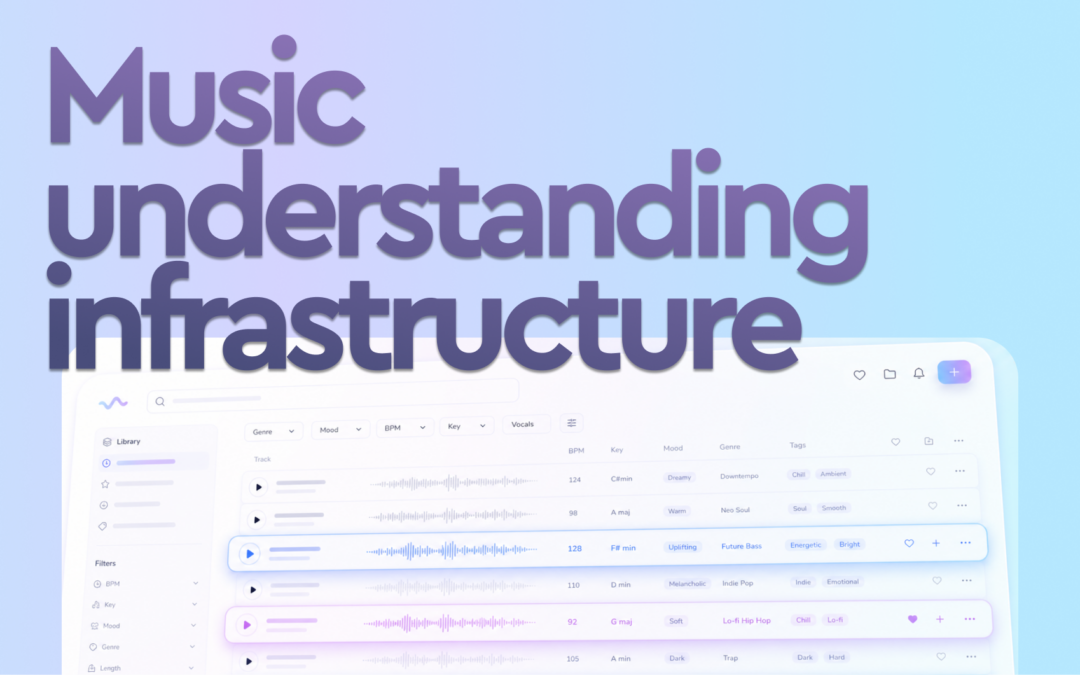
When we talk about music understanding, we mean translating what is present in the audio into structured, machine-readable information about the track, from genre, mood, and energy to tempo, instrumentation, and vocals.
That understanding is an output. Music understanding infrastructure is the system that produces it: the layer that analyzes a track and turns the result into reliable information that can be used for music tagging, catalog search, recommendation, and AI detection workflows.
This infrastructure usually sits underneath the product interfaces people interact with, quietly providing the data they depend on. For instance, a music library like Epidemic Sound has a music understanding layer under the hood, provided by Cyanite, that enables features such as using a prompt to search for a song and in-depth tags for each suggested track.
An audio LLM can describe a track on request, but unless additional structure is imposed, each description is generated anew, so the terminology and level of detail may not be consistent. A dedicated music understanding layer turns that analysis into a stable representation other systems can reliably build on.
Read more: Best AI tools for music tagging and search infrastructure
The building blocks of music understanding infrastructure
Not every system that analyzes music can be considered infrastructure. A music library that wants a searchable catalog and AI workflows running on top needs analysis that meets the requirements below.
Analysis from the audio itself
The same track can arrive in three catalogs tagged “indie pop,” “alternative,” or nothing at all. Metadata usually reflects whoever entered it and why, and it was never meant to describe every aspect of the music.
Analyzing the audio directly creates a consistent starting point: every track is understood from the same source, whether it arrived with 40 tags or none.
Structured output
Structured output means every attribute has a defined field and a defined set of values it can take:
- BPM = 128
- Vocals = female
- Mood = energetic
- Instruments = synth, bass, drum machine
The distinction matters because a field is only queryable if its values are predictable. For instance, if one track comes back with the tag “energetic”, but the next one says “high-energy” and another one says “upbeat and driving,” then you can’t use “energetic” as a mood filter, since you’d miss relevant tracks. In contrast, applying a fixed vocabulary means filtering for “energetic” returns every energetic track in the catalog with the same structured output every time.
If your music understanding model can consistently do this, then an agentic workflow would be able to query bpm > 120 AND vocals = female and act on the result without interpreting anything. The information arrives ready to use.
Breadth of musical dimensions
Tempo, key, instrumentation, mood, vocal presence, and energy each describe something different about a song. The more relevant dimensions a catalog captures, the more precisely search and AI systems can identify tracks that meet specific criteria.
Cyanite’s music tagging taxonomy covers around 30 dimensions per track. Instruments come from a list of 46, each scored depending on whether it appears throughout, frequently, partially, or not at all. Moods come from a vocabulary of 130.
Instrument presence, for instance, is the kind of specificity breadth buys. A search can separate tracks where the piano runs throughout from those where it only appears in one part.
Reliability at scale
Music understanding becomes infrastructure when it works consistently across an entire catalog. Each track can be analyzed once and represented in a way that remains usable as the catalog grows.
This creates a shared foundation for search, recommendation, and AI workflows across thousands or millions of tracks, rather than requiring each application to interpret the audio from scratch.
Trustworthiness
Reliable workflows depend on information that is grounded in the audio. As MuChoMusic showed, general-purpose audio language models can generate plausible descriptions that include characteristics not actually present in a recording.
Cyanite’s music understanding runs on an ensemble of expert models rather than a single LLM, each trained for a specific musical dimension and optimized for precision. That architecture is deterministic: the same audio produces the same analysis every time, and there’s no generative step that can invent an instrument. This eliminates the risk of hallucination.
For professional catalogs, greater precision at the analysis layer creates greater confidence in everything built on top of it.
Read more: How music platforms build personalized discovery with sound-based AI
Why it all works together as one
Cyanite provides the music understanding layer that LLMs and agentic workflows can use instead of trying to interpret every song for themselves.
That same underlying understanding supports different capabilities across the platform:
- Tagging makes the musical information explicit.
- Search matches a request against the catalog as a whole, and recommendations use the same analysis to surface tracks that belong together.
- AI Music Detection applies the same audio-first approach to determine whether a track was made with generative AI.
Together, these capabilities draw on the same consistent, audio-grounded analysis.
As AI evolves, the applications will change. The understanding they rely on doesn’t have to.