How Cyanite protects your sensitive audio: privacy-first workflows for every catalog

How Cyanite protects your sensitive audio: privacy-first workflows for every catalog

Looking for secure AI music analysis? Discover Cyanite’s integration options. 

For many music teams, a significant hesitation about AI analysis is not about its capability or quality. It’s about trust. When teams explore AI-driven tagging or search, the conversation almost always leads to the same question: What happens to our audio once it leaves our system?

At Cyanite, we’ve built our technology around that concern from the very beginning. Rather than offering a single security promise, we provide multiple privacy-first workflows designed to meet different levels of sensitivity and compliance. This gives teams the flexibility to choose how their audio is handled, without compromising on tagging quality or metadata depth.

This article outlines the three privacy models Cyanite offers, explains how each one works in practice, and helps you decide which setup best fits your catalog and internal requirements.

Why audio privacy matters in modern music workflows

For those who manage it, audio represents creative identity, contractual responsibility, and, often, years of human effort. It’s not just another data type. Sending that material outside an organization can feel risky, even when the technical safeguards are strong and the operational benefits are clear.

Teams that evaluate our services often raise concerns about protecting unreleased material, complying with licensing agreements, and maintaining long-term control over how their catalogs are used. They look for assurances around:

  • Safeguarding confidential or unreleased content
  • Complying with NDAs and contractual obligations
  • Meeting internal legal or security standards
  • Maintaining full ownership and control

These are not edge cases. They reflect everyday realities for publishers, film studios, broadcasters, and music-tech platforms alike. That’s why Cyanite treats privacy as a core design principle.

Security option 1: GDPR-compliant processing on secure EU servers

For many organizations, strong data protection combined with minimal operational complexity is the right balance. In Cyanite’s standard setup, all audio is processed on secure servers located in the EU and handled in full compliance with GDPR.

In practical terms, this means:

  • Audio files are never shared with third parties.
  • Songs can be deleted anytime.
  • Ownership and control of the music always remains with the customer.

This model works well for publishers, production libraries, sync platforms, and music-tech companies that want to scale tagging and search workflows without maintaining their own infrastructure. For most catalogs, this level of protection is both robust and sufficient.

That said, not every organization is able to send audio outside its own environment, even under GDPR. For those cases, Cyanite offers additional options.

Learn more: See how AI music tagging works in Cyanite and how it supports large catalogs.

Security option 2: zero-audio pipeline—tagging without transferring audio

Some teams manage catalogs that cannot be transferred externally at all. These include confidential film productions, enterprise music departments, and archives operating under strict internal compliance rules. For these situations, Cyanite provides a spectrogram-based workflow that enables full tagging without the audio files ever being sent.

Three spectograms

Spectrograms from left to right: Christina Aguilera, Fleetwood Mac, Pantera

Instead of uploading MP3s, audio is converted locally on the client side into spectrograms using a small Docker container provided by Cyanite. A spectrogram is a visual representation of frequency patterns over time. It contains no playable audio, cannot be converted back into a waveform without significant quality loss, and does not expose the original performance in any usable form.

From a metadata perspective, the results are identical to audio-based processing. From a privacy perspective, the original audio never leaves the customer’s environment. This makes the zero-audio pipeline a strong middle ground for teams that want AI-powered tagging while maintaining strict control over their content.

From a product perspective, all Cyanite features can be fully leveraged.

For us at Synchtank, the spectrogram-based upload was key. Many of our clients are cautious about where their audio goes, and this approach lets us use high-quality AI tagging and search without transferring any copyrighted audio. That balance, confidence for our customers without compromising on quality, is what made the difference for us.Amy Hegarty, CEO at Synchtank 

Learn more: What are spectrograms, and how can they be applied to music?

Security option 3: fully on-premise deployment via the Cyanite Audio Analyzer on the AWS Marketplace

For organizations with the highest security and compliance requirements, Cyanite also offers a pseudo-on-premises deployment option via the AWS Marketplace. In this setup, Cyanite’s tagging engine runs entirely inside the customer’s own AWS cloud infrastructure via the Cyanite Audio Analyzer.

This approach provides:

  • Complete pseudo-on-premise processing
  • Zero data transfer outside your AWS cloud environment
  • Full control over storage, access, and compliance
  • Tagging accuracy identical to cloud-based workflows

This option is typically chosen by film studios, broadcasters, public institutions, and organizations working with unreleased or highly sensitive material that must pass strict internal or external audits.

Because the pseudo-on-premise container operates in complete isolation (no internet connection), search-based features—including Similarity Search, Free Text Search, and Advanced Search—are not available in this setup. In pseudo-on-premise environments, Cyanite therefore focuses exclusively on audio tagging and metadata generation.

Important note: The rates on the AWS Marketplace are intentionally high to deter fraudulent activity. Please contact us for our enterprise rates and find the best plan for your needs.

Choosing the right privacy model for your catalog

Selecting the right setup depends less on catalog size and more on how tightly you need to control where your audio lives. A useful way to frame the decision is to consider how much data movement your internal policies allow.

In practice, teams tend to choose based on the following considerations:

  • GDPR cloud processing works well when secure external processing is acceptable.
  • Zero-audio pipelines suit teams that cannot transfer audio but can share abstract representations.
  • Pseudo-on-premise deployment is best for environments requiring complete isolation.

All three options deliver the same tagging depth, consistency, and accuracy. The difference lies entirely in how data moves, or doesn’t move, between systems.

Final thoughts

Using AI with music requires trust—trust that audio is handled responsibly, that ownership is respected, and that workflows adapt to real-world constraints rather than forcing compromises. Cyanite’s privacy-first architecture is designed to uphold that trust, whether you prefer cloud-based processing, a zero-audio pipeline, or a fully isolated pseudo-on-premise deployment.

If you’d like to explore which setup best fits your catalog, workflow, and compliance needs, you can review the available integration options.

FAQs

Q: Where is my audio processed when using Cyanite’s cloud setup?

A: In the standard setup, audio is processed on secure servers located in the EU and handled in full compliance with GDPR. Audio is not shared with third parties and remains your property at all times.

Q: Can I use Cyanite without sending audio files at all?

A: Yes. With the zero-audio pipeline, you convert audio locally into spectrograms and send only those abstract frequency representations to Cyanite. The original audio never leaves your environment, while full tagging results are still generated.

Q: What is the difference between the zero-audio pipeline and pseudi-on-premise deployment?

A: The zero-audio pipeline sends spectrograms to Cyanite’s cloud for analysis. The pseudo-on-premise deployment runs the Cyanite Audio Analyzer entirely inside your own AWS cloud infrastructure, which is cut off from the internet and only connected to your system. Pseudo-on-premises offers maximum isolation but only supports tagging, without search features.

Q: Are Similarity Search and Free Text Search available in all privacy setups?

A: Similarity Search, Free Text Search, and Advanced Search are available in cloud-based and zero-audio pipeline workflows. In fully pseudo-on-premise deployments, Cyanite focuses exclusively on tagging and metadata generation due to the isolated environment.

Q: Which privacy option is right for my catalog?

A: That depends on your internal security, legal, and compliance requirements. Teams with standard protection needs often use GDPR cloud processing. Those with higher sensitivity choose the zero-audio pipeline. Organizations requiring full isolation opt for on-premise deployment. Cyanite supports all three.


What is Music Prompt Search? ChatGPT for music?

What is Music Prompt Search? ChatGPT for music?

Last updated on March 6th, 2025 at 02:14 pm

How Music Prompt Search Works & Why It’s Only Part of the Puzzle

Alongside our Similarity Search, which recommends songs that are similar to one or many reference tracks, we’ve built an alternative to traditional keyword searches. We call it Free Text Search – our prompt-based music search. 

Imagine describing a song before you’ve even heard it:

Dreamy, with soft piano, a subtle build-up, and a bittersweet undertone. Think rainy day reflection.

This is the kind of prompt that Cyanite can turn into music suggestions – not based on genre or mood tags, but on the actual sound of the music. 

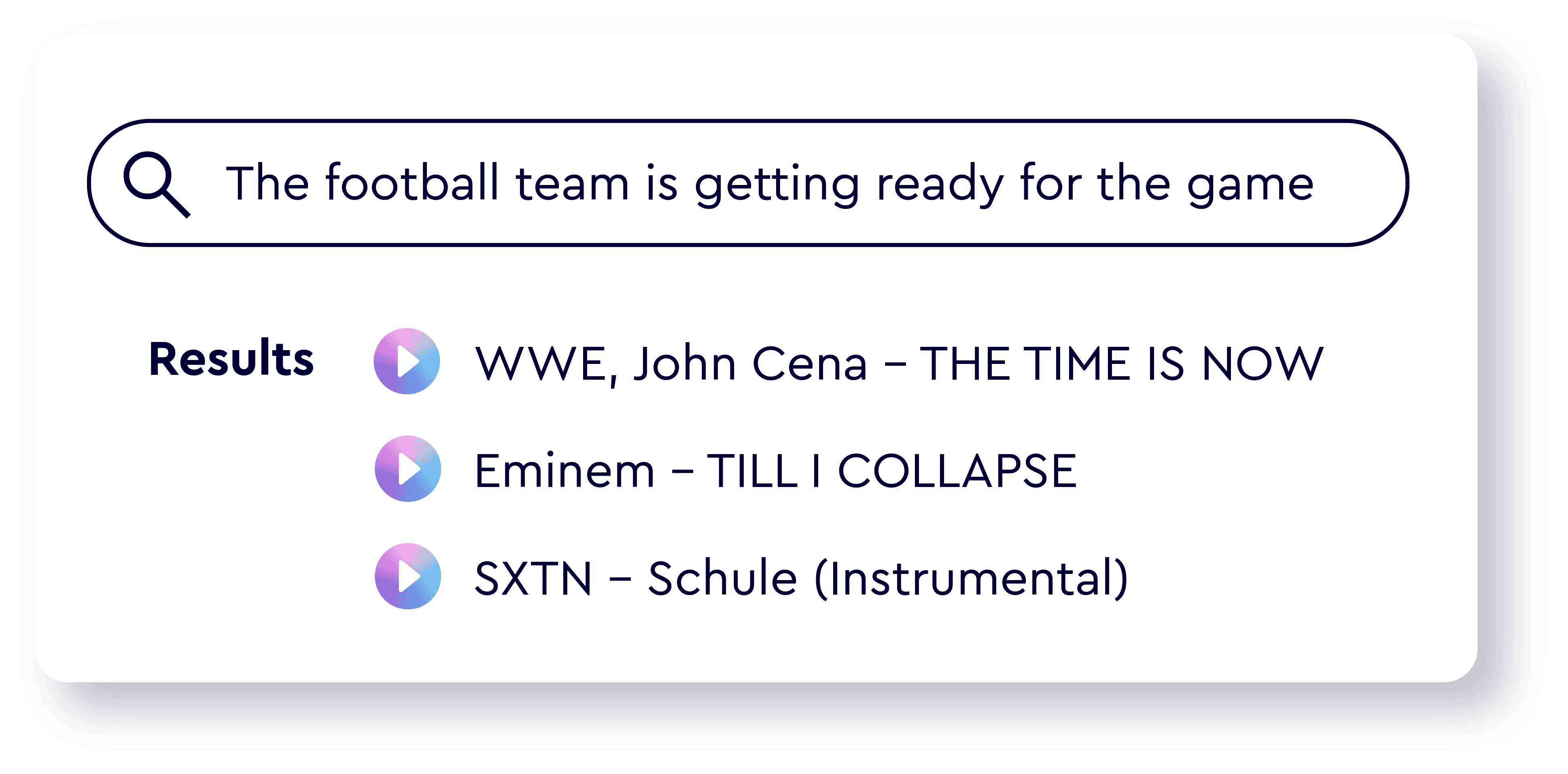
Music Prompt Search Example with Cyanite’s Free Text Search

What Is Music Prompt Search?

Prompt search allows you to enter a natural language description (e.g. uplifting indie with driving percussion and a nostalgic feel) and get back music that matches that idea sonically. 

We developed this idea in 2021 and were the first ones to launch a music search that was based on pure text input in 2022. Since then we’ve been improving and refining this kind of AI-powered search so that it can accurately translate text into sound. That way, you will get the closest result to the prompt that your catalog allows for. 

We are not searching for certain keywords that appear in a search. We directly map text to music. We make the system understand which text description fits a song. This is what we call Free Text Search.

Roman Gebhardt

CAIO & Founder, Cyanite

Built with ChatGPT? Not All Prompts Are Created Equal

More recently, different companies have entered the field of prompt-based music search, using large language models like ChatGPT as a foundation. These models are strong at interpreting natural language, but can not understand music the way we do. 

They generate tags based on text input and then search those tags. So in reality, these algorithms work like a traditional keyword search, and only decipher natural language prompts into keywords. 

When Prompt Search Shines

Prompt search is a game-changer when:

  • You have a specific scene or mood in mind
  • You’re working with briefs from film, games, or advertising
  • You want to match the energy or emotional arc of a moment

This is ideal for music supervisors, marketers, and creative producers.

Note: Our Free Text Search just got better!

With our latest update, Free Text Search is now:

✅ Multilingual – use prompts in nearly any language

✅ Culturally aware – understand references like “Harry Potter” or “Mario Kart”

✅ Significantly more accurate and intuitive

It’s available free for all API users on V7 and for all web app accounts created after March 15. Older accounts can request access via email.

Why We Build Our Own Models

We chose to develop every model in-house 

Not only for data security and IP protection, but because music deserves a dedicated algorithm. 

Few things are as complex and deep as the world of music. General-purpose AI doesn’t understand the nuance of tempo shifts, the subtle timbre of analog synths, or the emotional trajectory of a song.

Our models are trained on the sound itself. That means:

    • More precise results
    • Higher musical integrity
    • More confidence when recommending or licensing tracks

If you wanna learn more on how our models are working – check out this blog article and interview with our CAIO Roman Gebhardt.

Want to try our Free Text Search on your own music catalog?

Sync Music Matching with AI-powered Metadata | A Case Study with SyncMyMusic

Sync Music Matching with AI-powered Metadata | A Case Study with SyncMyMusic

The Problem

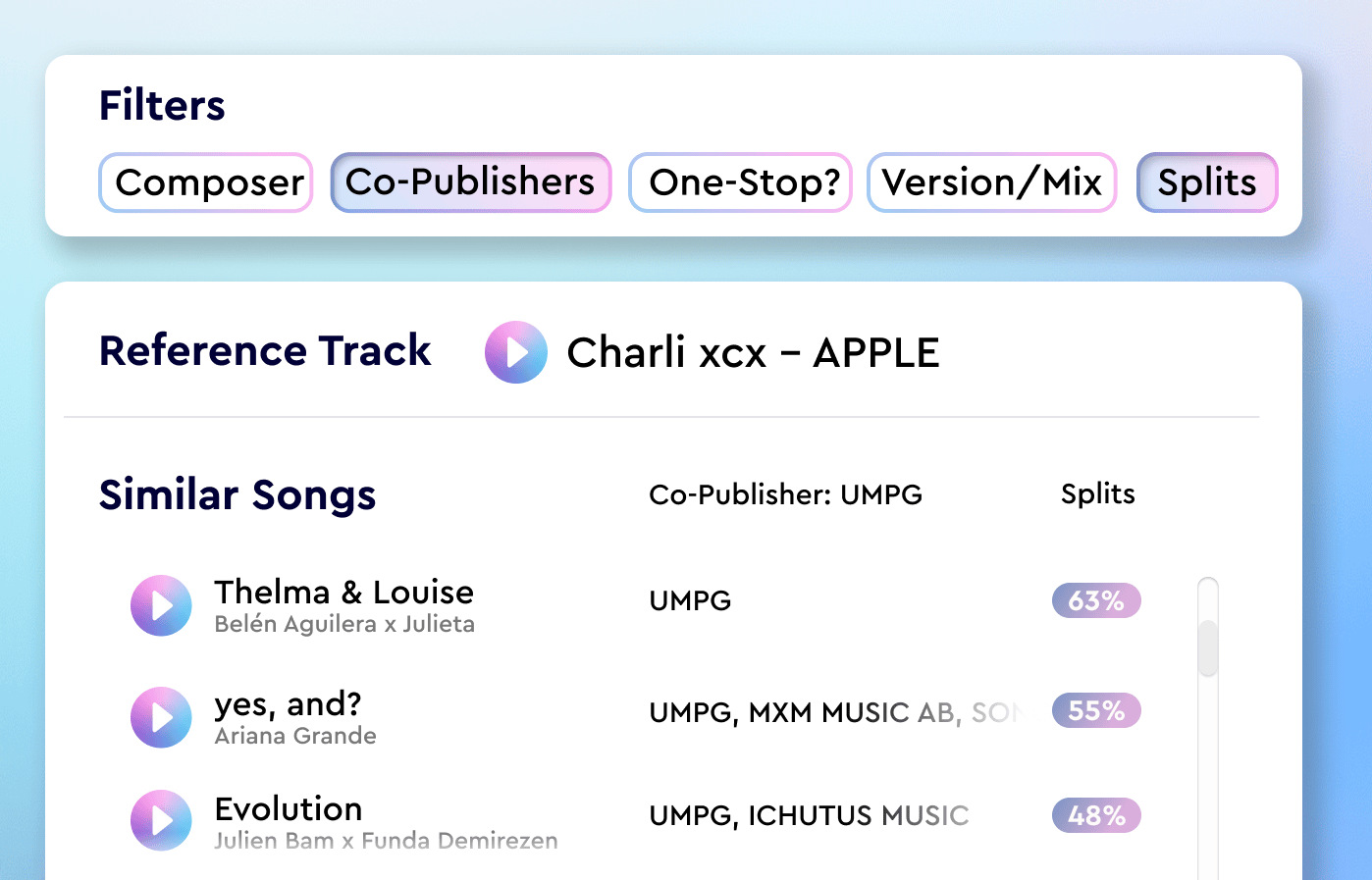
The sync licensing industry faces a fundamental information asymmetry problem. With hundreds of production music libraries operating globally, producers struggle to identify which companies are actively placing their style of music. Jesse Josefsson, veteran of 10,000+ sync placements, identified this gap as a core market inefficiency.

Genres were wrong, moods were wrong. Just not even close to what I would think as acceptable answers for an auto tagging model.

Jesse Josefsson

Founder, SyncMyMusic

Key Challenges:

    • Producers pitching to inappropriate libraries for years without results
    • Manual research taking days or weeks per opportunity
    • Inaccurate tagging solutions create more problems than they solve
    • Industry professionals “flying blind” when making strategic decisions

The Solution

One of the members said it was so accurate, it was almost spooky because it got things and it labeled things that even they wouldn’t have probably thought of themselves.” – Jesse Josefsson

After evaluating multiple auto-tagging solutions, SyncMyMusic selected Cyanite based on accuracy standards and industry reputation. The platform architecture combines TV placement data with AI-powered music metadata analysis to deliver targeted recommendations.

Why Cyanite:

    • Industry-leading accuracy in genre and mood classification
    • Partnership credibility through SourceAudio integration
    • Responsive customer support with sub-2-hour response times
    • Seamless API integration capabilities

The Implementation

I’m what they would probably call a “vibe coder”. I don’t have coding skills, but if I can do this, you can do this.Jesse Josefsson

Jesse built the entire SyncMatch platform using AI tutoring (ChatGPT/Grok) and automation tools (make.com) without traditional coding experience. The implementation took 2.5 months from concept to MVP, demonstrating how modern no-code approaches can deliver enterprise-grade solutions.

AI-Powered Music Marketing feat. Chromatic Talents

AI-Powered Music Marketing feat. Chromatic Talents

Chromatic Talents acts like a music brand consultancy providing a comprehensive range of services in artist management, development, digital branding, and business development. Find out how they use AI-Powered Music Marketing powered by Cyanite. The goal of the...

Cyanite Advanced Search (API only)

Cyanite Advanced Search (API only)

Ready to supercharge your discovery workflows? Try out the Advanced Search API.

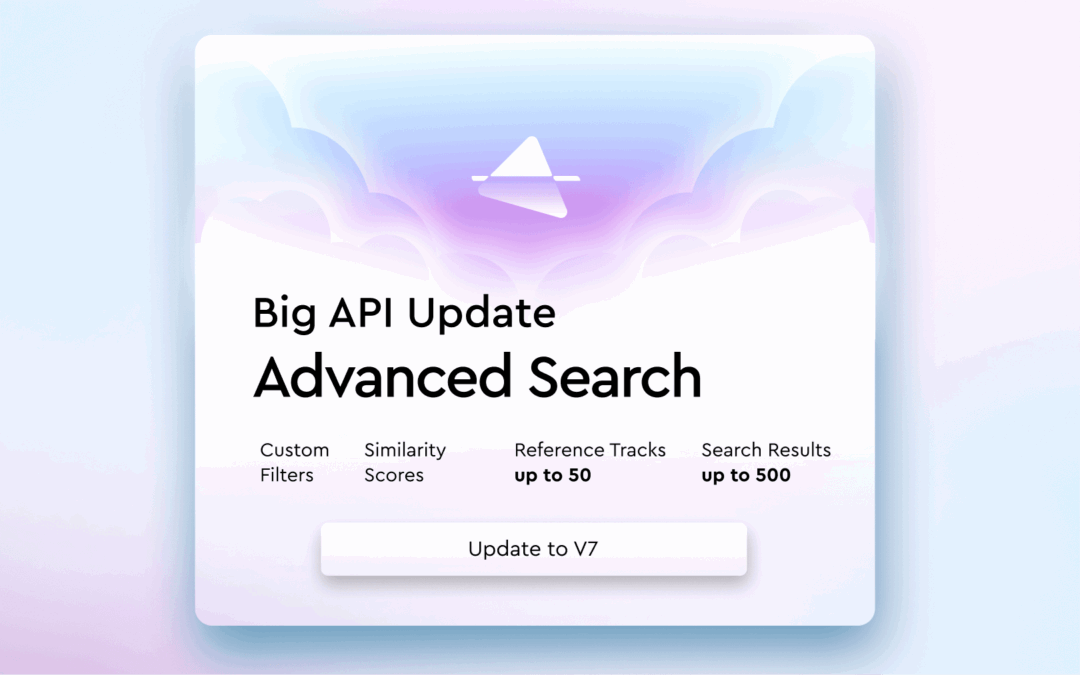
We’re excited to introduce Advanced Search, the biggest upgrade to Similarity and Free Text Search since we launched. With this release, we’re offering a sneak preview into the power of the new Cyanite system.

Advanced Search brings next-level precision, scalability, and usabilityall designed to supercharge your discovery workflows. From advanced filtering to more nuanced query controls, this feature is built for music teams ready to move faster and smarter.

Note: Advanced Search is an API-only feature intended for teams with developer resources who want to integrate Cyanite’s intelligence directly into their own systems.

Advanced Search Feature Overview

Click on the bullet point to jump to each feature directly

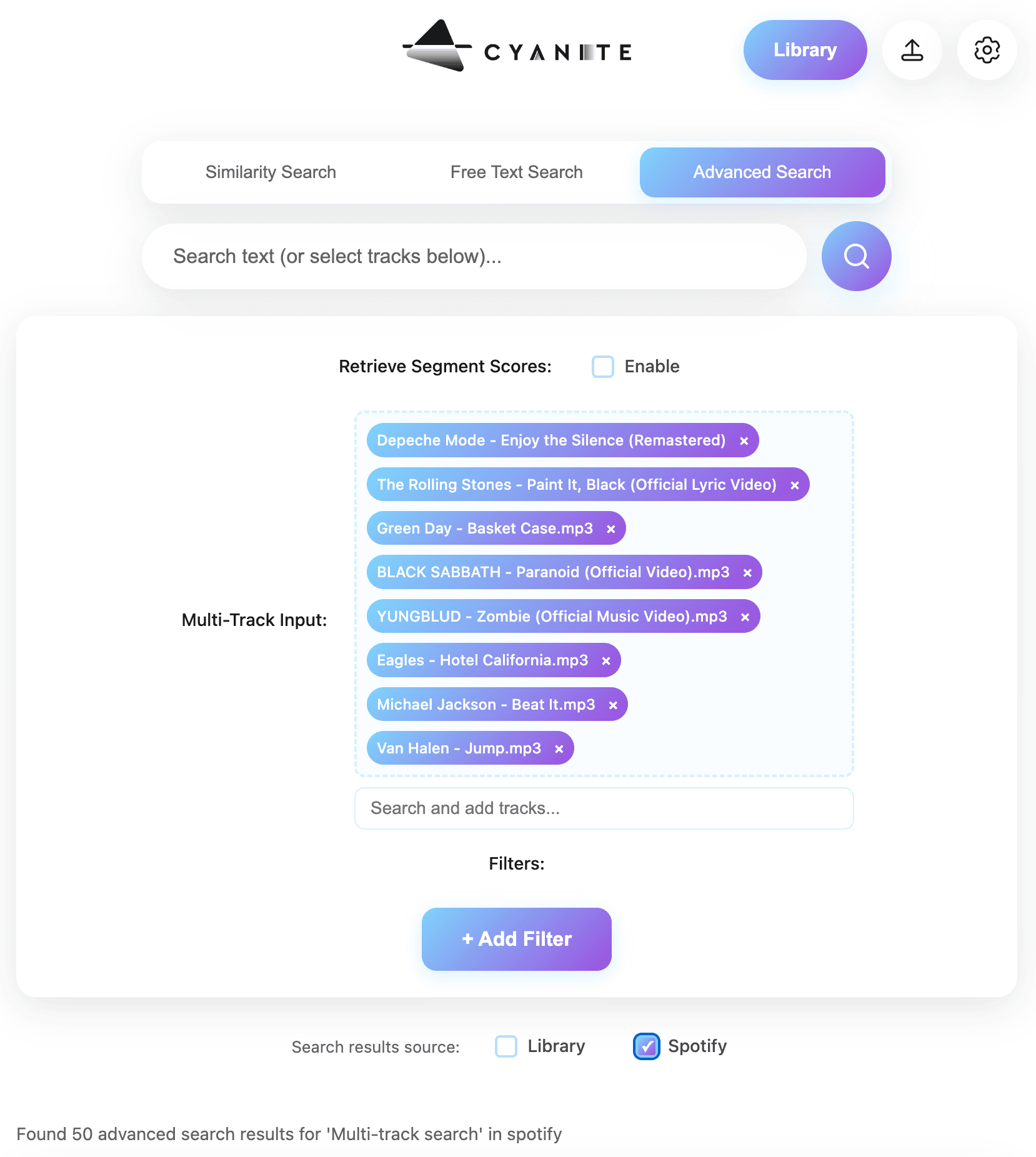
Multi-Track Search – multiple search inputs for playlist magic

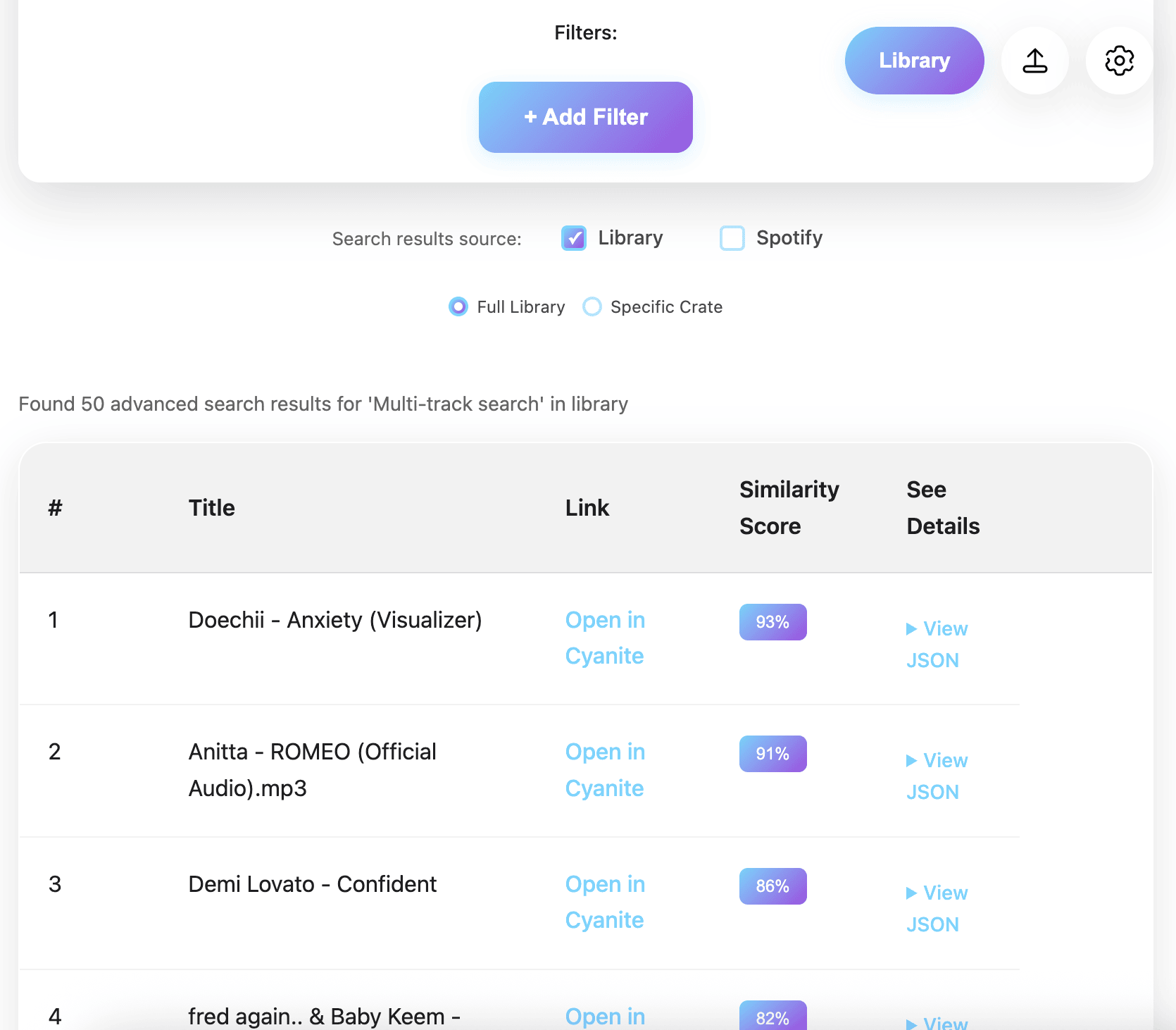
Similarity Scores: Total Clarity, Total Control

Now each result comes with a clear percentage score, helping you quickly evaluate how close a match really is—both for the overall track and for each top scoring segment. It’s a critical UX improvement that helps users better understand and trust the search results at a glance.

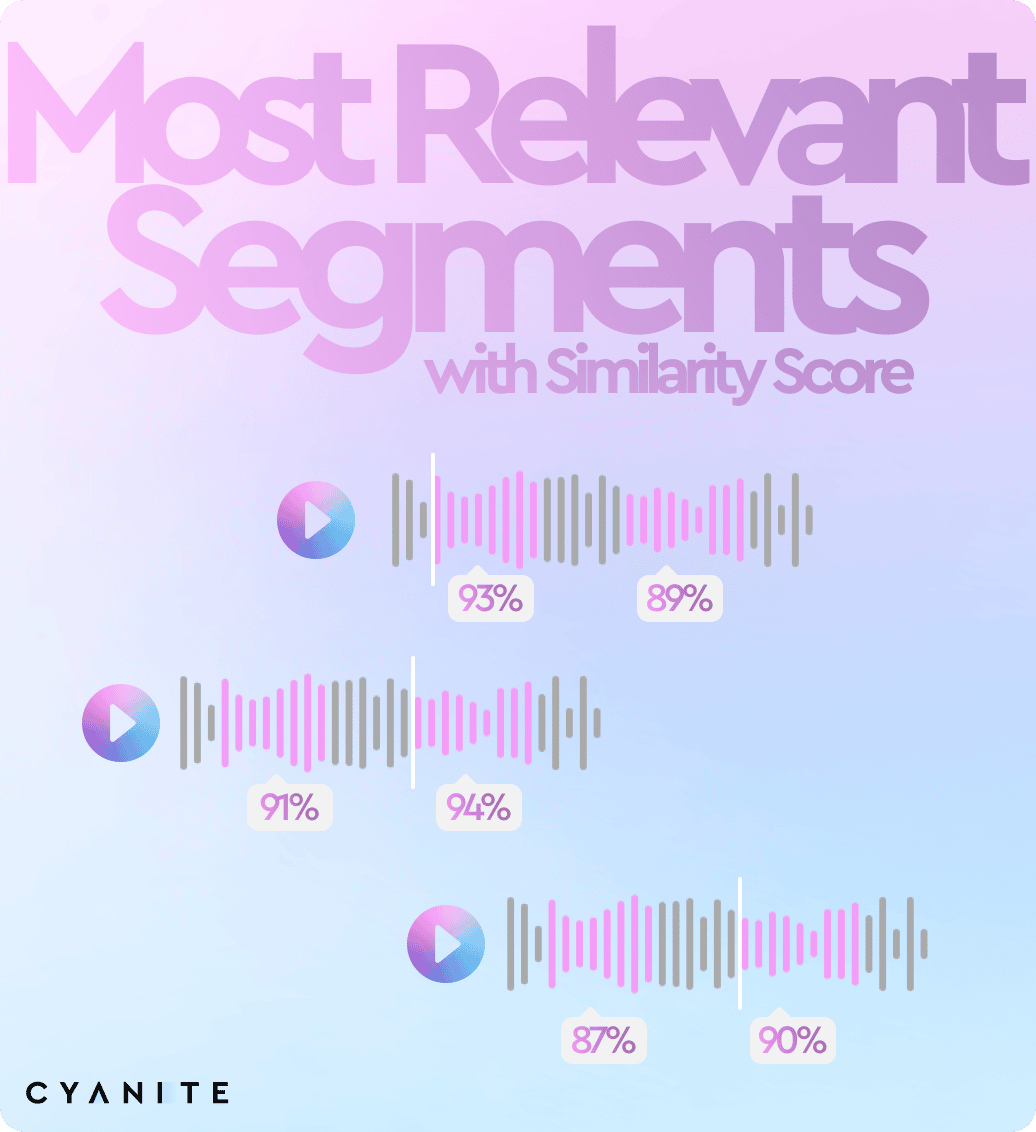
Most Relevant Segments zoom in on the best parts

We’re not just showing you results, we’re showing you their strongest moments. Each track now highlights its Most Relevant Segments for both Similarity and Free Text queries. It’s an instant way to jump to the most relevant slice of content without scrubbing through an entire track. 

Custom Metadata Filters – smarter searches start with smarter filters

Upload your own metadata to filter results before the search even begins. Want only pre-cleared tracks? Looking for music released after 2020? With Custom Metadata Filtering, you can target exactly what you need, making your search dramatically more efficient.

Up to 500 Search Results – sometimes more is more

Tired of hitting a ceiling with limited search returns? Now, Similarity Search and Free Text Search deliver up to 500 results, giving you a much broader snapshot of what’s out there. Whether you’re refining a vibe or exploring diverse sonic textures, you’ll have a fuller landscape to work with.

Testing Advanced Search free for a month gave us the confidence we needed to update our search and tagging systems. The integration was smooth, and we were able to ship several exciting features right away – but we’ve only scratched the surface of its full capabilities!

Jack Whitis

CEO, Wavmaker

Ready to level up your catalog search?

Advanced Search introduces a more powerful way to work with your catalog. It is most useful for teams who already understand our core music discovery tools. If you have not yet tried Similarity Search or Free Text Search, sign up to Cyanite and start finding tracks that match the musical references or creative direction you’re working with. 

When you’re ready to take it a step further, explore a track’s strongest moments or enhance your metadata with custom tags using Advanced Search. Make sure you are operating on Cyanite’s v7 architecture, since it enables the full capabilities of the new system.

Viralnoise x Cyanite: AI Music Search for Content Creation

Viralnoise x Cyanite: AI Music Search for Content Creation

Last updated on March 6th, 2025 at 02:14 pm

By Viralnoisehttps://www.viralnoise.com/

Finding the perfect track for your content used to mean endless scrolling, hoping you’d stumble across something that just worked. Those days? They’re over. Thanks to our partnership with Cyanite, creators are discovering their ideal soundtracks in seconds, not hours. Powered by Cyanite’s AI music search.

The Music Selection Struggle is Real

Here’s the thing about music selection: it’s make-or-break for your content, but it’s also one of the most time-consuming parts of the creative process. You know what you want your content to feel like, but translating that feeling into the right track? That’s where most creators hit a wall.

Maybe you’ve got zero musical background but you know you need something that builds energy without overwhelming your voiceover. Or you’ve heard the perfect track on someone else’s content and you’re desperate to find something similar. Traditional music libraries leave you playing guessing games with genre tags and hoping for the best.

Enter AI Music Search Intelligence

Our partnership with Cyanite has completely transformed how creators find music on Viralnoise – specifically when you need to match a specific sound. When combined with our carefully curated human-generated playlists and album collections, Cyanite’s AI provides a powerful AI music search tool for matching reference material. It’s like having a music supervisor who knows the entire Viralnoise catalog right there at your disposal, 24/7.

This is where the magic happens: Cyanite’s AI actually listens to music the way humans do, understanding mood, energy, instruments, and even emotional progression throughout a song. Got a YouTube video or Spotify track that has exactly the sound you want? Just drop that link into our search bar. Cyanite’s AI analyzes the musical DNA of your reference track and finds similar options in our catalog. Same energy, same mood, but completely cleared for your content.

Viralnoise’s AI search has completely changed how I approach finding music. I’m constantly discovering new artists and sounds that inspire me, so being able to just paste a link from YouTube or Spotify and instantly get similar tracks from Viralnoise’s catalog is a total game-changer. It’s saved me hours of digging through playlists.

Corey Moss

Content Creator, Bold Soul Sports

The time saved here is incredible. Instead of trying to describe what you heard in someone else’s video, you can show us exactly what you want and get matching options instantly.
Paste a link or upload an mp3 to search for similar tracks to your reference material

Find Similar Tracks in our Catalog

Already found something you like on Viralnoise but want more options with that same vibe? Cyanite’s AI can analyze any track in our catalog and surface similar options. This means when you find one great track, you’re actually finding a whole sonic palette to work with.

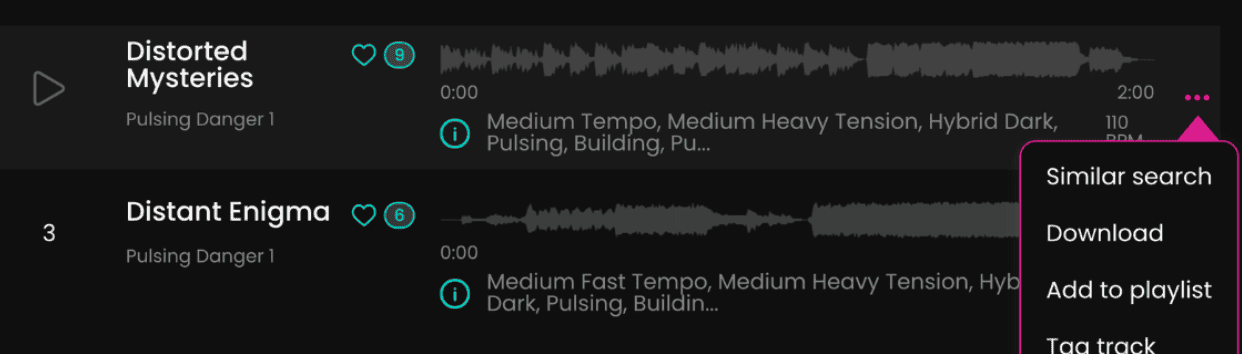
Every track has a Similar Search function that is easily accessed in the side bar.

Zero Musical Background Required

You don’t need to know the difference between a minor and major key to find professional-quality music for your content. The AI translates your creative vision into actual musical characteristics. This has democratized music selection in a way that’s never existed before.

Why This Partnership Changes Everything

Cyanite’s technology has made Viralnoise the go-to platform for creators who know exactly what they want but struggle to find it through traditional search methods. We’re talking about creators finding their perfect track in under a minute instead of losing entire afternoons trying to describe that one specific sound they heard somewhere else.

The AI understands musical relationships in ways that go far beyond genre tags. It recognizes when two tracks share similar emotional arcs, instrumentation choices, or energy patterns – even if they’re technically in different genres.

Professional Results, Creator-Friendly Process

What we’ve built together isn’t just faster – it’s smarter. The same tracks that major productions use are now accessible to solo creators through AI-powered search that actually understands what you’re trying to create.

When your content needs that perfect sonic foundation and you’re working against tight deadlines, having AI that can instantly parse our entire catalog based on your specific needs? That’s not just convenient – it’s revolutionary.

Ready to experience how AI-powered music search can transform your content creation workflow? Your perfect track is waiting at Viralnoise – and now it’s easier to find than ever.