
5 Technology Trends for Catalog Owners – How Technology is Changing the Music Industry?
The music industry is technology-driven. As new technologies become mainstream, how customers use them affects how music industry players organize their catalogs. Even though traditional structures make it a challenge for music labels, publishing houses, and distribution companies to adapt quickly, to truly monetize the potential value of a music catalog, a continuously evolving market needs to be addressed.
This article explores the state of technology in the music industry and outlines 5 emerging technologies that are disrupting the field.
The Current State of Technology in the Music Industry
Digital technology has been affecting the music industry for many years. Nowadays professional musicians can record music at home and the control over the distribution channels is mainly in the hands of digital platforms. These developments plus the proliferation of social media and video channels mark the democratization of the music industry.
The pandemic brought about the inability to hold live performances which in turn propelled digital technology to even more growth. At the same time, Tik Tok reached its popularity around the same time and its easily discoverable bite-sized music has been celebrated by younger music fans.
In 2022 the market continues to develop with new technology in music industry emerging and the center of entertainment shifting from live venues to home and virtual reality.
Emerging Technologies in the Music Industry
These four major technology trends affect the future of the music industry and are increasingly important for music catalog owners.
Trend 1 – New media production & consumption channels
@Alexander Shatov from Unsplash
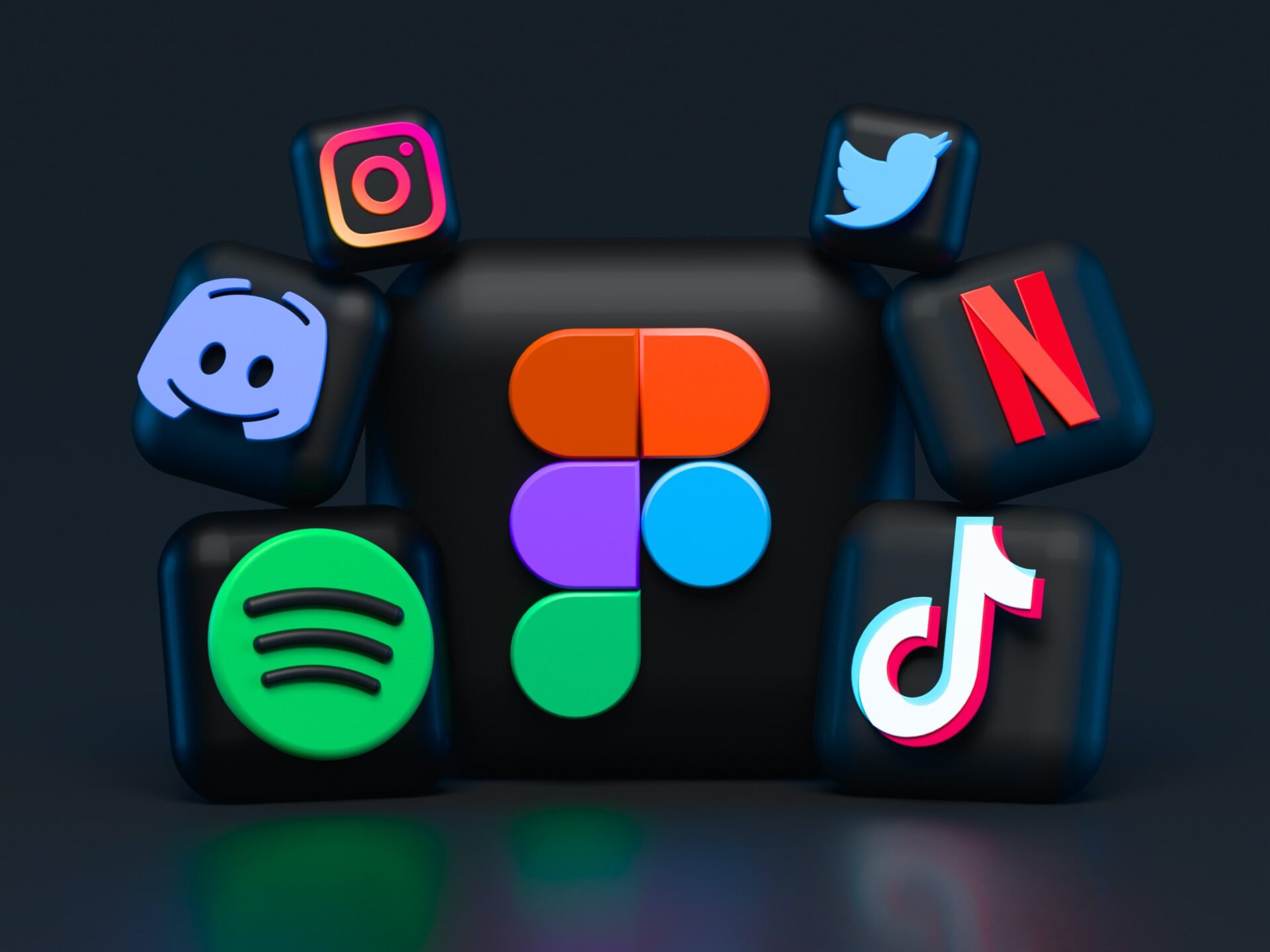
User-generated content (UGC) amplifies the amount of music content created these days. The delivery and consumption of music are now often happening through UGC channels such as Instagram reels, Facebook Watch, and Tik Tok. Big streaming platforms are under clear pressure as social media continues to gain further musical ground. The proliferation of these channels means that everyone can be a creator and produce music.
This is not a new trend. Since the launch of Spotify, the amount of music content produced and consumed has skyrocketed. It was fueled by the freemium approach adopted by most streaming services. Users sign up for free and have access to an endless catalog of content. As a result, artists and creators were able potentially to reach millions of listeners worldwide.
With this incentive, content creators have jumped on board, signing exclusive deals with these platforms. All these developments plus the rise of UGC have led to more music content than we can consume in our lifetime.
As further entry points continue to appear for independent creators to offer content, this fully opens the floodgates of the UGC flood. AI-generated music will also be submitted by creators, which multiplies release cadences exponentially. Trawling through all the data to categorize it becomes challenging. The music industry responded to these challenges with the development of AI tagging and classification engines, that can categorize the catalog and help create more targeted campaigns for music releases on various platforms. Just recently Soundcloud acquired Musiio – an automated tagging and playlisting engine to help categorize Soundcloud’s vast music library which proves how important categorization is for these platforms.
Trend 2 – Using AI to evaluate and benchmark a catalog

@Jeremy Bezanger from Unsplash
To respond to a constant increase in the amount of music content, AI is being used as the main tool for sorting and organizing the library. The basic thing such an AI does is it tags music in the catalog automatically so the classification is consistent. It can also analyze the constant stream of new songs and tag them according to the catalog’s classification. The ability of AI to categorize large amounts of music data as well as do the tagging on the fly keeps the catalog’s volume manageable.
Not only does AI work with new content, but it also helps music library owners get the most out of the library in terms of revenue. AI is used to bring to light the back catalog where all the niche songs are stored in the tail and revive old music genres and subgenres. It solves the so-called long-tail problem using a combination of tagging, which makes old and niche songs easier to discover for search engines, and similarity search algorithms that find tracks similar to popular artists based on metadata.
Standing aside is the inability of search engines to respond to the needs of customers, which is one of the reasons behind the rise of user-generated content. Finding fitting songs is still a challenge as most music remains uncategorized and manually tagged. Using AI to improve the search function in the catalog is a new music technology that’s coming forward.
To read more about AI for tagging and benchmarking, see the article on the 4 Applications of AI in the Music Industry.
Trend 3 – The rise of AI-generated music

@marcelalaskoski from Unsplash
It is clear that AI presents manifold opportunities to music catalog owners. But what about the music itself and music creators. Although AI-generated music dates back to the Illiac Suite of 1957, it attracted more interest during the last decade – just in 2019, the first music-making AI signed a deal with a major label.
While the quality of AI-generated music keeps improving, an algorithm that can generate Oscar-worthy film scores or emotionally riveting material is a distant reality. Currently, AI is used more as a tool for assisting in music creation, generating ideas that producers or artists turn into tracks. For example, Google’s Magenta provides such a tool
That said, music catalog owners need to be aware that AI-generated music will continue to improve. Those looking for alternatives to score their projects may consider exploring it as an option. In the future, the chances are high that AI-generated music will end up in your catalog along with other tracks, which returns us back to the question of proper classification and music search. While AI-generated music is definitely an opportunity for the music industry, it raises several problems including copyright issues and classification.
Trend 4 – Music for Extended Reality

A new wave of technology trends brings new forms of media content. The two applications most relevant for music catalog owners are Augmented Reality (AR) and Virtual Reality (VR).
Both rely on immersion, which refers to how believable the experience is for the user. Music is used to increase this believability. Just like the movie score creates an emotional connection with the viewer, music in AR and VR can enhance and stimulate the effect of the virtual space you’re moving around in.
The emotional and situational contexts are therefore critical. It is likely that AR and VR will follow the game industry to provide immersive music experiences. For example, adaptive soundtracks are already used in games where the music changes based on where the character is in the game and their perspective. Apple is rumored to release such an AR/VR set at the end of 2022 where music adapts to the environment.
For AR and VR, you’d need to identify songs that adapt to the positioning, movement, and changing emotional state of users. This would mean tagging the songs for mood and other XR-related factors if you want to increase the speed of finding the right song.
Trend 5 – Music search will be assisted with technologies like Google
The quality of the search function supported by AI tagging is already high enough, but the way music is searched for is going through a transformation. The future of music search looks similar to what Google offers now, which is the search result based on the user’s input of phrases or sentences in the search bar. According to our research, the ability of AI to translate music into text-based descriptions is one of the most anticipated technologies of 2022.
Right now you can only search music by its meta-information such as the artist or title, or by specific descriptors, for example, mood or genre. For example, in Cyanite keyword search by weights allows to select up to 10 keywords and then specify their weights from 0 to 1 to find the right fitting track. You can also use Similarity Search which takes the reference track and gives you a list of tracks that match. To see this use case in action, see the Video Interview – How Cinephonix Integrated AI Search into Their Music Library.
The AI-based text descriptions take into account many characteristics of the song so simply typing “richly textured grand orchestral anthem featuring a lusty tenor and mezzo soprano“ will return a list of songs that correspond to the search query.
How the music business will change in the next 5-10 years
The development of technologies has always been challenging for the music industry. First, artists and labels lost their regular sources of income from CD sales, then the pandemic brought about the destruction of the live venues.
AI is set to bring even more disruption. Users and AI generate an avalanche of new content that makes music professionals worried about the quality of music and the loss of a human element that is attached to it. At the same time, the speed of development of these technologies is overwhelming as they produce a crazy amount of content that needs to be classified and sorted.
On the other hand, AI as a tool is used by labels and managers to automate repetitive tasks so they can focus on more complex goals. So these emerging technologies not only disrupt the industry but also help the music players to adapt to the ever-changing landscape. AI-assisted tagging, AI text descriptions for search, and new channels of distribution such as AR and VR represent revenue drivers and new ways of monetization for everyone involved.
I want to try out Cyanite’s AI platform – how can I get started?
If you want to get a first grip on how Cyanite works, you can also register for our free web app to analyze music and try out similarity searches without any coding needed
Contact us with any questions about our frontend and API services via mail@cyanite.ai. You can also directly book a web session with Cyanite co-founder Markus here.